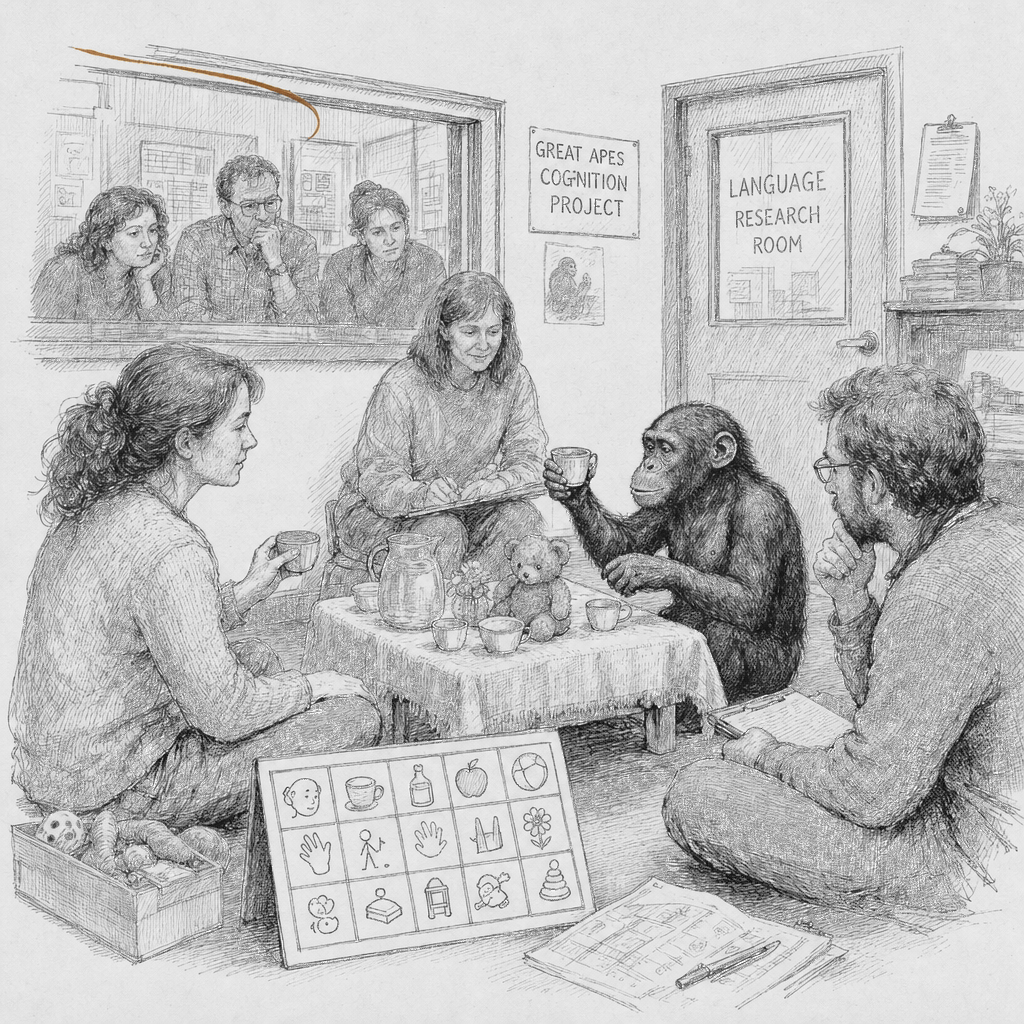
Kanzi, a bonobo raised in captivity and trained to communicate with humans using graphic symbols, has become the focus of a new study examining whether a captive ape can play pretend. The research, described as the first experiment to probe the question in this way for an ape, adapts methods commonly used to study pretend play in young children, aiming to get at what animals might understand about make-believe.
The study team staged a “juice party” for Kanzi, drawing on a key challenge in the research: even if an animal appears to respond to imaginary scenarios, it could be imitating cues from experimenters or failing to separate what is real from what is not. To address that, the researchers introduced both pretend and real versions of the same setup—then measured which option Kanzi would choose.
In the juice experiment, the researchers poured what they described as imaginary juice from a pitcher into two cups and pretended to empty only one of them. They then asked Kanzi which cup he wanted; he pointed to the cup that still held the pretend juice 68% of the time, a result the researchers highlighted as consistent with treating the imaginary contents as meaningful.
To test whether Kanzi was confusing fake for real, the team also ran a condition using actual juice. In that separate test, Kanzi chose real juice over the pretend version almost 80% of the time, which study co-author Amalia Bastos said suggests he could tell the difference between real juice and imaginary juice.
The researchers also used a third experiment involving fake grapes placed into two jars, reporting positive results there as well. Taken together, the work prompted study co-author Christopher Krupenye of Johns Hopkins University to say in an interview that the findings are exciting because they suggest imagination’s roots may not be limited to human beings.
Not all researchers were convinced that the results demonstrate pretend play in the same sense humans do. Michael Tomasello, a comparative psychologist at Duke University who said he had no role in the study, argued that there is a difference between envisioning an outcome—like juice being poured into a cup—and maintaining the pretense that it is real. Tomasello wrote that he would need to see Kanzi actually pretend to pour water into a container himself in order to be convinced.
The researchers also noted a limitation they said is important for interpreting the findings: Kanzi grew up among humans, so it remains unclear whether the abilities observed extend to other apes or whether they reflect the special upbringing and training Kanzi received. Kanzi died last year at age 44, and the study’s authors said future work will be needed to understand what the results might mean for other great ape species that are critically endangered.
“Kanzi opened this path for a lot of future studies,” Bastos said, adding that more research is needed to determine the broader range of minds and capacities across species.