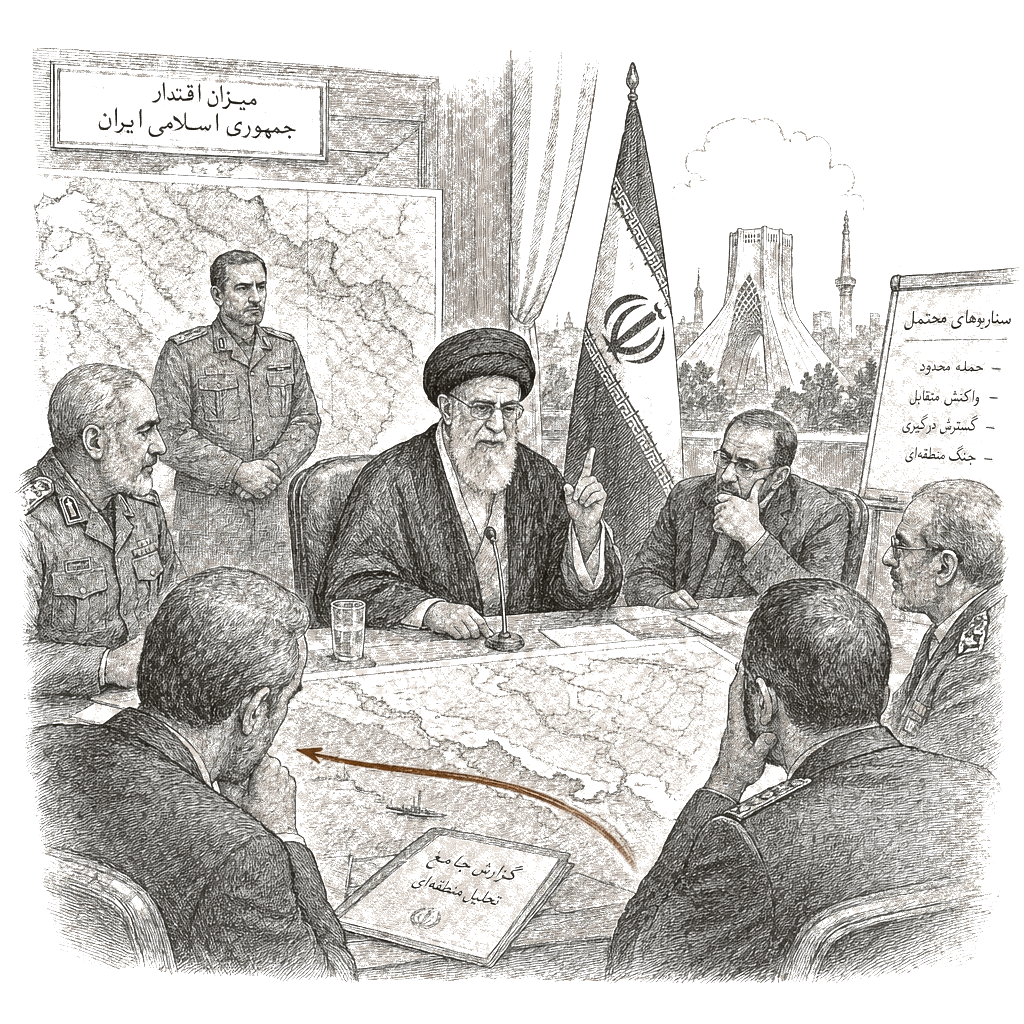
Iran’s supreme leader Ayatollah Ali Khamenei warned on Feb. 1 that a U.S. attack on the Islamic Republic would spark a “regional war,” escalating rhetoric amid heightened tensions following the Trump administration’s threats and Iran’s crackdown on nationwide protests. Khamenei made the remarks to a crowd at his compound in Tehran as Iran marked the start of a dayslong commemoration of the 1979 Islamic Revolution.
Khamenei said the United States was interested in Iran’s oil, natural gas and other mineral resources, and he warned that if the United States “wage a war this time, it will be a regional war.” He added that Iran was “not the instigators,” that it was not going to be “unfair to anyone,” and that it did not plan to “attack any country.” But he said that “if anyone shows greed and wants to attack or harass, the Iranian nation will deal a heavy blow to them,” framing the warning as conditional on U.S. actions.
The comments came after Trump threatened military strikes over Iran’s crackdown and sent the aircraft carrier USS Abraham Lincoln and associated warships to the Arabian Sea, the Associated Press reported. Asked about Khamenei’s warning, Trump told reporters the U.S. has “the biggest, most powerful ships in the world over there,” saying the sides were close to a potential deal and that the U.S. would “find out whether or not he was right” if an agreement is not reached.
While it remained unclear whether Trump would use force, the AP reported that Trump has repeatedly said Iran wants to negotiate and has raised Tehran’s nuclear program as another issue he wants resolved. Khamenei, in parallel, hardened his depiction of the protests, describing them as “a coup,” and saying the demonstrations were suppressed. The supreme leader said the “recent sedition was similar to a coup,” adding that protestors attacked police, government centers, Revolutionary Guard facilities, banks and mosques and burned copies of the Quran.
Separately, Khamenei acknowledged earlier in the unrest that some people had legitimate economic grievances that sparked the protests, which began Dec. 28 after the collapse of Iran’s rial and then grew into a direct challenge to his rule. The Associated Press reported that sedition charges in Iran can carry the death penalty, which renewed concerns about the possibility of mass executions for those arrested, a position the AP described as a “red line” for Trump.
Rights monitors say the crackdown has been extensive, but the AP reported it could not independently verify the figures after authorities cut Iran’s internet off from the rest of the world. The U.S.-based Human Rights Activists New Agency, which relies on a network inside Iran, reported that over 49,500 people have been detained and that violence killed at least 6,713 people, “the vast majority of them demonstrators.” The AP contrasted that with Iran’s government report as of Jan. 21, when Tehran put the death toll at 3,117 and said 2,427 were civilians and security forces while labeling the rest “terrorists,” which the AP said is consistent with the country’s past undercounting or non-reporting of fatalities from unrest.
On the political front, Iran’s parliament speaker Mohammad Bagher Qalibaf said the Islamic Republic now considers all European Union militaries to be terrorist groups. Qalibaf made the announcement after the bloc declared the Revolutionary Guard a terror group for its role in the crackdown. The AP reported Qalibaf’s comments came as lawmakers wore Revolutionary Guard uniforms in support of the force, which he previously commanded and which answers only to Khamenei.
Qalibaf said the Europeans “shot themselves in the foot” and, through what he described as “blind obedience to the Americans,” decided against the interests of their own people when they targeted the Revolutionary Guard, which he said he described as the biggest barrier to the spread of terrorism to Europe. The AP reported that lawmakers later chanted “Death to America!” and “Death to Israel!” during the session, continuing a rhetoric that has tracked the standoff between Iran and the United States.
As tensions sharpened, the AP reported that Iran had planned live-fire military drills on Feb. 1 and Feb. 2 in the Strait of Hormuz. It reported that the U.S. Central Command had warned against threatening American warships or aircraft during the drills or disrupting commercial traffic through the strategic waterway, which carries a significant share of oil traded globally. With warships positioned in the region and both sides signaling deterrence, the standoff continued to hinge on whether Trump moves beyond negotiation toward force.