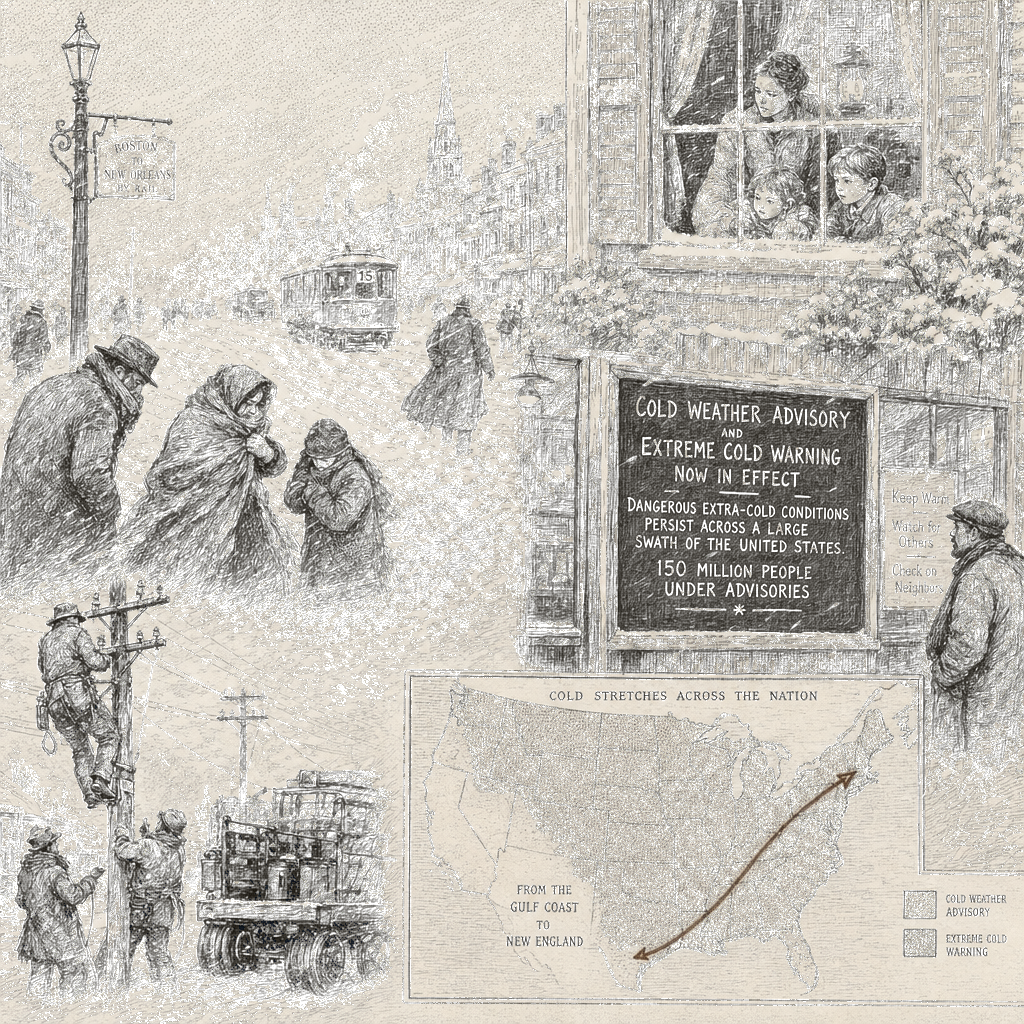
Winter’s grip tightened again across much of the United States as forecasts called for dangerous extra-cold conditions to persist into Monday morning, following a weekend bomb cyclone that delivered heavy snow and disrupted travel, including flight cancellations. Temperatures were expected to begin inching upward during the day, but forecasters warned that more misery remained for people still coping with the aftermath of earlier winter storms, including power outages and hazardous road conditions.
About 150 million people in the eastern part of the country were under cold weather advisories and extreme cold warnings Sunday, according to Peter Mullinax, a National Weather Service meteorologist in College Park, Maryland. Mullinax said southern states saw single-digit temperatures, and that the cold air mass pushing into South Florida was the coldest there since December 1989.
In eastern North Carolina, the National Weather Service office for Raleigh warned that wind chills early Monday would fall to near zero Fahrenheit (-17 Celsius). The office said “snow and ice will linger, with refreezing tonight making travel hazardous,” and told residents to use caution on roads and dress in warm layers.
The weather service reported that James City recorded 18 inches (45 centimeters) of snow and Swansboro recorded 17 inches (43 centimeters). Mullinax said the bomb cyclone contributed to nearly a foot (30 centimeters) of snow around Charlotte, North Carolina’s largest city, and that the snowfall ranked among the top-five snow events there.
Travel disruptions persisted after the weekend storm. FlightAware data showed flight cancellations exceeded 2,800 in the U.S. on Saturday and at least another 1,800 on Sunday, with more than 800 of Sunday’s cancellations tied to departures from or arrivals at Charlotte Douglas International Airport.
The storm also contributed to a major traffic and crash mess on Interstate 85 northeast of Charlotte. North Carolina State Highway Patrol officials said dozens of semitractors and other vehicles were backed up into Saturday evening after a crash, and Gov. Josh Stein said more than 1,000 traffic collisions and two road deaths were reported.
Further south, the cold brought unusual impacts in Florida, where the Tampa-St. Petersburg area saw snow flurries and temperatures fell into the 20s in the Panhandle and the 30s in South Florida on Sunday. The cold stunned iguanas, leaving them lying motionless on the ground; the report said iguanas go dormant in cold weather but can die after more than a day of extreme cold. The cold also left ice on strawberries and oranges, and the story noted that farmers sometimes spray water on fruit trees and berry plants to protect them from cold temperatures.
The cold also complicated ongoing winter recovery in parts of the South. The story said more than 110 deaths connected to the wintry weather and storms had been reported nationwide since late January. In Tennessee and Mississippi, which were hit by a previous storm carrying snow and ice, poweroutage.us showed more than 81,000 customers were still without electricity by Sunday evening.
Nashville Electric Service said it expected 90% of its customers to have power restored Tuesday and 99% to be back by next Sunday—two weeks after the earlier storm struck. Gov. Bill Lee said he shared “strong concerns” with leadership of the utility, which defended its response and said the storm was unprecedented.
In Mississippi, officials said it was the state’s worst winter storm since 1994 and that about 80 warming centers were opened as National Guard troops delivered supplies by truck and helicopter. Jamita Washington, a Vicksburg resident, said she lost power in the prior storm and spent three nights at a hotel with her son before electricity returned on Thursday, but that one of her furnaces later froze over, leaving her to sleep on the living room sofa as nighttime temperatures remained freezing.
On North Carolina’s Outer Banks, Susan Sawin described conditions in Kitty Hawk, saying her house received a “whopping” amount of snow and was battered by strong winds that made the house shake. She said she did not lose power and that officials had provided sufficient warning ahead of the bomb cyclone; Sawin, who owns three book stores, said she closed her businesses over the weekend and planned to stay closed again Monday.
The cold was also tied to damage reports in North Carolina. In the Buxton community on Hatteras Island, officials said an unoccupied beachfront house collapsed in heavy surf Sunday. Mullinax said parts of the Carolinas would be “digging out” for several days as they contended with gusty winds and bitterly cold wind chills, and he said light snow could fall in the Ohio Valley and the mid-Atlantic heading into Tuesday and Wednesday, from Washington possibly into New York City.