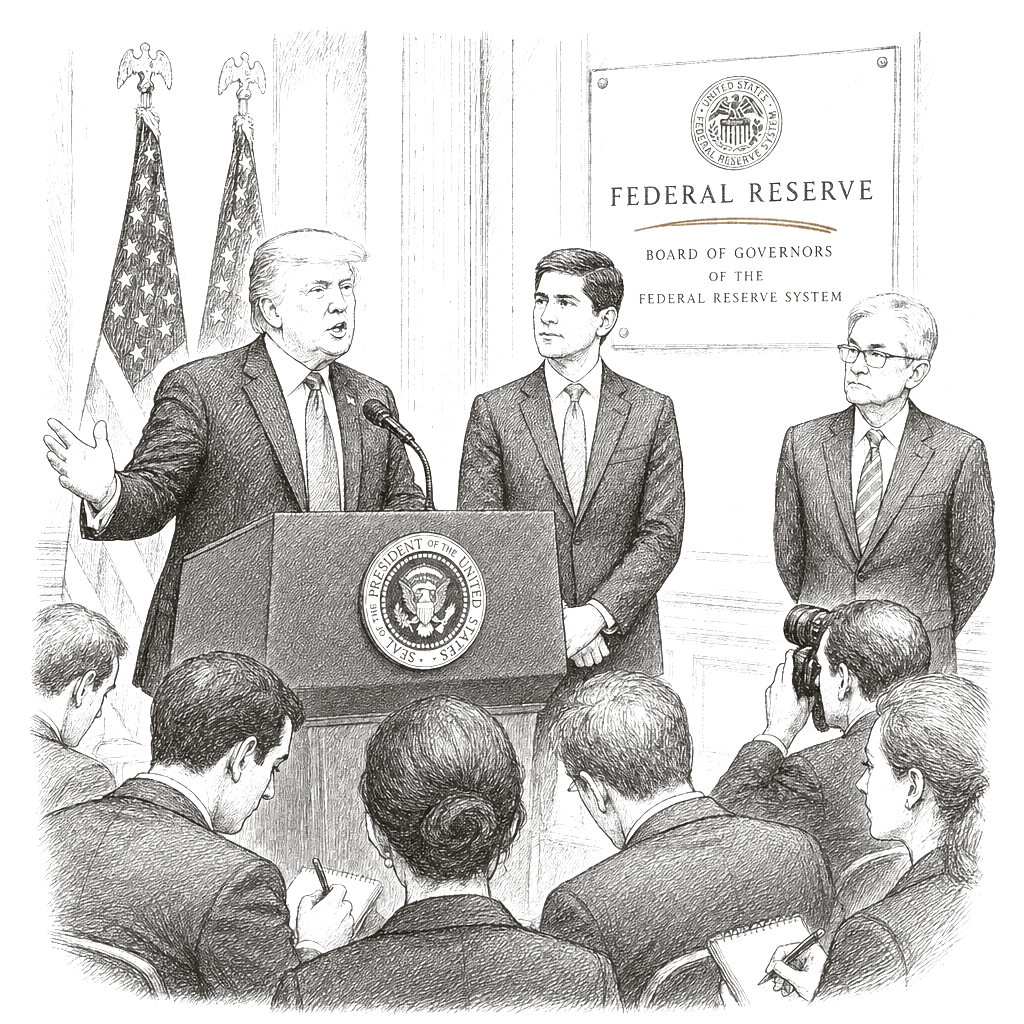
Kevin Warsh, a former Federal Reserve governor, is set to be nominated to lead the central bank after President Donald Trump announced he will name the 55-year-old economist as chair, a post that carries major influence over U.S. interest rates and the broader economy. Under the plan, Warsh would replace Jerome Powell when Powell’s term ends in May, and the nomination would require Senate confirmation.
Trump’s announcement also puts Warsh at the center of a political dispute over the Fed’s rate-setting independence. The White House president has publicly demanded much lower interest rates than some economists think current economic conditions justify, and the selection is likely to be tested in Senate hearings over how the Fed will balance inflation concerns with employment and growth objectives.
Raghuram Rajan, a professor at the University of Chicago and formerly head of India’s central bank, pointed to Warsh’s ability to navigate the job’s pressures. “a judicious temperament and both the intellectual understanding but also the hopefully diplomatic talents to navigate what is a challenging position at this point,” Rajan said, describing the challenge of keeping the Fed insulated from day-to-day politics while also managing the president’s expectations.
Trump, for his part, promoted Warsh as a strong choice in public remarks and on social media. The president posted that he had known Warsh “for a long period of time” and said he had “no doubt that he will go down as one of the GREAT Fed Chairmen, maybe the best,” adding that Warsh was “central casting” and “will never let you down.” Afterward in the Oval Office, Trump said he did not ask Warsh to commit to cutting rates, saying such a question was “inappropriate” while adding, “I want to keep it nice and pure,” but also saying, “But he certainly wants to cut rates.”
The nomination triggered immediate market movement that suggested investors were parsing what it could mean for future policy. Financial markets reacted with the dollar and yields on long-term U.S. Treasurys ticking higher, while U.S. stocks fell about 0.5%. Trading in precious metals showed larger swings, with gold dropping more than 5% and silver sinking more than 13%.
In Congress, the politics around the nomination quickly sharpened. Sen. Thom Tillis, a North Carolina Republican who sits on the Senate committee that would consider Warsh’s nomination, said he would oppose Warsh until a Justice Department investigation into Powell is resolved. Tillis said Warsh is a “qualified nominee,” but argued that “protecting the independence of the Federal Reserve from political interference or legal intimidation is non-negotiable,” a stance that could complicate the confirmation timetable.
Senate Majority Leader John Thune indicated the opposition could matter. Asked late Thursday whether Warsh could be confirmed without Tillis’s support, Thune said, “probably not.” Meanwhile, Democratic Sen. Elizabeth Warren, the highest-ranking Democrat on the committee, accused Warsh of reshaping his views to appease Trump ahead of the nomination, saying, “I don’t know how to interpret that, except to say, that’s exactly what a sock puppet does,” and adding, “If Donald Trump says it, then Kevin Warsh echoes it, even though it contradicts everything he had done for years.”
Much of the scrutiny centers on Warsh’s past policy positions and what they may signal for the Fed’s next phase. During Warsh’s time as a governor, he objected to some of the Fed’s low-interest-rate policies pursued during and after the Great Recession, and he raised concerns then that inflation could accelerate even after it had fallen to very low levels for years following that downturn. More recently, however, Warsh has voiced support for lower rates in speeches and opinion columns, a shift that aligns more closely with Trump’s position.
If Warsh is confirmed, he could also face challenges associated with changing the Fed’s balance sheet and its approach to inflation modeling. The nomination comes after Warsh repeatedly criticized the Fed’s holdings of trillions of dollars in government and mortgage-backed securities accumulated after the Great Recession and during the pandemic, and he has argued that those bond purchases helped Congress spend more without worrying about borrowing costs. Warsh has also warned that reducing the Fed’s $6.6 trillion balance sheet would be difficult, as banks have grown accustomed to the large amount of cash in the system that the Fed provides.
Beyond balance sheet policy, Warsh has criticized how the Fed views inflation dynamics. He wrote in a November Wall Street Journal column that the Fed’s economic models wrongly assume that rapid economic growth threatens to elevate inflation, and he said instead, “Inflation is caused when government spends too much and prints too much.” Supporters who see the nomination as a return to Warsh’s views may also point to his remarks that artificial intelligence could boost productivity and, with lower inflation, allow the Fed to lower rates.
Trump’s nomination lands against a backdrop of heightened public friction between the White House and the Fed. The AP report described Trump’s efforts during his first term to influence Fed personnel, including an attempt in August to fire Lisa Cook, one of the seven governors, which Cook sued to stop and the Supreme Court appeared inclined to allow to proceed while her case is resolved. Powell also said this month the Justice Department subpoenaed the Fed regarding his congressional testimony on a $2.5 billion building renovation, and he said the subpoenas were “pretexts” to force the Fed to cut rates.
The Fed chair role, regardless of who holds it, requires decision-making through a committee structure. The Fed’s rate decisions are made by a 19-person group, and while the chair is influential, the report noted that 12 officials vote on each rate decision. That structure means the committee may not line up neatly behind a chair who pushes for rapid rate cuts, particularly if members focus on persistent inflation or interpret recent increases in unemployment as signaling economic weakness.
Markets could also become a constraint if policymakers are perceived as cutting rates too aggressively for political reasons. The AP report said investors could sell Treasury bonds in that scenario, pushing up longer-term interest rates including mortgage rates, which could undermine the very conditions the Fed would aim to improve. Warsh’s nomination is therefore expected to face both institutional and market pressures as the Senate weighs whether he can maintain the Fed’s independence while meeting the expectations attached to his selection.