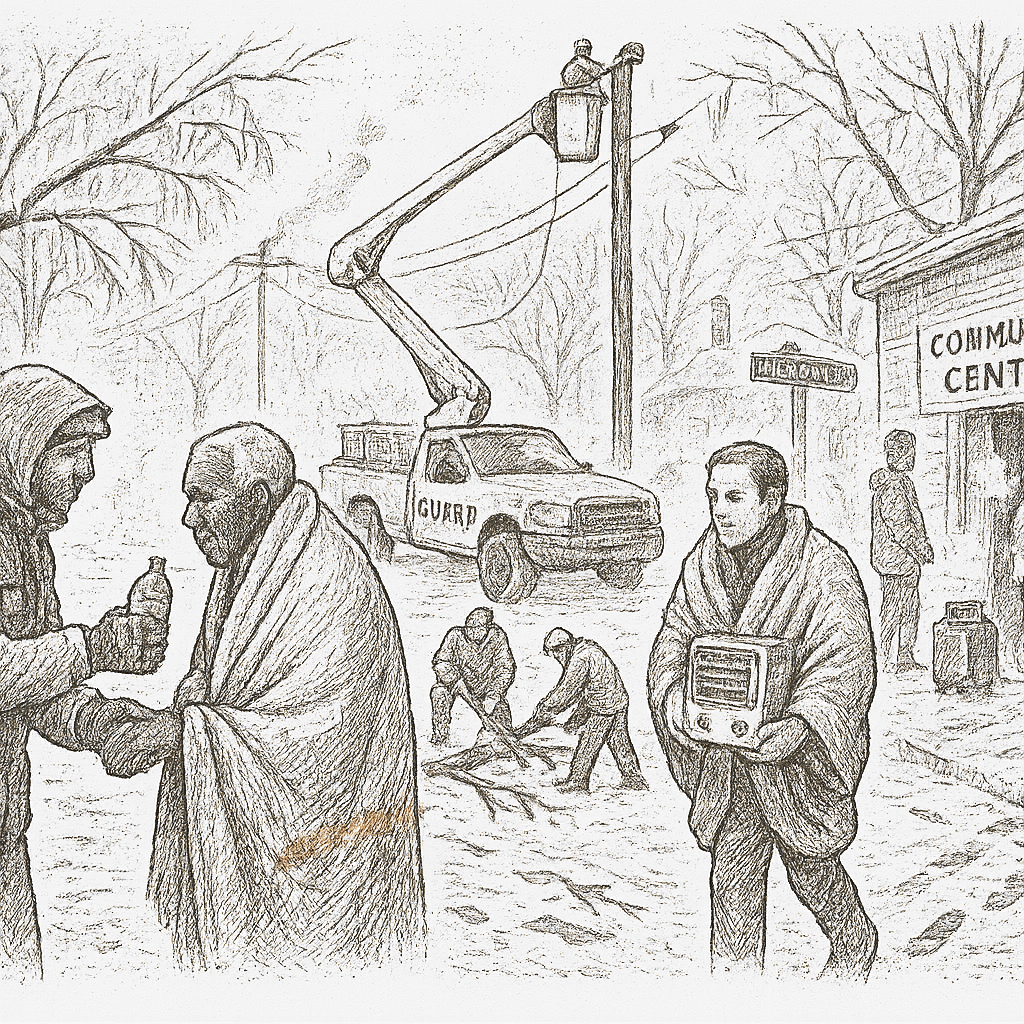
The new cold snap is adding urgency to recovery efforts across the South, with officials racing to restore heat and electricity after a crippling winter storm left many residents still without power in Mississippi and Tennessee. Hundreds of National Guard troops were mobilized Thursday to clear debris and assist people stranded in cars or unable to leave homes.
The National Weather Service warned that arctic air moving into the Southeast would drive already frigid conditions lower, with temperatures expected to plunge into the teens (minus 10 Celsius) Friday night in cities including Nashville. In Nashville, the outage burden was still heavy days after the storm dumped snow and ice across parts of the eastern U.S., according to the Associated Press reporting.
In Belzoni, Mississippi, Glyn Alexander, 73, said she endured three days without electricity before leaving her home and moving to a local warming shelter, where a generator kept the indoor temperature at 82 F (28 C). Alexander described the decision to leave as a response to the conditions at home, saying, “Three days in the cold, sleeping in the cold, eating in the cold,” and adding, “I just couldn’t take the cold anymore.”
The storm’s toll extended beyond the two hardest-hit states, with the Associated Press reporting that at least 85 people died in areas affected by bitter cold from Texas to New Jersey, and that roughly half of those deaths were reported in Tennessee, Mississippi and Louisiana. Emergency dispatchers in Mississippi received calls from residents who said they were running out of food and medications while stuck at home, while in Tennessee social workers coordinated with police and firefighters to check on people who had not been heard from in days.
First responders described the difficulty of reaching residents who remained without power and relied on neighborhoods’ wiring, roads and communications functioning normally—conditions disrupted by ice and downed infrastructure. CJ Bynum, who used his Jeep to help drivers stranded along Interstate 55 in northern Mississippi, said, “No one really knew that it was going to be like this, or how bad,” as AP reported that 18-wheel trucks still lined the icy highway two days after traffic ground to a halt. In Nashville, Harriet Wallace of a social services agency said police and firefighters were visiting homes to check on older adults whose relatives could not reach them by phone, and Wallace said officers found everyone alive, adding that some people who refused to leave were “a little delirious.”
Power outages continued to constrain recovery, with the Associated Press citing poweroutage.us for a snapshot showing more than 230,000 homes and businesses without electricity late Thursday. The AP said the vast majority were in Mississippi and Tennessee, with roughly 88,000 each. In the Nashville area, Nashville Electric Service reported 963 linemen repairing damage after the storm snapped hundreds of power poles, and utility vice president Brent Baker said full restoration could take until the weekend or longer.
Road closures also complicated logistics. Interstates 55 and 22 remained closed in northern Mississippi as emergency crews used tow trucks and snowplows to clear the highways, and Mississippi Gov. Tate Reeves said 650 National Guard troops were clearing fallen trees and delivering meals, blankets and other supplies by truck and helicopter. The Tennessee National Guard said about 170 soldiers and airmen were assisting recovery, including helping more than 200 people stranded in vehicles and homes and providing rides to nearly 300 emergency and health care workers.
Mississippi officials said the storm was the state’s worst since 1994, and they opened about 80 warming centers statewide. In some places, officials said the sites were still not enough: in Batesville, Mississippi, where the AP reported that most of the city’s 7,400 residents were without power, Mayor Hal Ferrell said officials faced outages at nursing homes, a shortage of generators for shelters, and ice-covered interstates that slowed deliveries. “We’re just stymied with everything we’re trying to do,” Ferrell said.
Health experts warned that prolonged exposure to cold without heat can quickly become dangerous, especially for young children, older adults and people with cardiovascular conditions. Dr. Hans House, a professor of emergency medicine at the University of Iowa, said, “The body can handle cold temperatures briefly very well,” but that “the prolonged exposure is a problem,” explaining that as hypothermia sets in the body shivers and reduces blood flow to hands and feet, increasing the risk of frostbite. House said that as exposure continues, people can become sleepy and confused and, in severe cases, the heart and lungs can fail.
Forecasters said the subfreezing weather was expected to persist in the eastern U.S. into February, with a high chance of heavy snow in the Carolinas, Virginia and northeast Georgia this weekend, possibly up to a foot (30 centimeters) in parts of North Carolina. Snow was also possible along the East Coast from Maryland to Maine, and the National Weather Service reported that freezing rain was possible Thursday night in parts of Mississippi while light snow showers could hit Nashville overnight Friday, with forecasters citing extreme cold and subzero wind chills (minus 18 C) as the greatest danger.