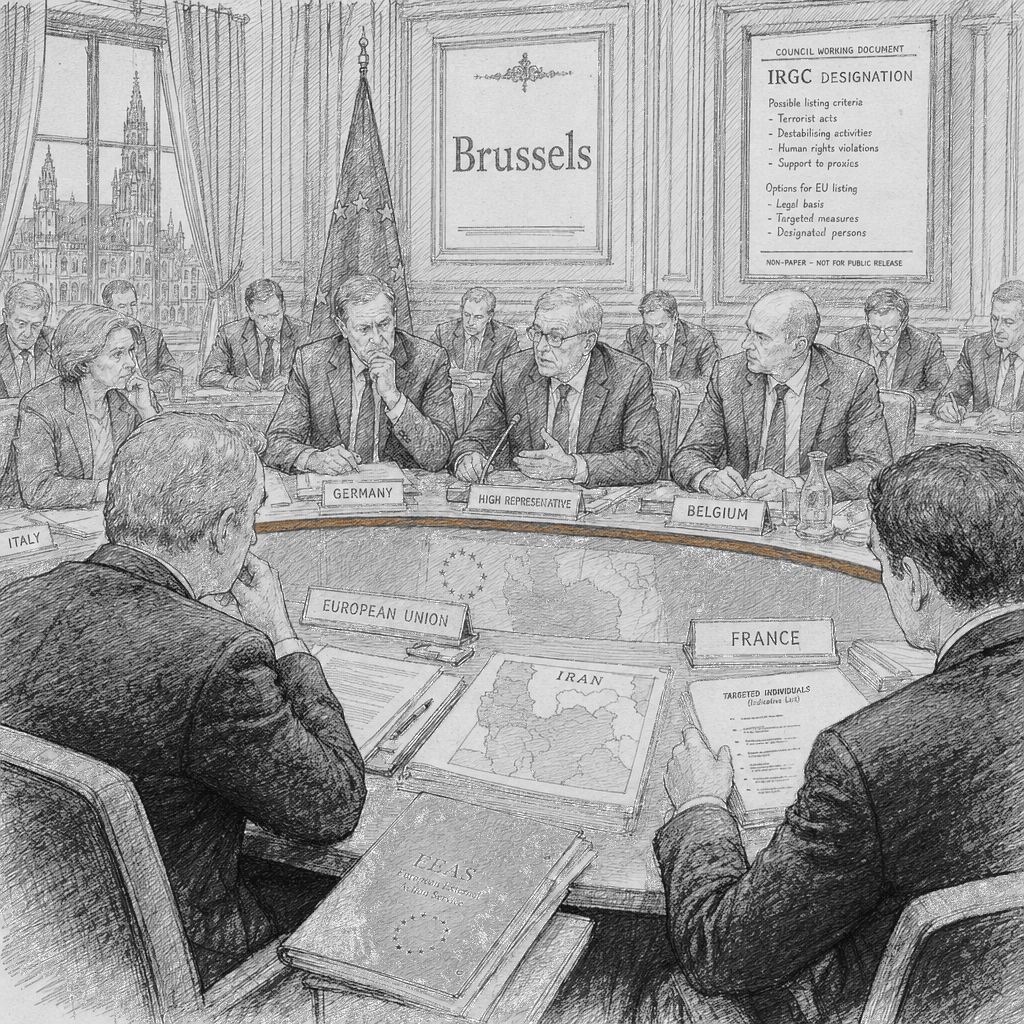
The European Union agreed to designate Iran’s Revolutionary Guard as a terrorist organization on Thursday, as protests that began over economic woes have expanded into a broader challenge to the Iranian theocracy and as Tehran continues its crackdown. The decision was made unanimously by foreign ministers of the EU’s 27 member states, the EU’s top diplomat said in remarks from Brussels.
Kaja Kallas said the listing is meant to treat the Revolutionary Guard as a terrorist group on a footing comparable to other organizations already designated by the EU, and she framed it as a response to what she said was terror-based conduct. In her comments, she said: “Those who operate through terror must be treated as terrorists.” Kallas also said the designation will put the Revolutionary Guard “on the same footing” with al-Qaida, Hamas and the Islamic State group.
The EU action was described as largely symbolic because it adds to pressure already being applied to Iran and its institutions. During the announcement, Kallas linked the protests’ origins and the continuing violence to economic hardship and to a later phase that activists say has become a challenge to the Iranian government, while emphasizing the scale of the crackdown. “Any regime that kills thousands of its own people is working toward its own demise,” Kallas said.
Iran’s response was immediate and dismissive. Abbas Araghchi, Iran’s foreign minister, rejected the designation as what he called a “PR stunt,” and wrote on X that Europe could be affected if energy prices surge due to the sanctions. A deputy director at the German Marshall Fund, Kristina Kausch, characterized the listing as “a symbolic act” and said it indicated the EU’s position that dialogue had not led anywhere, with isolation and containment now the priority.
Before the EU formally adopted the designation, the Revolutionary Guard was given time to submit comments, according to a sanctions lawyer, Edouard Gergondet, who said the group would be able to comment ahead of the step becoming final. Gergondet said the Guard would have time to respond before adoption, signaling that the EU still expects a final procedural phase after the foreign ministers’ decision.
Alongside the terrorist designation, the EU sanctioned additional targets in Iran. French Foreign Minister Jean-Noël Barrot said the bloc imposed sanctions on 15 top officials and six organizations, including entities involved in monitoring online content, while Iran remained under a three-week internet blackout by authorities. Barrot said the sanctions would include asset freezes for affected officials and organizations and bans on traveling to Europe.
The Revolutionary Guard, which emerged after Iran’s 1979 Islamic Revolution, was created as a force to protect the cleric-led government and was later enshrined in Iran’s constitution. The Guard operates alongside the country’s regular armed forces, and in later decades expanded in influence and power, including through a role in private enterprise after Supreme Leader Ayatollah Ali Khamenei granted it powers following the 1980s war with Iraq.
The developments in Brussels also unfolded amid warnings and security concerns in the wider region. A notice to mariners sent Thursday said Iran planned a “naval shooting” drill in the Strait of Hormuz on Sunday and Monday, and two Pakistani security officials, speaking on condition of anonymity, said the warning had been transmitted. Iran did not immediately confirm the drill.
Iranian officials also faced broader diplomatic and military pressures tied to the unrest. The Associated Press reported that the U.S. has moved the USS Abraham Lincoln and several guided-missile destroyers into the Middle East, while it remained unclear whether President Donald Trump would decide to use force in response to the killings of demonstrators. Iran, meanwhile, issued a warning to ships at sea Thursday that it planned the drill with live firing that could disrupt traffic through a waterway through which, the report said, 20% of the world’s oil passes.
As the international response grows, Iranian officials and international monitors continue to disagree on the death toll from the protests. The Associated Press said the U.S.-based Human Rights Activists News Agency reported that at least 6,479 people have been killed in recent weeks, including at least 6,092 protesters, with additional counts for government-affiliated forces, children, and civilians not demonstrating. The report said Iran’s government put the death toll at 3,117 as of Jan. 21 and labeled the difference “terrorists,” while the Associated Press said it could not independently assess the agency’s total.