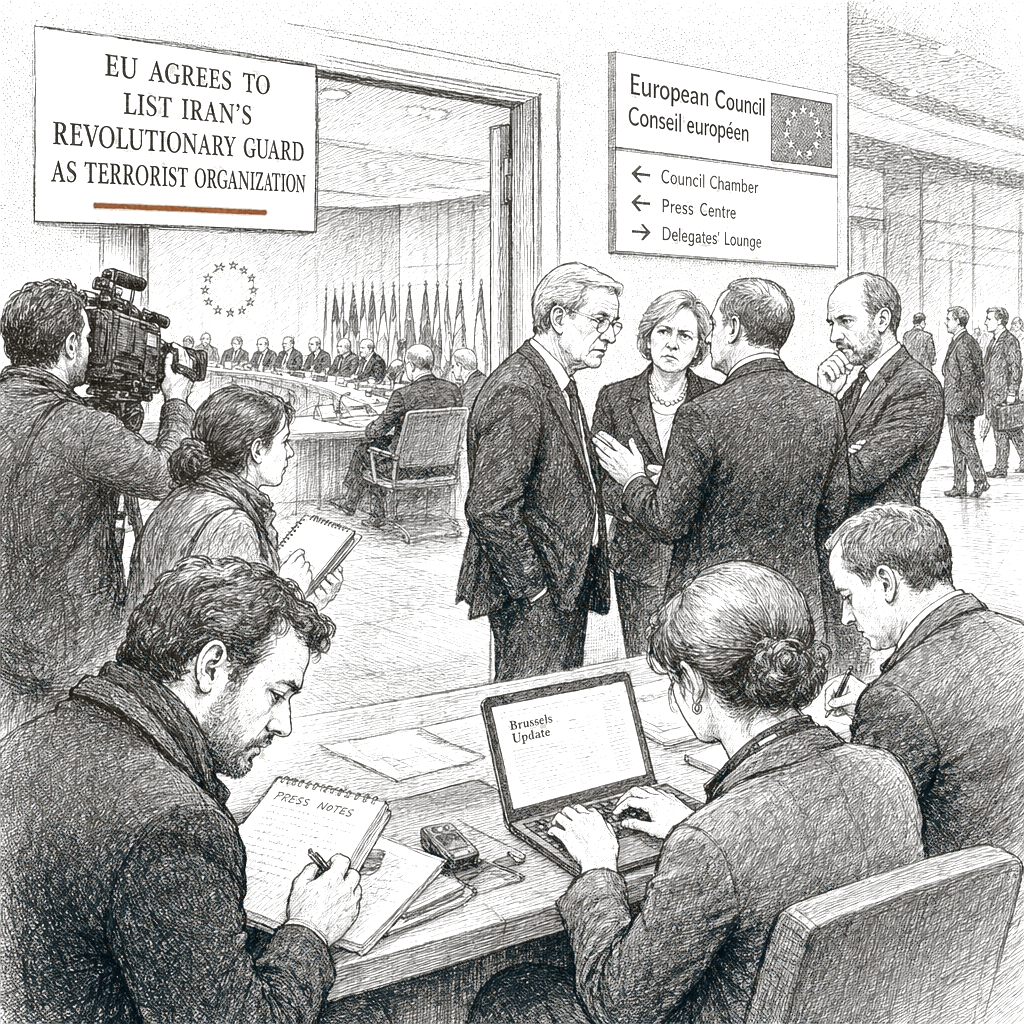
The European Union agreed Thursday to list Iran’s paramilitary Revolutionary Guard as a terrorist organization, EU foreign policy chief Kaja Kallas said, in a largely symbolic move aimed at adding pressure on Tehran as the fallout from nationwide protests continues to spread.
Kallas said foreign ministers in the 27-nation bloc unanimously approved the designation. She said the listing would put the Revolutionary Guard “on the same footing” with al-Qaida, Hamas and the Islamic State group, and she cited as a principle: “Those who operate through terror must be treated as terrorists.”
The protests that erupted before widening into a challenge to Iran’s theocracy followed economic woes, according to the report. Activists say Iran’s crackdown on the protests has killed at least 6,479 people, and Kallas said “Any regime that kills thousands of its own people is working toward its own demise.”
Other countries, including the U.S. and Canada, have previously designated the Revolutionary Guard as a terrorist organization. The EU decision also comes amid international concern over Iran’s response to the protests, with Iranian officials and European analysts offering competing characterizations of the impact of the latest step.
Iranian Foreign Minister Abbas Araghchi dismissed the EU designation as a “PR stunt,” writing on X that Europe would be affected if energy prices surge as a result of sanctions. Kristina Kausch, a deputy director at the German Marshall Fund, said the listing was “a symbolic act” that shows the EU’s “dialogue path hasn’t led anywhere,” adding that isolation and containment were now a priority.
The EU also said Thursday that the Revolutionary Guard would have time to comment before the listing is formally adopted, according to Edouard Gergondet, a lawyer focused on sanctions with the firm Mayer Brown. In parallel, the bloc sanctioned 15 top Iranian officials and six organizations, including those involved in monitoring online content, as Iran faced a three-week internet blackout by authorities.
French Foreign Minister Jean-Noël Barrot said the sanctions mean affected officials and organizations would have assets frozen and would be banned from traveling to Europe. The report said the Revolutionary Guard holds vast business interests across Iran, and that sanctions could allow its assets in Europe to be seized.
While the EU moved on the terrorist designation, the report described intensifying risks around the region. Iran warned ships at sea that it planned a drill next week in the Strait of Hormuz that would include live firing, potentially disrupting traffic through a waterway that sees 20% of all the world’s oil pass through it. The U.S. has moved the USS Abraham Lincoln and several guided-missile destroyers into the Middle East, and it remains unclear whether President Donald Trump will decide to use force, the report said.
Separate from Iran’s warning, a notice to mariners sent Thursday by radio said Iran planned to conduct “naval shooting” in the Strait of Hormuz on Sunday and Monday, according to the report. Two Pakistani security officials, speaking on condition of anonymity because they were not authorized to talk to journalists, confirmed the warning had been sent, while Iran did not immediately acknowledge the drill.
Iran’s hard-line Keyhan newspaper raised the specter that Tehran could try to close the strait by force, saying: “Today, Iran and its allies have their finger on a trigger that, at the first enemy mistake, will sever the world’s energy artery in the Strait of Hormuz and bury the hollow prestige of billion-dollar Yankee warships in the depths of the Persian Gulf,” in the passage cited by the report. The report said such a move would likely invite U.S. military intervention, and it added that American military officials did not respond to a request for comment.
On the death toll from the protests, the report said the U.S.-based Human Rights Activists News Agency reported at least 6,479 deaths, with its count including at least 6,092 protesters, 214 government-affiliated forces, 118 children and 55 civilians who were not demonstrating. The group said it verifies each death and arrest with a network of activists on the ground and has been accurate in multiple rounds of previous unrest in Iran, while the Associated Press said it was unable to independently assess the death toll.
The report said Iran’s government put the death toll far lower, at 3,117 as of Jan. 21, saying 2,427 were civilians and security forces and labeling the rest “terrorists,” and it noted that Iran’s theocracy has undercounted or not reported fatalities from unrest in the past. The death toll described by activists exceeds that of any other round of protest or unrest in Iran in decades, according to the report.