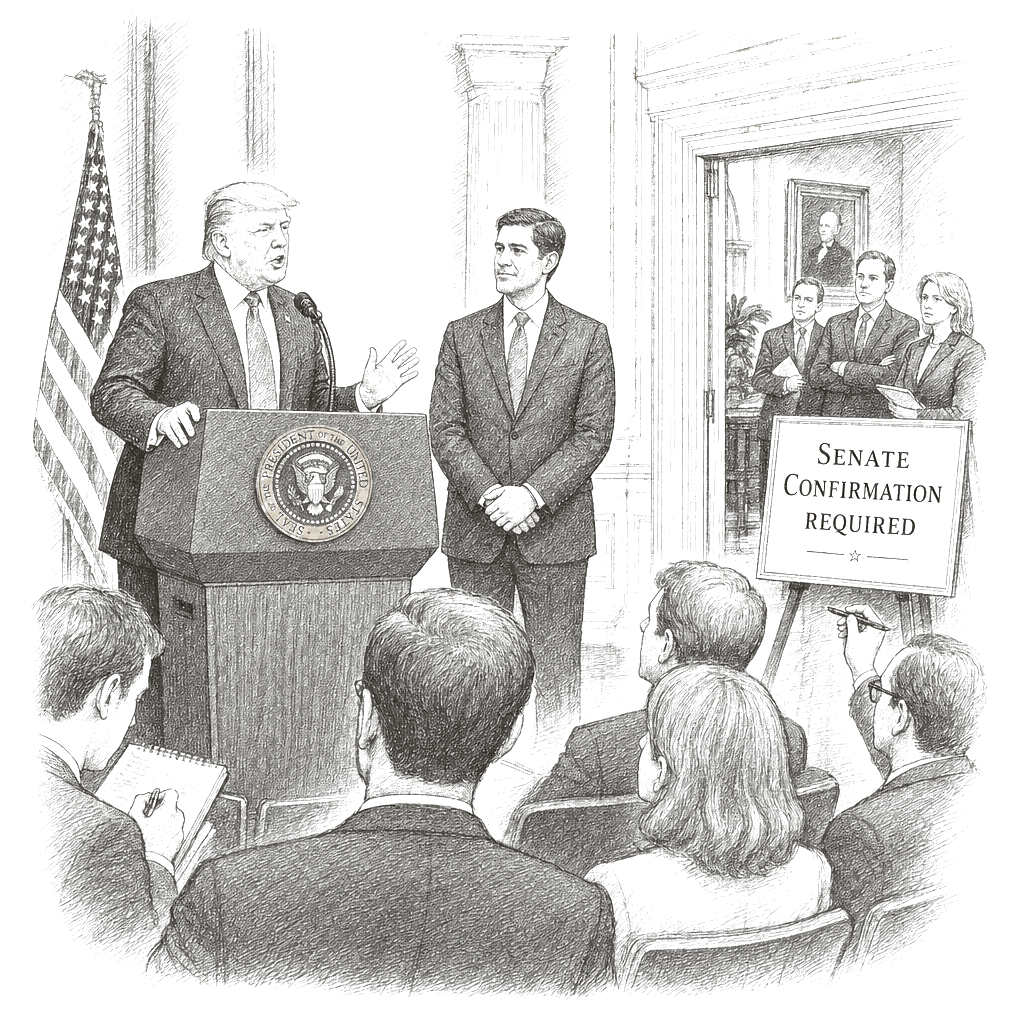
Trump’s nomination of Kevin Warsh to chair the Federal Reserve set up a high-stakes fight over both monetary policy and the Fed’s independence, with Senate confirmation now the next major step. The president announced the choice as the central bank prepares for a leadership transition in May, when current Chair Jerome Powell’s term expires.
The nomination is expected to place Warsh under close scrutiny from financial markets and Congress, in part because Trump has repeatedly pressed for the Fed to cut interest rates faster than many economists say economic conditions justify. In the Oval Office on Friday, Trump said he did not ask Warsh to commit to cutting rates, calling it “inappropriate,” and adding, “I want to keep it nice and pure,” according to the Associated Press report. Trump later added, “But he certainly wants to cut rates,” the report said.
Warsh, 55, would return to the Fed in the top role after serving on the Fed’s board from 2006 to 2011. During that earlier stint, the Associated Press reported, he was the youngest governor in history at the time of his appointment at age 35. He is currently described as a fellow at the Hoover Institution and a lecturer at the Stanford Graduate School of Business.
The choice also reflects, at least in part, a contrast between Warsh’s earlier views and the position Trump has taken on rates. The Associated Press reported that Warsh long supported higher interest rates to control inflation and objected to some low-rate policies the Fed pursued during and after the Great Recession of 2008-09. More recently, however, the report said Warsh has voiced support for lower rates in speeches and opinion columns, aligning himself more closely with Trump’s view.
Supporters of Warsh pointed to his ability to manage the politics around the Fed. Raghuram Rajan, a University of Chicago economics professor and former head of India’s central bank, said Warsh has “a judicious temperament and both the intellectual understanding but also the hopefully diplomatic talents to navigate what is a challenging position at this point,” according to the Associated Press.
At the same time, Warsh’s nomination quickly produced pushback in Congress and tension over how the process could unfold at the committee level. Sen. Thom Tillis of North Carolina, a Republican on the Senate committee that will consider the nomination, reiterated on social media that he will oppose Warsh until a Justice Department investigation into Powell is resolved. Tillis said Warsh is a “qualified nominee,” but added that “protecting the independence of the Federal Reserve from political interference or legal intimidation is non-negotiable,” the Associated Press reported. The report also said Senate Majority Leader John Thune responded to a question about confirmation without Tillis’s support by saying, “probably not.”
Democratic Sen. Elizabeth Warren also raised concerns, accusing Warsh of reshaping his views to appease Trump ahead of the nomination. Warren said, “I don’t know how to interpret that, except to say, that’s exactly what a sock puppet does,” and added that if Trump says it, Warsh echoes it “even though it contradicts everything he had done for years,” the Associated Press reported.
The nomination prompted immediate market reaction, the Associated Press said, with investors appearing to adjust expectations about the rate path. The dollar and yields on long-term U.S. Treasurys ticked higher, U.S. stocks fell about 0.5%, and moves in metals were especially large: gold dropped more than 5% and silver sank more than 13%, according to the report.
Warsh’s policy views—and how they may translate into Fed decisions—could become a central theme of confirmation hearings. The Associated Press reported that Warsh has criticized the Fed’s ownership of trillions of dollars in government and mortgage-backed securities acquired after the Great Recession and during the pandemic. The report said he argued that bond-buying enabled Congress to increase spending without fully accounting for higher borrowing costs.
The Associated Press also described potential challenges to shrinking the Fed’s balance sheet. The Fed’s total assets were reported in FRED’s vintage data for this article date at 6,587,568.0 (in the series WALCL), a figure that reflects the scale of the Fed’s holdings that the central bank would need to manage over time.
Warsh has also pointed to the Fed’s economic models, according to the Associated Press. The report said he wrote in a November column in The Wall Street Journal that “Inflation is caused when government spends too much and prints too much,” and that the Fed’s models wrongly assume that rapid economic growth threatens inflation.
Trump has sought greater influence over the Fed in recent months, the Associated Press reported, including an attempt in August to fire Lisa Cook, one of seven Fed governors, to secure a majority of the board. The Associated Press said Cook sued to keep her job and that the Supreme Court appeared inclined to let her stay while the suit is resolved. Separately, the report said Powell revealed this month that the Justice Department subpoenaed the Fed about his congressional testimony on a $2.5 billion building renovation, and that Powell called the subpoenas “pretexts” to force rate cuts.
If confirmed, Warsh would not control rates alone. The Associated Press reported that the chair is one member of the Fed’s 19-person rate-setting committee, with 12 voting on each rate decision, and that committee members already diverge between those concerned about persistent inflation and those who view recent increases in unemployment as signaling economic weakness that could call for lower rates.
The Fed decision pipeline also runs into market expectations, the report said, warning that if investors conclude political motives are driving cuts, they could sell Treasurys, pushing up longer-term yields and potentially raising mortgage rates. That risk is one reason Warsh’s ability to maintain Fed credibility while pursuing a lower-rate approach could be tested as much by markets as by lawmakers.
Trump’s nomination also came against a backdrop of previous consideration of Warsh for the Fed chair role during Trump’s first term, when he ultimately chose Powell, the Associated Press said. The report further noted that Warsh’s father-in-law is Ronald Lauder, heir to the Estée Lauder cosmetics fortune and described as a longtime donor and confidant of Trump.