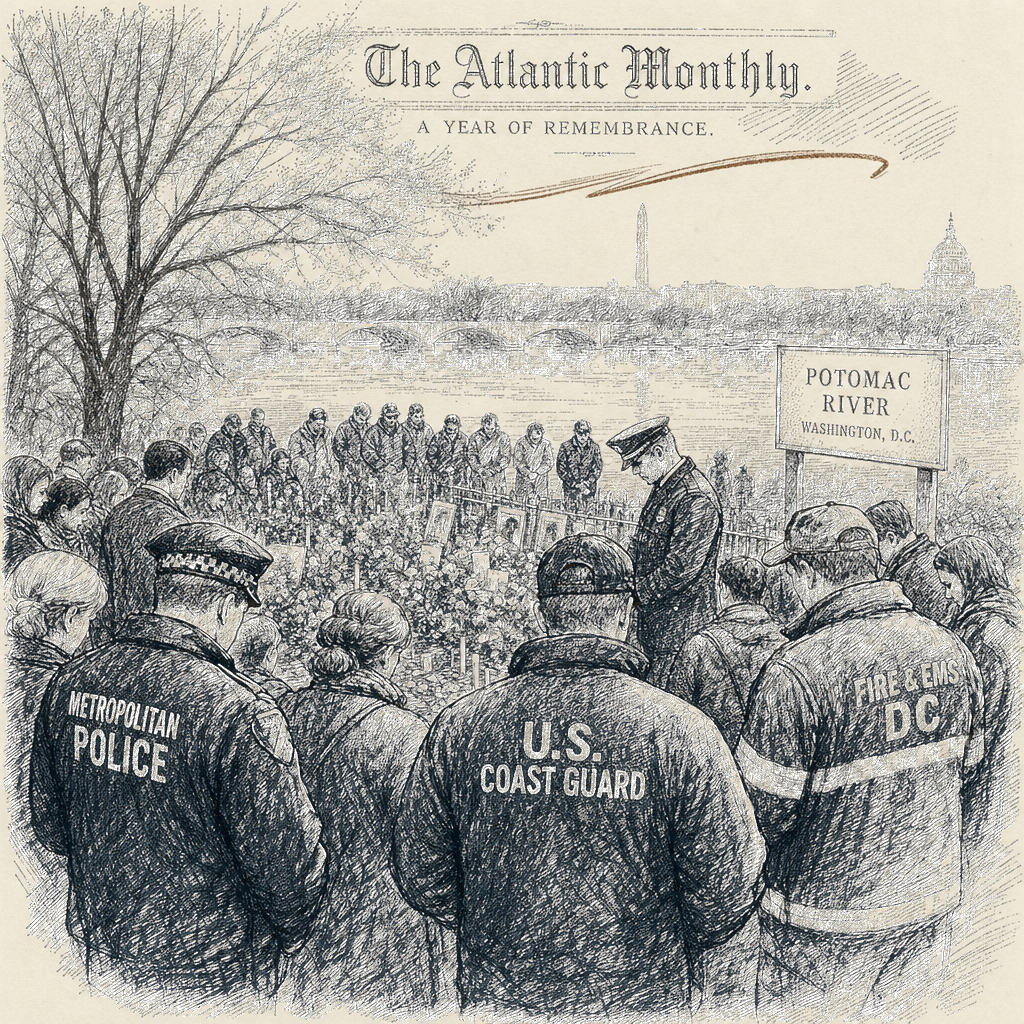
For some families, the memories from the night a passenger jet and an Army Black Hawk helicopter collided over the Potomac River have settled into specific, personal details—children’s luggage, ice skates and other small items that became impossible to lose. Others remembered the work of getting wreckage out of cold, murky water and bringing victims’ bodies ashore. And many described the same unshakable feature of the crash: the suddenness, when people were seconds from landing and then were gone. On Thursday, families of those aboard American Airlines Flight 5342 and the helicopter marked the one-year anniversary of the deadliest plane crash on U.S. soil in more than 20 years, while the emergency responders who carried out the search looked back on the effort.
In Washington, District of Columbia’s Fire and EMS chief John Donnelly said that responders reached a point about an hour into the response when they knew rescue efforts would not produce survivors. “We knew at the one-hour mark there weren’t going to be any survivors,” Donnelly said, describing the shift in priorities as the work turned to recovery and identification. He said the next focus became recovering bodies and personal belongings and returning them to families, while responders also gathered evidence for crash investigators.
The collision occurred near Washington and killed everyone aboard both aircraft. The Associated Press reported that 64 passengers and crew on American Airlines Flight 5342 were moments from touchdown when it collided with the Black Hawk helicopter and its crew of three. All 67 people on the two aircraft died in the crash on Jan. 29, 2025.
As the anniversary approached, the accounts from responders emphasized both the physical risk and the narrow margins they faced. Families and emergency personnel recalled nearly zero visibility in the river and conditions that included cold water, jet fuel and jagged wreckage as divers repeatedly searched for victims. Over nearly a week, divers and other emergency personnel recovered the victims from about 8 feet (2.5 meters) of water, while other personnel spent months looking for personal effects.
Tim Lilley, a former Black Hawk pilot whose son, Sam, was the co-pilot of the American flight, described the decision-making that kept responders in the water despite the circumstances. Lilley said that after about a week, later in the spring, first responders took him and his wife, Sheri, onto the river so they could lay flowers at the places where the aircraft came to rest. He said that meeting someone who helped pull his son out of the water was “a huge emotional experience” and that it was “so healing,” tying the recovery effort to a form of recognition for the families left behind.
The scale of the emergency response reflected how quickly officials learned the severity of the crash. The first call—described as “crash crash crash”—came from the Ronald Reagan Washington National Airport control tower at 8:48 p.m. That alert and subsequent notifications triggered what officials said was the region’s largest emergency response since Sept. 11, 2001, when hijackers flew a plane into the Pentagon. By midnight, about 350 responders from dozens of agencies were on scene, including 20 to 30 divers from harbor patrol units, according to the Associated Press report.
Metropolitan Police Department scuba diver Robert Varga, who said he was at home when the call came and was in the water within the hour, described the moment the alarm reached him as deeply visceral. “The first time you hear it, like anything else, your stomach drops,” Varga said. He said he knew that if the department was being called in, it would be a serious scene.
Other responders tied the memory of the recovery to the visible aftermath that met them when they arrived. Washington fire rescue squad Lt. Sam Short said that when responders reached the frozen river, the plane’s fuselage was partially submerged and suitcases and other possessions were scattered about, while jet fuel produced a heavy smell. He said he witnessed “gruesome sights,” and described the difficulty of explaining the experience afterward. “There’s a lot of different things that we saw and did that night. You just can’t describe it to people,” Short said.
For some of the responders, the work extended far beyond the first days, including repeated returns to the site and continued searches for personal effects. Police officer and diver Jeffrey Leslie said his memory can be triggered by cold weather and sometimes by the white ice skates in his daughter’s closet. Leslie said he was putting his children to bed when he received a text about the crash, and that during a visit last week he navigated one of the unit’s boats to the crash site “almost on instinct” as planes took off and landed.
As the river recovery progressed, officials also spoke about how returning personal items could offer a kind of closure for families. Donnelly said his emotions intensified when he met with families hoping for positive news as he gave updates on the recovery effort, describing how the work became “very personal” and how responders could feel “other people’s grief and pain.” Edward Kelly, president of the International Association of Fire Fighters, said the union sent 12 peer support personnel to the city and met with 75% of the firefighters and paramedics who responded, describing one goal as helping responders recognize traumatic stress in themselves and know where to seek help.
Kelly said the importance of mental health support was particularly significant in an incident that involved so many children, and said that many responders were parents. Short also said that a couple of his team members had been out for “numerous months” over the last year because of what they experienced. Donnelly said the department also monitored the divers’ health for hazardous materials they may have encountered, underscoring that the risks did not end when the last body was recovered.
In the months after the crash, responders continued to work to retrieve and identify belongings alongside the remains. Leslie said recovering items such as earrings, wedding bands and children’s skates and returning them to grieving families helped in a “therapy of sorts.” Harbor master Lt. Andrew Horos said families “appreciated every single thing we could get back,” and Varga said that if he could speak directly to families, he would say that emergency personnel did their best to save, and then continued to recover personal effects for them as often as possible because each item mattered.