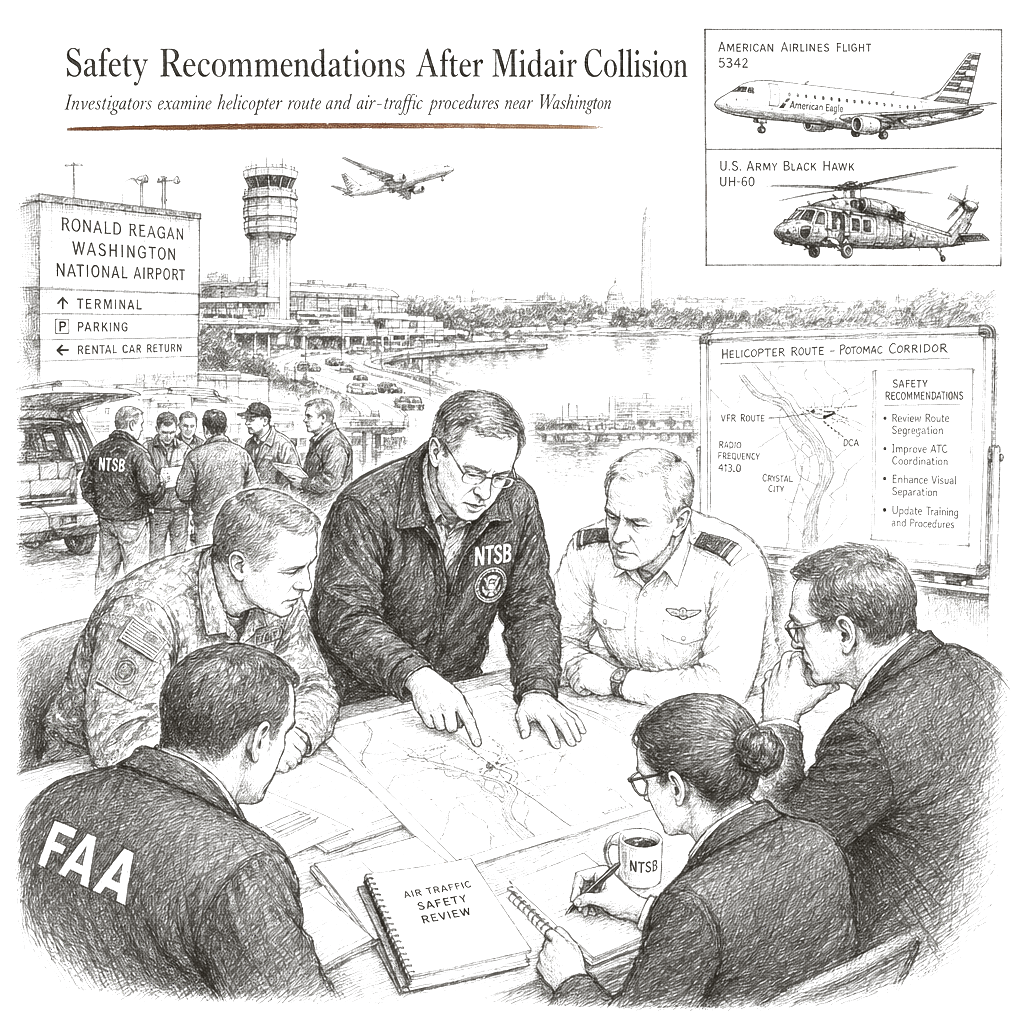
WASHINGTON — The National Transportation Safety Board on Tuesday adopted recommendations after a hearing focused on a deadly midair collision near Washington, D.C., in which an American Airlines jet and a U.S. Army Black Hawk helicopter collided and killed 67 people, the board said.
The NTSB said its investigation found multiple contributing factors that involved more than any single crew mistake. In its account, a helicopter route in the approach path of a Ronald Reagan Washington National Airport runway created dangerous airspace, and irregular safety reviews made the situation worse, according to the board. The NTSB also said air traffic at the time overly relied on asking helicopter pilots to avoid aircraft rather than using other methods to prevent conflicts.
During the hearing, NTSB Chairwoman Jennifer Homendy addressed families and investigators’ findings, emphasizing that she believed the risk was known long before the crash. “We should be angry. This was 100% preventable,” Homendy said. She added, “We have talked about seeing and avoid for well over five decades,” and called the outcome “shameful.” Homendy also said she did not want to be “looking at other families that had to suffer such devastating loss.”
Families of victims watched the proceedings, including an animation meant to recreate parts of the final moments, the report said. Some relatives were escorted out during the presentation, and others wore black shirts bearing the names of first responder units. Kristen Miller-Zahn, who watched from the front row, told the room during a break, “The negligence of not fixing things that needed to be fixed killed my brother and 66 other people.”
Investigators said the animation showed how spotting other aircraft could be difficult in the lighting around Washington, and that windshields and the helicopter crew’s night vision goggles restricted views. The NTSB and investigators also described broader systemic problems, saying the crash was not best explained as an individual error. Todd Inman told the hearing that “systemic issues across multiple organizations” caused the tragedy and that it was “not an error by any individual.”
The board’s recommendations addressed the need for changes aimed at airport operations and broader safety practices. More than 30 of the recommendations were directed at the Federal Aviation Administration, with emphasis on training and staffing and on when visual separation can be used, according to the hearing account. The NTSB also said the FAA should reconsider how Reagan is classified, reevaluate all of its helicopter routes, and make better use of data.
Homendy said she could not understand why the FAA did not recognize that the helicopter route provided “at most a mere 75 feet (23 meters) of separation between planes landing on Reagan’s secondary runway.” The hearing record also included criticism from Mary Schiavo, a former Department of Transportation Inspector General. Schiavo said it was “just a shocking dereliction of duty by the FAA,” adding that the agency had “so much work to be done to fix it.”
Investigators testified that safety concerns were not acted on as quickly as they should have been, including an FAA denial of a 2023 request from a regional supervisor to reduce air traffic at Reagan. They also said the FAA did not relocate the helicopter route or warn pilots more after an earlier near miss in 2013.
The NTSB said the board recommended that the FAA seek outside advice from the department’s Inspector General instead of creating a single office to track concerns and enforce standards. Transportation Secretary Sean Duffy had announced the new safety office Monday, the hearing account said.
The board also highlighted what it described as gaps in sharing safety information between agencies before the crash. NTSB investigators said the Army and FAA were not sharing all safety data with each other before the collision, and that Army helicopter pilots often were not aware when they were involved in a near-miss around Reagan. The report also cited concerns about controller workload on the day of the collision: investigator Katherine Wilson testified that a controller felt “a little overwhelmed” as traffic volume increased, and she said radio communications showed the local controller was shifting focus among airborne, ground and transiting aircraft. Wilson said the resulting workload “reduced his situational awareness,” and she said dividing responsibility for helicopters and planes between two controllers “might have been” able to prevent the collision by warning aircraft sooner.
In a statement provided for the hearing, the FAA said safety remained its top priority and that it had taken steps after the crash. It said it has reduced hourly plane arrivals at Reagan from 36 to 30 and worked to increase tower staff. The FAA also said it has 22 certified controllers in the tower and eight more in training, and it said, “We will diligently consider any additional recommendations” from the NTSB.
The report said investigators had previously identified key operational factors in how the crash unfolded, including that controllers in the Reagan tower overreliably asked pilots to spot aircraft and maintain visual separation. It said that on the night of the crash, the controller approved the Black Hawk’s request to do that twice, and that the investigation showed helicopter pilots likely never spotted the American Airlines plane as the jet circled to land on the secondary runway.