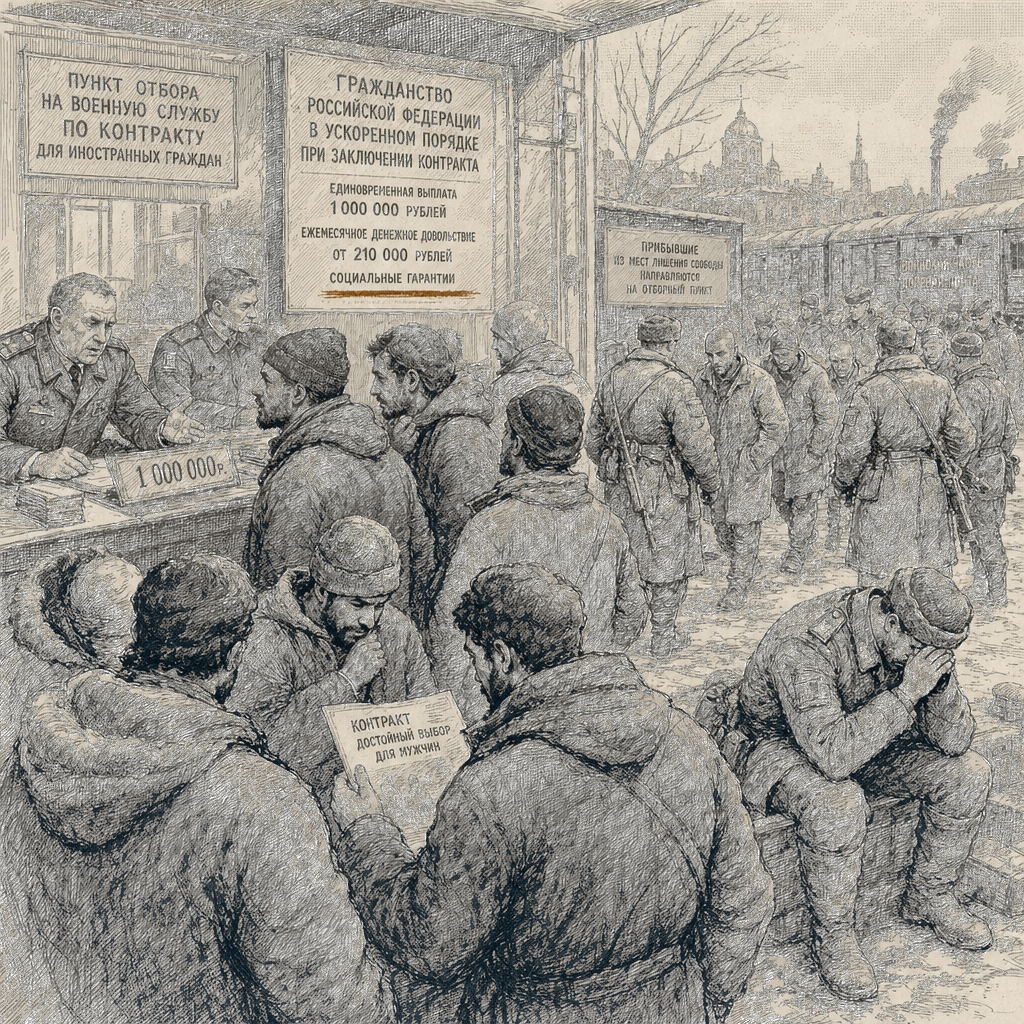
Russia is turning to unprecedented recruitment methods to fill its depleted ranks in Ukraine, offering substantial cash bonuses, prisoner releases, and accelerated paths to citizenship. As the war enters its fourth year, the Kremlin has drawn fighters from South Asia, Africa, the Middle East, and elsewhere to avoid the political cost of a nationwide draft. Over 18,000 foreign nationals have fought or are fighting on the Russian side, with nearly 3,400 killed and hundreds more held as prisoners of war by Ukrainian forces, according to a Ukrainian agency cited by the Associated Press.
Russia’s expanding reliance on foreign fighters and financial incentives reflects the mounting cost and strain of the conflict. As recruitment efforts grow “extremely expensive” for Russia’s slowing economy, Moscow has broadened its targeting of vulnerable populations, including workers duped by trafficking rings and prisoners seeking escape from detention.
When President Vladimir Putin attempted a limited mobilization of 300,000 men in 2022, tens of thousands fled the country. The effort stopped after a few weeks once the target was met, leaving Putin reluctant to order another nationwide call-up. Instead, Russia has pursued what the Kremlin describes as “voluntary enlistment”—relying on financial inducements, prisoner releases, and an expanding international recruitment network.
Russia’s Recruitment Strategy and Scale
The strategy has created an unprecedented reliance on foreign fighters. The government’s incentive structure is aggressive. In the Khanty-Mansi region of central Russia, a new recruit receives approximately $50,000 in various bonuses—more than twice the average annual income in that region. Regional authorities offer tax breaks, debt relief, and other perks beyond base pay.
The scope of foreign recruitment has become substantial. Over 18,000 foreign nationals have fought or are fighting on the Russian side, according to a Ukrainian agency. Nearly 3,400 have been killed, and hundreds of citizens from 40 countries are held in Ukraine as prisoners of war.
The geographic reach of recruitment extends across multiple continents. North Korea contributed thousands of soldiers to help Russia defend its Kursk region against a Ukrainian incursion, following a mutual defense treaty signed in 2024.
Trafficking, Deception, and Vulnerability
Some foreign recruits are brought to Russia through deception and trafficking. Men from South Asian countries—India, Nepal, and Bangladesh—report being lured by recruiters promising civilian employment, only to be pressured into military contracts.
Nepal’s Foreign Minister Narayan Prakash Saud told the AP in 2024 that his country requested Russia return hundreds of Nepali nationals who had been recruited to fight, as well as repatriate the remains of those killed. Nepal subsequently barred its citizens from traveling to Russia or Ukraine for work.
India’s federal investigation agency said it broke up a network that deceived at least 35 Indian citizens into traveling to Russia under false employment pretenses. The men were trained for combat and deployed to Ukraine against their will. When President Vladimir Putin hosted Indian Prime Minister Narendra Modi in 2024, New Delhi secured a commitment that Indian nationals “misled” into service would be discharged.
Iraqi officials reported that about 5,000 Iraqi citizens have joined the Russian military, along with an unspecified number fighting for Ukrainian forces. Some families described relatives being lured under false pretenses and forced to enlist; others said Iraqis joined voluntarily for the salary and the pathway to Russian citizenship. A human trafficking conviction and life sentence handed down in Baghdad in 2024 reflected the scale of organized recruitment networks.
Foreigners lacking Russian language skills and military experience face particular vulnerabilities. Anton Gorbatsevich of the activist group Idite Lesom, which assists soldiers seeking to desert, said military commanders view foreign fighters as “dispensable, to put it bluntly.”
Expanding Recruitment and Rising Costs
Russia has also expanded recruitment within its own detention system. A practice pioneered early in the war has now become law: the government can recruit both convicted prisoners and suspects awaiting trial. The incentive structure extends to them as well—a chance at freedom or a sentence reduction in exchange for military service.
The flow of voluntary enlistees has remained substantial. Putin stated in December 2025 that more than 400,000 men signed contracts that year, though the claims could not be independently verified. Similar numbers were announced in 2024 and 2023.
But the financial costs are escalating. Kateryna Stepanenko, a Russia researcher at the Institute for the Study of War, said the Kremlin has grown more “creative” in attracting enlistees over the last two years, including targeting foreigners. Yet recruitment efforts have become “extremely expensive” for Russia, which faces a slowing domestic economy.
Artyom Klyga, head of the legal department at the Movement of Conscientious Objectors, noted that recruitment appears stable. Most people seeking help from his organization, which assists men avoiding military service, are Russian citizens. But the scale of foreign recruitment suggests Moscow has become willing to absorb higher costs to avoid the political risk of naming unpopular mobilization in public terms.
Casualty Toll and Military Losses
President Putin has maintained that 700,000 Russian troops are fighting in Ukraine—a figure he held constant in 2024 and 2023. The accuracy of those numbers remains unclear.
Moscow has released limited official casualty figures. The British Defense Ministry estimated in 2025 that more than 1 million Russian troops may have been killed or wounded.
An independent accounting carried out by Mediazona, an independent Russian news site, together with the BBC and a team of volunteers, assembled the names of more than 160,000 troops killed by combing through news reports, social media, and government websites. More than 550 of those documented dead were foreigners from over two dozen countries.