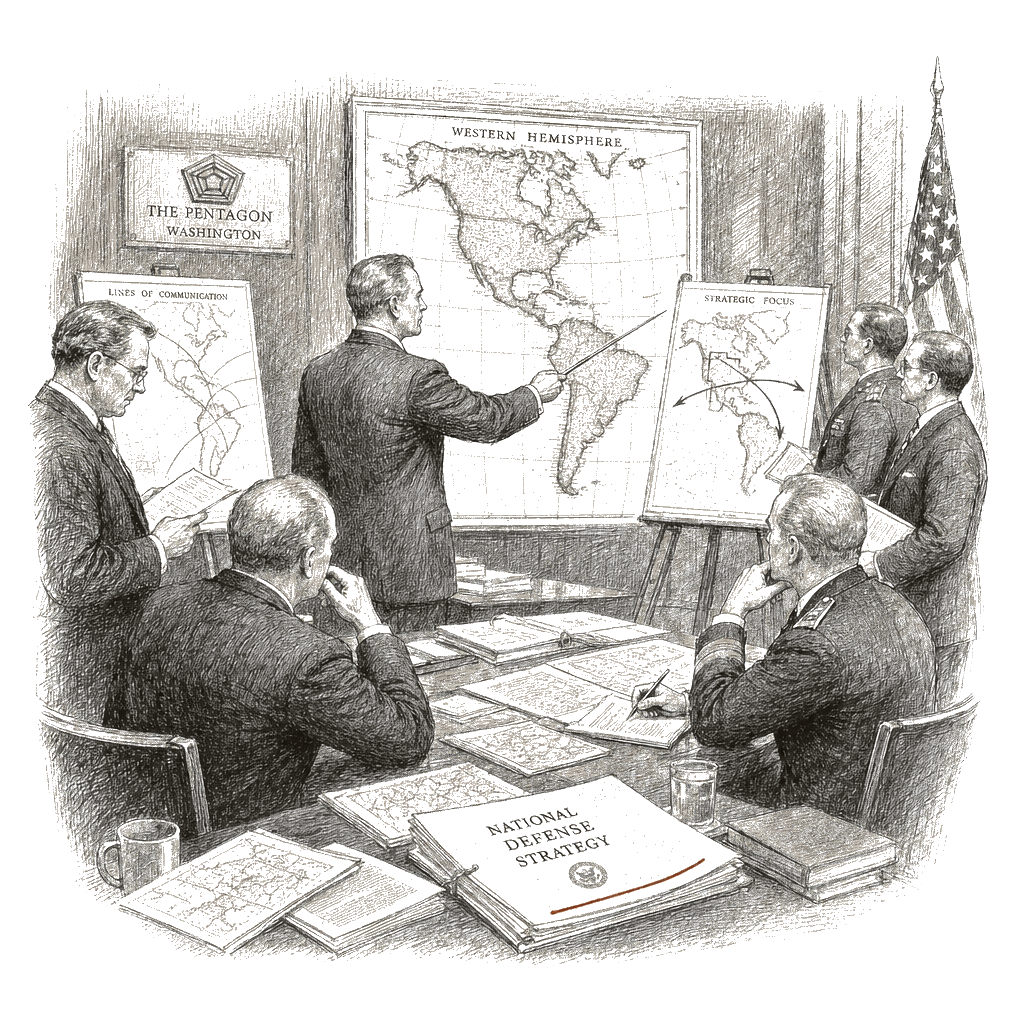
Pentagon releases defense strategy pivoting toward Americas
The Trump administration’s Pentagon released a sweeping National Defense Strategy on Friday that fundamentally reorders U.S. military priorities, demanding that allies boost their own defense spending while shifting American focus from containing China to securing dominance in the Western Hemisphere, including access to Greenland and the Panama Canal.
The 34-page strategy, the first major defense blueprint since 2022, marks a sharp break from the Biden administration’s approach and reflects President Trump’s “America First” philosophy. It charges U.S. allies from Europe to Asia that they must take primary responsibility for their own security rather than relying on American military and financial support.
“For too long, the U.S. Government neglected — even rejected — putting Americans and their concrete interests first,” the document’s opening sentence states, setting the tone for what the Pentagon described as “a sharp shift — in approach, focus, and tone.”
Defense Secretary Pete Hegseth’s department will provide “credible options to guarantee U.S. military and commercial access to key terrain,” especially Greenland and the Panama Canal, according to the document. The strategy comes days after Trump announced he had reached a “framework of a future deal” on Arctic security with NATO leader Mark Rutte that would offer the U.S. “total access” to Greenland, a territory of NATO ally Denmark.
Danish officials, speaking anonymously to discuss sensitive negotiations, said formal negotiations have yet to begin.
Trump previously suggested the U.S. should consider retaking control of the Panama Canal and accused Panama of ceding influence to China. Asked this week if the U.S. reclaiming the canal was still possible, Trump said: “I don’t want to tell you that. Sort of, I must say, sort of. That’s sort of on the table.”
Reframing U.S.-China relations
The strategy represents a fundamental shift in how the Trump administration views China, treating it not as the top threat requiring American dominance but as a settled force in the Indo-Pacific region that need only be deterred from expansion.
“The goal is not to dominate China; nor is it to strangle or humiliate them,” the document says. “This does not require regime change or some other existential struggle.”
The Pentagon added that “President Trump seeks a stable peace, fair trade, and respectful relations with China,” and said the administration would “open a wider range of military-to-military communications” with China’s army.
The strategy contains no mention of or guarantee to Taiwan, the self-governing island that Beijing claims as its own and says it will take by force if necessary. By contrast, the Biden administration’s 2022 defense strategy explicitly stated the U.S. would “support Taiwan’s asymmetric self-defense.”
Allies told to shoulder more burden
The document says South Korea is “capable of taking primary responsibility for deterring North Korea with critical but more limited U.S. support,” effectively placing the weight of regional deterrence on Seoul rather than Washington.
In Europe, while the strategy acknowledges that “Russia will remain a persistent but manageable threat to NATO’s eastern members for the foreseeable future,” it asserts that NATO allies are “strongly positioned to take primary responsibility for Europe’s conventional defense.”
The Pentagon said it would play a key role in NATO “even as we calibrate U.S. force posture and activities in the European theater” to focus on priorities closer to home. The U.S. has confirmed it will reduce its troop presence on NATO’s borders with Ukraine, drawing concern from European allies about a potential security vacuum as they confront an increasingly aggressive Russia.
The strategy simultaneously courts cooperation from neighboring countries while issuing stark warnings. “We will engage in good faith with our neighbors, from Canada to our partners in Central and South America, but we will ensure that they respect and do their part to defend our shared interests,” the document states. “And where they do not, we will stand ready to take focused, decisive action that concretely advances U.S. interests.”
The Pentagon also cited the recent military operation that ousted Venezuelan President Nicolás Maduro as an example of U.S. commitment to Western Hemisphere security, saying “all narco-terrorists should take note.”
The defense strategy capped off a week of tension between the Trump administration and traditional allies. Trump had threatened tariffs against European partners while pursuing Greenland and had engaged in a confrontation with Canadian Prime Minister Mark Carney at the World Economic Forum in Davos, Switzerland. The document’s tone reflects an underlying shift: the era of unquestioned U.S. security guarantees is moving toward a transactional model in which countries must invest significantly in their own defense.