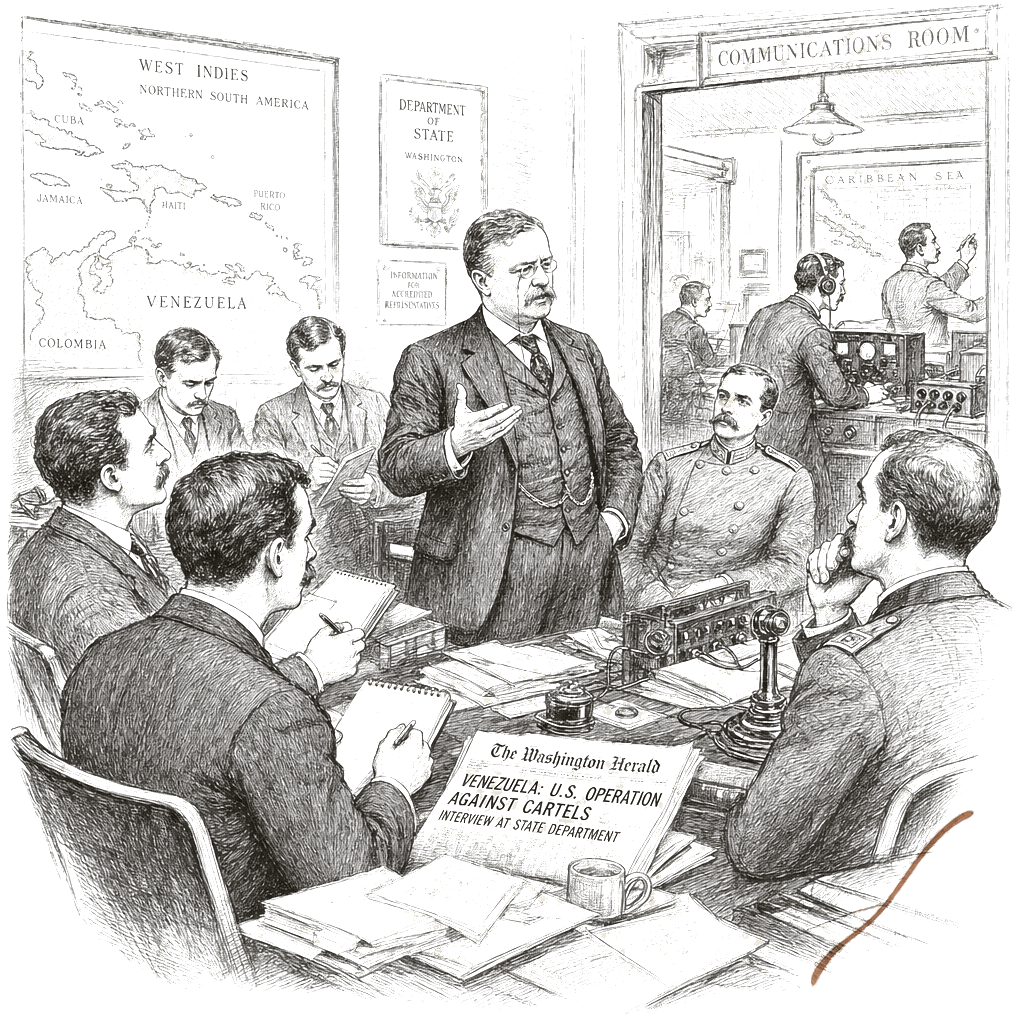
President Donald Trump said in a Friday interview that the U.S. employed a secret weapon he called “The Discombobulator” to disable Venezuelan military equipment during the operation that captured Nicolás Maduro. Speaking to the New York Post, Trump claimed the weapon prevented Venezuelan forces from launching Russian and Chinese rockets and said “they pressed buttons and nothing worked.”
Trump also renewed threats to conduct military strikes against drug cartels, saying the U.S. could extend operations from South America into Mexico and Central America. “Could be anywhere,” he said when asked if strikes could occur in Mexico or Central America.
The comments came days after the U.S. carried out a strike Friday on an alleged drug-trafficking boat in the eastern Pacific Ocean, the first such action since Maduro’s capture in early January.
Trump’s disclosure of the weapon system and his renewed threats underscore the administration’s escalating military campaign in the Western Hemisphere targeting both political adversaries and criminal organizations. The expanded strike operations signal a potential expansion of how the administration executes its regional strategy.
Trump Details Secret Weapon Used in Venezuelan Operation
Trump disclosed limited information about the secret weapon during the Friday interview with the New York Post. “The Discombobulator. I’m not allowed to talk about it,” he said, describing its effect on Venezuelan equipment. “They never got their rockets off. They had Russian and Chinese rockets, and they never got one off.”
“We came in, they pressed buttons and nothing worked. They were all set for us,” Trump said in the interview.
Trump had previously stated during his announcement of Maduro’s capture that the U.S. turned off “almost all of the lights in Caracas” during the operation. The Friday interview provided the first attribution for that claim.
Expanding Strike Campaign Against Cartels
Trump renewed the administration’s threat to conduct military strikes targeting drug cartels and indicated operations could expand beyond South America into Mexico and Central America. “We know their routes. We know everything about them. We know their homes. We know everything about them,” Trump said. “We’re going to hit the cartels.”
When asked if the strikes could occur in Mexico or Central America, Trump said: “Could be anywhere.”
The U.S. carried out a strike Friday on an alleged drug-trafficking boat in the eastern Pacific Ocean—the first such action since Maduro’s capture in early January. The operation is part of a campaign that has struck at least 36 vessels in the Caribbean and eastern Pacific since early September, killing at least 117 people.
Venezuelan Oil and Other Matters
Trump said the U.S. has seized seven oil tankers connected to Venezuela and removed the oil aboard them, though he declined to specify the vessels’ current location. “I’m not allowed to tell you,” Trump said. “But let’s put it this way, they don’t have any oil. We take the oil.”
Trump also addressed the Nobel Peace Prize awarded to Venezuelan opposition leader María Corina Machado earlier in January. She gave the prize to Trump, who said he was still determining where to display it in the Oval Office.
The president discussed an Arctic security framework he struck with NATO chief Mark Rutte, saying the arrangement would give the U.S. ownership of land where American bases are located. “We’ll have everything we want,” Trump said. Denmark and Greenland have stated the island’s sovereignty is non-negotiable, and a NATO spokesperson said Rutte did not propose any compromise to sovereignty in his conversations with Trump.
Finally, Trump said he would not attend the Super Bowl, calling the selection of Bad Bunny and Green Day as halftime performers a “terrible choice.”