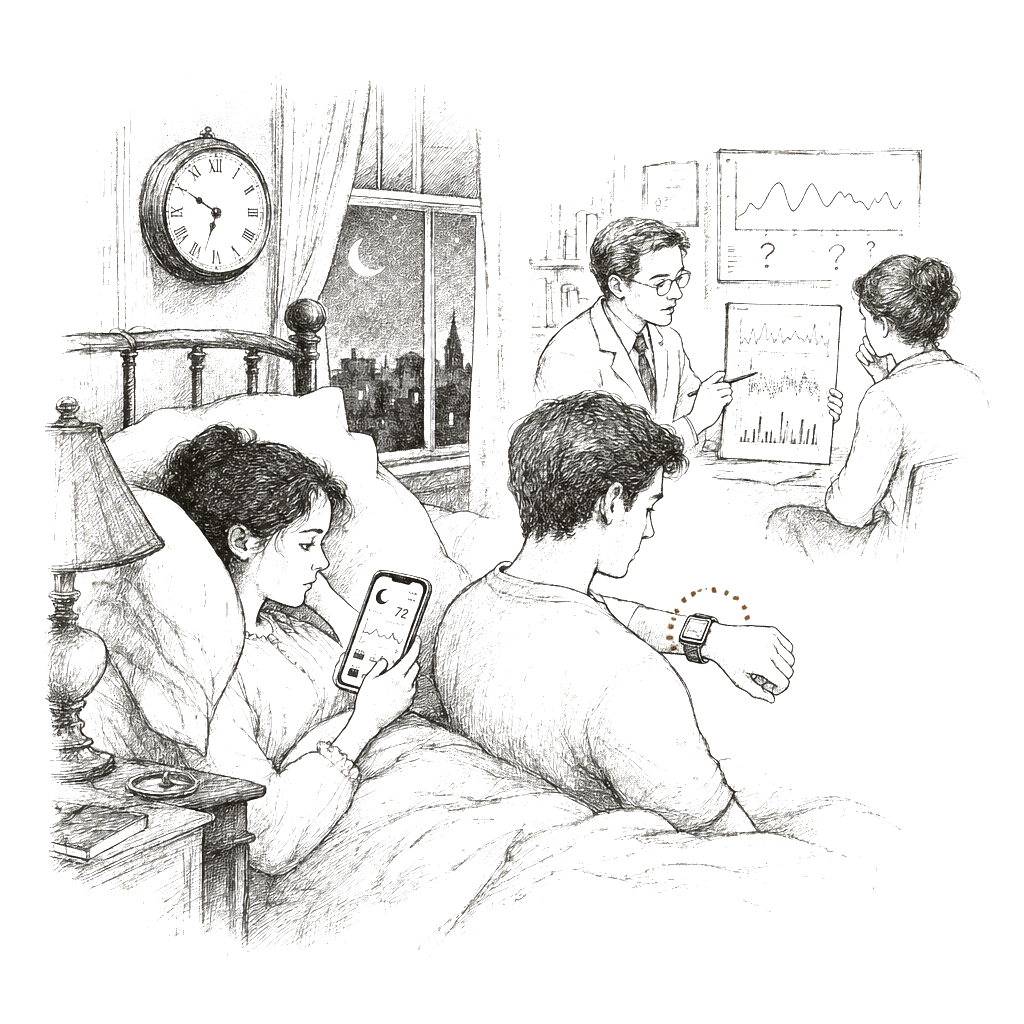
Millions of people rely on smartphone apps and wearable devices to monitor their sleep, but these trackers have significant limitations that experts say users often misunderstand. The devices do not measure sleep directly; instead, they infer sleep states from signals like heart rate and movement. That distinction matters: the trackers are less precise than laboratory studies for measuring specific sleep stages like REM and non-REM sleep, according to sleep researchers.
The sleep-tracking device market generated approximately $5 billion in revenue in 2023 and is expected to double by 2030, according to market research firm Grand View Research. As wearables become more popular, sleep experts say understanding what the devices can and cannot measure is increasingly important for users’ health and decision-making.
How Trackers Work
Sleep trackers made by companies like Apple, Fitbit, and Oura operate on the same basic principle: they record the wearer’s movements and heart rate during rest, then use algorithms to estimate sleep patterns. The algorithms have become quite good at determining whether someone is asleep, according to Daniel Forger, a University of Michigan mathematician who researches the science behind sleep wearables.
But there are limits to what the devices can determine.
“If you really want to know definitively how much non-REM sleep you’re having versus REM sleep, that’s where the in-lab studies really excel,” Forger said.
In laboratory settings, technicians use electroencephalography and other direct measurements to observe sleep stages in real time. Wearables, which lack that direct access to brain activity, must estimate sleep stages from indirect signals — a fundamentally less precise approach.
What the Data Does and Doesn’t Say
Sleep tracker data should be used to identify trends over time rather than obsessed over for individual nights, according to Dr. Chantale Branson, a neurologist and professor at the Morehouse School of Medicine.
“We would have believed them with or without the device and worked on trying to figure out why they can’t sleep — and that is what the wearables do not do,” Branson said.
Branson said she frequently has patients arriving at her office fixated on granular details from their trackers, such as how much REM sleep they got on a specific night. That focus misses the point. The trackers reveal whether sleep patterns are improving or worsening over weeks or months, but they cannot explain why sleep is poor or what to do about it.
Forger takes a more favorable view toward the devices, saying they help keep the overlooked importance of sleep front of mind. He recommends them even for people without significant sleep issues.
“Seeing if your biological clock is in sync is a huge benefit because even if you’re giving yourself the right amount of time, if you’re sleeping at the wrong times, the sleep won’t be as efficient,” Forger said.
When Obsession Becomes a Problem
For some people, sleep trackers backfire. Mai Barreneche, who works in advertising in New York City, used to wear her Oura Ring constantly. She said it helped her develop good sleep habits and encouraged her to maintain a daily morning exercise regimen. But as a metric-driven person, she became obsessed enough with her nightly sleep scores that it began to cause anxiety — a condition researchers have documented as “orthosomnia.”
“I remember I would go to bed thinking about the score I was going to get in the morning,” Barreneche said.
She decided not to wear her ring on a beach vacation a few years ago, and when she returned home, she never put it back on. She said she has maintained the good habits the device pointed her toward, but no longer wants the stress of monitoring her nightly scores.
Branson has observed similar score-induced anxiety in her own patients, particularly those who set goals to achieve a certain amount of REM sleep or who shared their nightly scores with friends using the same device. Comparing sleep types and stages is ill-advised since individual needs vary by age, genetics and other factors, she said.
“These devices are supposed to help you. And if you feel anxious or worried or frustrated about it, then it’s not helpful, and you should really talk to a professional,” Branson said.
Practical Guidance for Users
Rather than fixating on sleep tracker data, Branson recommends that people focus on foundational sleep practices. Creating a relaxing bedtime routine, avoiding screens before bed, and maintaining a comfortable sleep environment matter far more than any sleep score.
She advises those concerned about their sleep to consult a clinician before spending money on a wearable.
For some users, though, the data has served as a useful mirror. Kate Stoye, an Atlanta-area middle school teacher, bought an Oura Ring last summer after hearing positive things from friends. After noticing that nights she drank alcohol coincided with poorer sleep quality, she decided to give up alcohol.
“I don’t see much reason to drink if I know that it’s going to affect how I feel,” Stoye said.
Stoye also identified a pattern in her ring’s data about the importance of not eating too late if she wants to get good rest.
“I always struggle with going to bed, and it’s often because I eat late at night. I know that about myself, and it knows it too,” Stoye said.
The Future of Sleep Tracking
Forger believes the full potential of wearables has been underestimated. Emerging research suggests the devices could one day help detect infections before symptoms appear and flag sleep pattern changes that may signal the onset of depression or increased risk of relapse.
“The body is making these really interesting and really important decisions that we’re not aware of to keep us healthy and active and alert at the right times of day. If you have an infection, that rhythm very quickly starts to disappear because the body goes into overdrive to start fighting the infection. Those are the kind of things we can pick up,” Forger said.
The technology could be particularly useful in low-resource communities, where wearables could help health issues be identified more quickly and monitored remotely without requiring access to doctors or specialized clinics, he said.
“There’s this really important story that’s about to come out: About just how understanding sleep rhythms and sleep architecture is going to generally improve our lives,” Forger said.