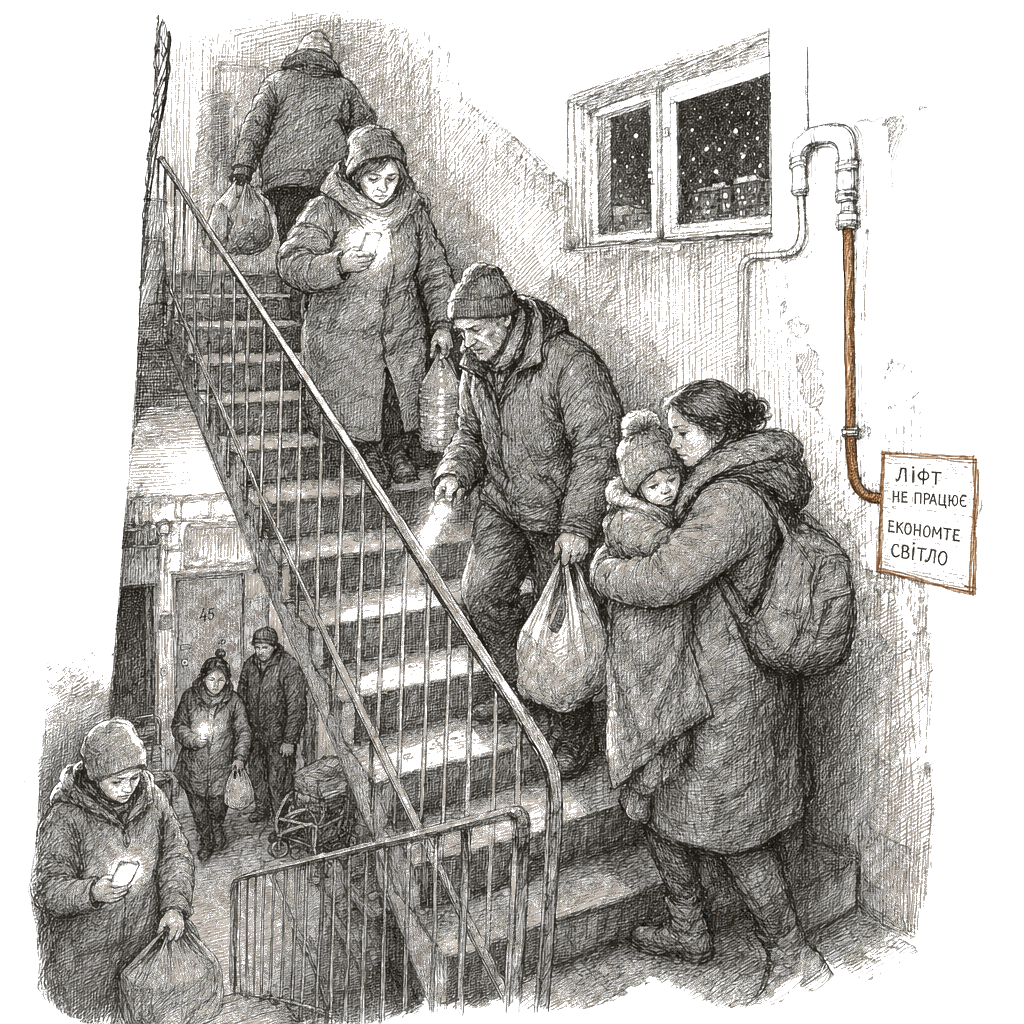
Freezing and in the dark, residents in Kyiv are spending long hours trapped inside tower blocks as Russia targets Ukraine’s power system, the Associated Press reported. The report described how electricity shortages during January blackouts are leaving many households without heat and making even basic movement around high-rise buildings contingent on power restoration.
Olena Janchuk, a 53-year-old former kindergarten teacher, has been trapped for weeks on the 19th floor of her Kyiv apartment, according to the AP story. The report said Janchuk has severe rheumatoid arthritis and that long daily blackouts have made working elevators a luxury. With January temperatures dropping to minus 10 degrees Celsius (14 degrees Fahrenheit), the AP said frost has formed on the inside of her windows.
Janchuk’s room has become a makeshift refuge as central heating remains unavailable. The AP described her using candles arranged beneath stacked bricks to create a makeshift fireplace designed to absorb and slowly release heat. It also said she relies on USB charging from overloaded power strips and an electric blanket hooked up to a power bank rationed for the coldest hours.
“When there’s no light and heat for seventeen and a half hours, you have to come up with something,” Janchuk said, according to the AP report. She added: “The bricks work best in a small room, so we stay in there.” By day, the AP said her family shifts between rooms to catch winter sun, adjusting which space they use based on the blackout schedule.
The AP said Kyiv, home to about 3 million people, is dominated by Soviet-era tower blocks left without power for most of the day. It reported that residents plan cooking, showering, phone charging and running washing machines around electricity schedules, while choosing food for longer shelf life and filtering water into bottles stored in buckets. When the power is out, the report said, small camping gas burners are used to heat soup or tea.
The story also described how sleep and daily routines are shaped by air raid sirens and the timing of electricity during off-peak hours. Outside, across snow-covered Kyiv, the AP said diesel generators run on commercial streets, shoppers navigate with phone flashlights, and bars glow by candlelight. It said apps notify users about narrowing electricity windows, usually just a few hours, enough for a household “reboot.”
Higher floors have added consequences during blackouts, the AP reported, including residents climbing stairs in darkness. The report said Janchuk’s 22-story building is located near a power station and that residents can see missile and drone attacks firsthand, with flashes lighting the horizon at night. It also said people sometimes leave plastic bags with cookies or water inside elevators for those who get stuck when power cuts midride.
The AP described how Janchuk’s husband brings groceries in the evening while her mother, 72-year-old Lyudmila Bachurina, handles chores. Bachurina told the AP: “It’s cold, but we manage.” She said: “When the lights come on, I start turning on the washing machine, fill up water bottles, cook food, charge power banks, run around the kitchen and run around the house.”
In more affluent neighborhoods, the AP reported that residents pool funds for generators to keep elevators running, while many blocks cannot afford such measures. Disability advocates, including groups representing wounded war veterans, told the AP they are urging city officials to fund generators for residential buildings, saying staircases have become an “invisible social barrier” that cuts people off inside their own homes.
The AP said that, until generators are funded, Kyiv residents are relying on USB lamps, power banks and inverter batteries, with Telegram chats used to check on elderly neighbors and swap blackout updates. From upper floors, the AP reported, residents look out over high-rise skylines and historic churches as explosions flash visible across the city at night, while Russia continues its campaign against Ukraine’s energy system.
The AP said the scale of damage has been driven by strikes that have hit too many power plants and transmission lines for the grid to meet demand, even with electricity imports from Europe. It said operators impose rolling blackouts to prevent grid collapse, keeping hospitals and other critical services supplied while homes lose power.
At one coal-fired power plant hit repeatedly, the AP reported, a shift supervisor identified as Yuriy walked through wreckage described as charred machinery, collapsed roofs and melted control panels, with repairs carried out by torchlight. “After missile and drone attacks, the consequences are terrible — large-scale,” Yuriy said, according to the AP. The report said officials asked that the plant location and Yuriy’s full name not be disclosed for security reasons.
Yuriy told the AP that the equipment has been destroyed. “Our energy equipment has been destroyed. It is expensive,” he said. “Right now, we’re restoring what we can.” The AP also said Ukraine’s energy sector has suffered more than $20 billion in direct war damage, citing a joint estimate by the World Bank, the European Commission and the United Nations.
The AP said Kyiv has repeatedly updated its austere winter power-saving schedule, including dimming or cutting streetlights in low-traffic areas and investing in less centralized power generation. For residents in tower blocks, the report said, restoration can feel far off. Bachurina said: “I’m tired, really tired, to be honest. When you can’t go outside, when you don’t see the sun, when there’s no light and you can’t even go to the store on your own. … It wears you down.”
“But the important thing, as all Ukrainians say now, is that we will endure anything until the war ends,” Bachurina said, according to the AP report.