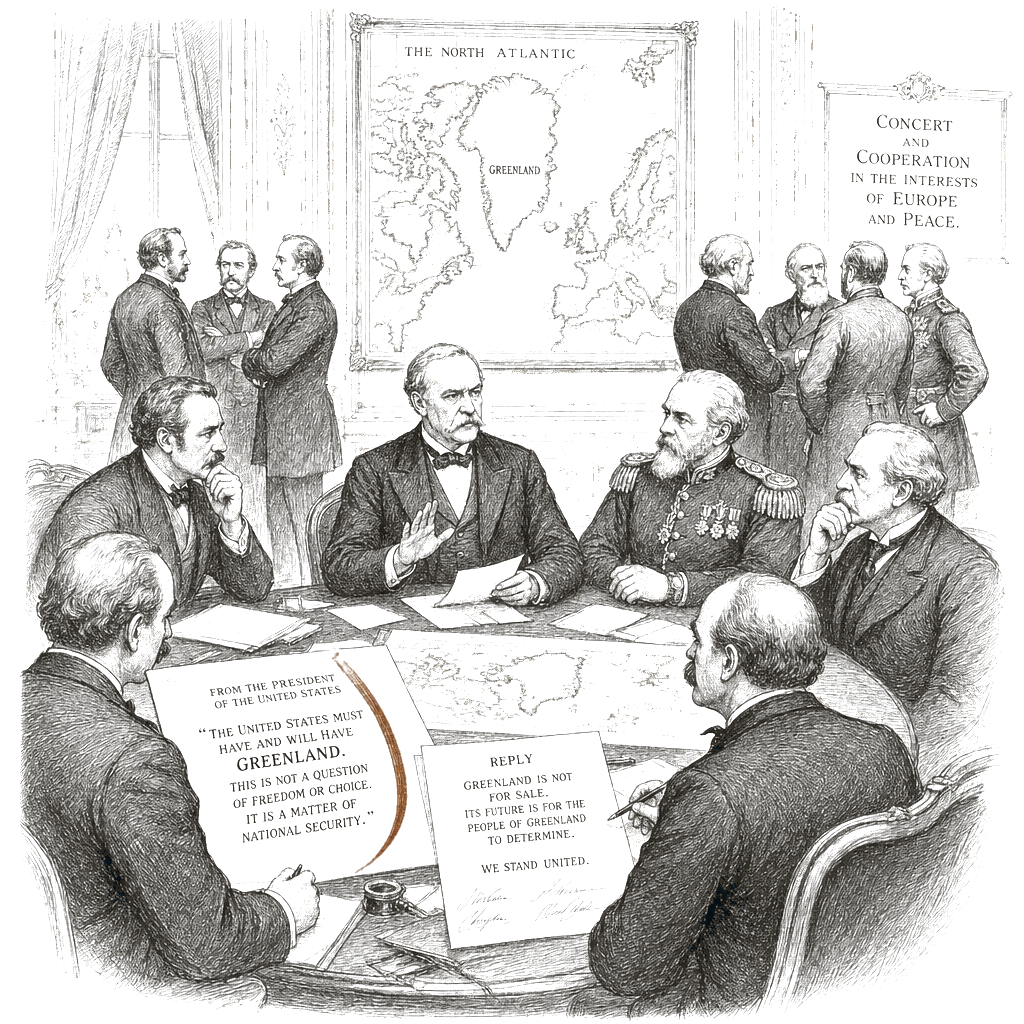
European leaders delivered coordinated rejections of President Donald Trump’s demand that the United States “absolutely” must rule Greenland, with senior officials warning that threats have no place among allied nations. The unified stance emerged at the World Economic Forum in Davos last week, marking a shift toward openly confronting the American president after struggling to forge consensus for a year.
The moment marked a striking reversal for European governments that previously relied on softer diplomacy and appeals to Trump. Danish Prime Minister Mette Frederiksen said the experience showed that “when Europe is not divided, when we stand together and when we are clear and strong also in our willingness to stand up for ourselves, then the results will show.”
At the World Economic Forum in Davos, Trump told his audience he had a simple proposition for European nations: accept American control of Greenland or face consequences. “You can say yes, and we will be very appreciative,” Trump said. “Or you can say no, and we will remember.”
Within days, Europe answered.
European Unity Takes Shape
British Prime Minister Keir Starmer declared that “Britain will not yield” its support for Greenland’s sovereignty. Norwegian Prime Minister Jonas Gahr Støre issued a blunt warning: “Threats have no place among allies.” Leaders across the continent issued statement after statement rejecting Trump’s renewed demand that the United States “absolutely” must rule Greenland, the semiautonomous Danish territory and NATO member.
The coordinated pushback marked a deliberate shift from how European governments had managed Trump during his first term. For a year, European leaders had scrambled to figure out how to deal with an emboldened American president, often relying on measured diplomacy and appeals. That approach had yielded little. This moment was different.
“When Europe is not divided, when we stand together and when we are clear and strong also in our willingness to stand up for ourselves, then the results will show,” Danish Prime Minister Mette Frederiksen said.
The unity began at the grassroots. When Trump revived his Greenland demand in early January, Greenland’s Prime Minister Jens-Frederik Nielsen responded with a rare bluntness from a diplomat. “Enough,” he said in a statement. “No more pressure. No more hints. No more fantasies about annexation.” Denmark’s government backed him up, with Frederiksen warning that any attempt to seize Greenland would mark the end of NATO.
Tariffs and Pressure
Trump responded last weekend from his golf course in Florida with an economic threat. He announced he would impose 10 percent tariffs within one month on goods from eight European nations: Denmark, Norway, Sweden, France, Germany, the United Kingdom, the Netherlands, and Finland. Unless those countries agreed to “the Complete and Total purchase of Greenland” by the United States, he wrote, the tariff rate would climb to 25 percent by June 1.
The threat appeared calculated to divide Europe by targeting specific nations. Instead, it appeared to consolidate a response. Even leaders Trump had previously cultivated with praise and flattery began to speak plainly about his conduct.
“We want a piece of ice for world protection, and they won’t give it,” Trump had said at Davos, referring to Greenland’s strategic location in the Arctic. But European leaders rejected the premise of his demand. Several said flatly that “Europe will not be blackmailed” over the territory.
Trump Steps Back
Within days, Trump began to walk back his position. He canceled his threat to use “force” to take over Greenland. Before Trump stepped away from the podium in Davos, he had begun to back down. He then announced a “framework” for a deal that would make his tariff threat unnecessary, telling Fox Business that “we’re going to have total access to Greenland” under the arrangement, though he did not specify what that might entail.
Frederiksen responded by reiterating Denmark’s red line. “We cannot negotiate on our sovereignty,” she said in a statement.
What the Standoff Revealed
The episode offered what academic observers described as a lesson in how to manage Trump’s demands. Mark Shanahan, an associate professor of political engagement at the University of Surrey, noted that European leaders had initially tried to manage Trump by using traditional diplomatic channels during his first term. “It’s very hard for other leaders who deal with each other through the niceties of a rules-based system and diplomatic conversation,” Shanahan said.
Duncan Snidal, professor emeritus of international relations at Oxford University and the University of Chicago, observed that Trump had been “in a fairly weak position” during the standoff because of domestic political pressures, including an upcoming Supreme Court decision on his tariffs and a backlash to immigration enforcement operations in Minnesota. That weakness appeared to have created space for European leaders to resist.
Canada’s Mark Carney framed the moment not as a dispute over Greenland but as a choice about Europe’s future. He called on European countries to build power together against what he characterized as “coercion” and “exploitation” by a larger power — and to reject the big-power paradigm Trump represented.
Whether the European unity would hold remained to be seen. Snidal noted that while a rupture in the transatlantic alliance appeared to have occurred, repairing it under adjusted terms remained in the interests of both sides. “It’s too good a deal for all of them not to,” he said, referring to the alliance itself.