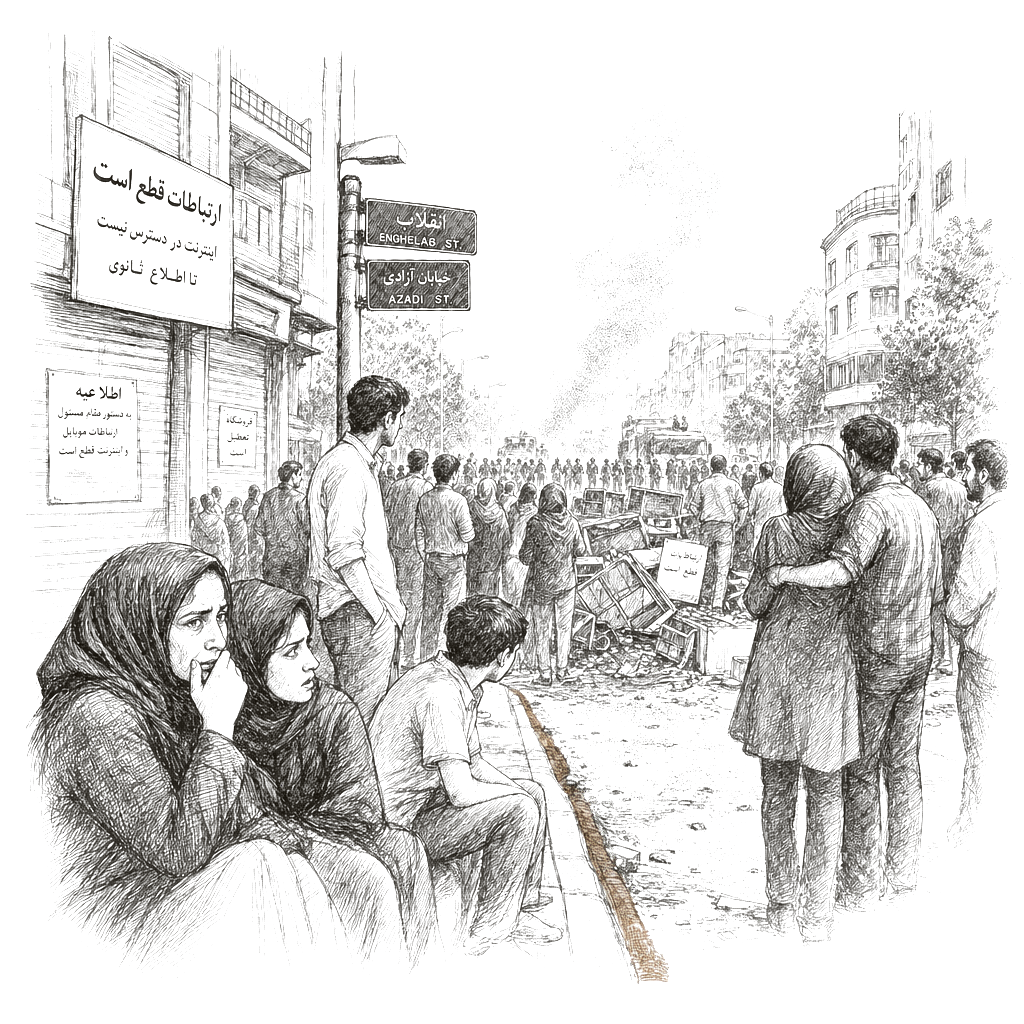
Iran’s authorities have killed thousands of demonstrators in what activists describe as the bloodiest crackdown on dissent since the country’s 1979 Islamic Revolution, according to the Associated Press. The violence, which has damaged at least $125 million in property and cut the country off from the internet, comes as the United States prepares military options in response. Hundreds of cities across Iran have been affected by the month-long wave of protests, which began in late December as demonstrations over the collapse of Iran’s currency spiraled into broader calls for change.
The crackdown represents Iran’s most violent response to domestic unrest in decades and raises the risk of direct U.S. military intervention, as President Donald Trump has signaled readiness to act if mass executions occur.
Cities and towns across Iran reek of smoke as fire-damaged mosques and government offices line streets. Banks have been torched, their automated teller machines smashed. The Islamic Republic’s authorities cut off internet and phone communication, leaving much of the scale of violence difficult to verify independently.
The scale of the crackdown
Property damage exceeds $125 million across over 20 cities, according to an Associated Press tally of reports from the state-run Iranian news agency IRNA. That figure accounts for 750 banks, 414 government buildings, 600 damaged ATMs, and hundreds of vehicles destroyed during the month-long wave of unrest.
The death toll figures carry sharp discrepancies that underscore the information vacuum created by Iran’s internet shutdown. On Wednesday, Iran’s government reported 3,117 people killed in the crackdown, consisting of 2,427 civilians and security force members plus another 690 it identified as “terrorists.”
The U.S.-based Human Rights Activists News Agency, citing activists inside Iran verifying fatalities against public records and witness statements, put the death toll at 5,137. That figure includes 4,834 demonstrators, 208 government-affiliated personnel, 54 children, and 41 civilians not participating in protests.
“Death tolls in Iran have long been inflated or deflated for political reasons,” the Associated Press reported. But the fact that Iran’s government offered any death toll figure—a number exceeding any other political unrest in modern Iranian history—underscores the unprecedented scale.
Origins and escalation
Demonstrations began December 28 at Tehran’s historic Grand Bazaar, initially driven by anger over the collapse of Iran’s currency, the rial. The unrest spread rapidly across the country.
Tensions erupted dramatically on January 8, after Iran’s exiled crown prince, Reza Pahlavi, called for demonstrations. Witnesses in Tehran told the Associated Press before the internet blackout that they saw tens of thousands of demonstrators on the streets.
Ali Akbar Pourjamshidian, a deputy interior minister, acknowledged the violence began in earnest that day. “More than 400 cities were involved,” he said.
By January 9, Revolutionary Guard General Hossein Yekta appeared on Iranian state television warning parents to keep their children home. “Tonight you all must be vigilant,” he said. “Tonight is the night for keeping mosques, all bases everywhere filled with ‘Hezbollahi,’” using language that carries connotations of fervent support for Iran’s theocracy.
Methods of suppression
Video footage and eyewitness accounts document the scope and methods of the state response.
“The vast majority of protesters were peaceful. The video footage shows crowds of people—including children and families—chanting, dancing around bonfires, marching on their streets,” said Raha Bahreini of Amnesty International. “The authorities have opened fire unlawfully.”
Security forces employed tactics documented in prior waves of Iranian unrest but deployed at unprecedented scale. Revolutionary Guard members and plainclothes units fired from rooftops at demonstrators, shot birdshot into crowds, and deployed motorcycle-riding paramilitary volunteers to beat and detain those unable to escape.
Scores of people sustained blinding eye injuries from birdshot—wounds authorities deny despite medical evidence and precedent from the 2022 protests that followed the death of Mahsa Amini. Tehran’s Farabi Eye Hospital, the premier clinic for eye injuries in Iran, called in “all current and retired doctors” to manage the caseload.
“They’re not just targeting one or two people to create a climate of terror for people to disperse,” Bahreini said. “But just relentlessly firing at thousands of protesters and chasing after them, even as they were fleeing so that more people were just collapsing to the ground with severe gunshot wounds.”
The Basij, the Revolutionary Guard’s volunteer paramilitary arm, formed the backbone of the crackdown. Mosques in Iran frequently house Basij facilities, with estimates placing 79% of Basij bases in mosques and 5% in other religious sites, according to reporting from 2024.
“Most neighborhood Basij bases are co-located with mosques and most neighborhood Basij leaders are associated with the mosque leadership,” said Afshon Ostovar, an expert on the Revolutionary Guard at the Naval Postgraduate School in California. Demonstrators targeting these facilities viewed them as “legitimate” regime targets “associated with repression.”
Video evidence shows Basij members holding long guns, batons, and pellet guns. Anti-riot police wore helmets and body armor while carrying assault rifles and submachine guns. Paramilitary riders on motorcycles moved through crowds with a mobility authorities deployed to trap demonstrators.
Looking ahead
Experts suggest Iran’s government viewed the January 8 escalation as an existential threat.
“I think the regime viewed it as this was a moment of existential threat and that they could either allow it to play out and allow the protests to build and allow foreign powers to increase their rhetoric and increase their demands on Iran,” Ostovar said. “Or they could turn out the lights, kill as many people as necessary and hope they could get away with it. And I think that’s what they ultimately did.”
The escalation came after a 12-day war Israel launched against Iran in June 2025, which had already weakened the government’s standing.
The killing of peaceful protesters—and the possibility of mass executions—constitute a red line for U.S. military action that President Donald Trump has said he may cross. An American aircraft carrier and accompanying warships are moving toward the Middle East, positioning that could allow Trump to launch strikes on Iran similar to ones he ordered against Iranian nuclear enrichment facilities in the prior year.
Iranians traditionally hold memorial services for the deceased 40 days after death. That practice means the country faces the risk of renewed large-scale demonstrations around February 17.
Satellite images from Planet Labs analyzed by the Associated Press show high numbers of vehicles daily at Behesht-e Zahra, the massive cemetery on Tehran’s outskirts where those killed in the demonstrations are being buried.
Elaheh Mohammadi, a journalist at the pro-reform newspaper Ham Mihan in Tehran, described the mood as one of collective mourning. Her newspaper has been shuttered by authorities. “We send out a message to let people know we’re still alive,” she wrote online. “The city smells of death. Hard days have passed and everyone is stunned; a whole country is in mourning, a whole country is holding back tears, a whole country has a lump in its throat.”