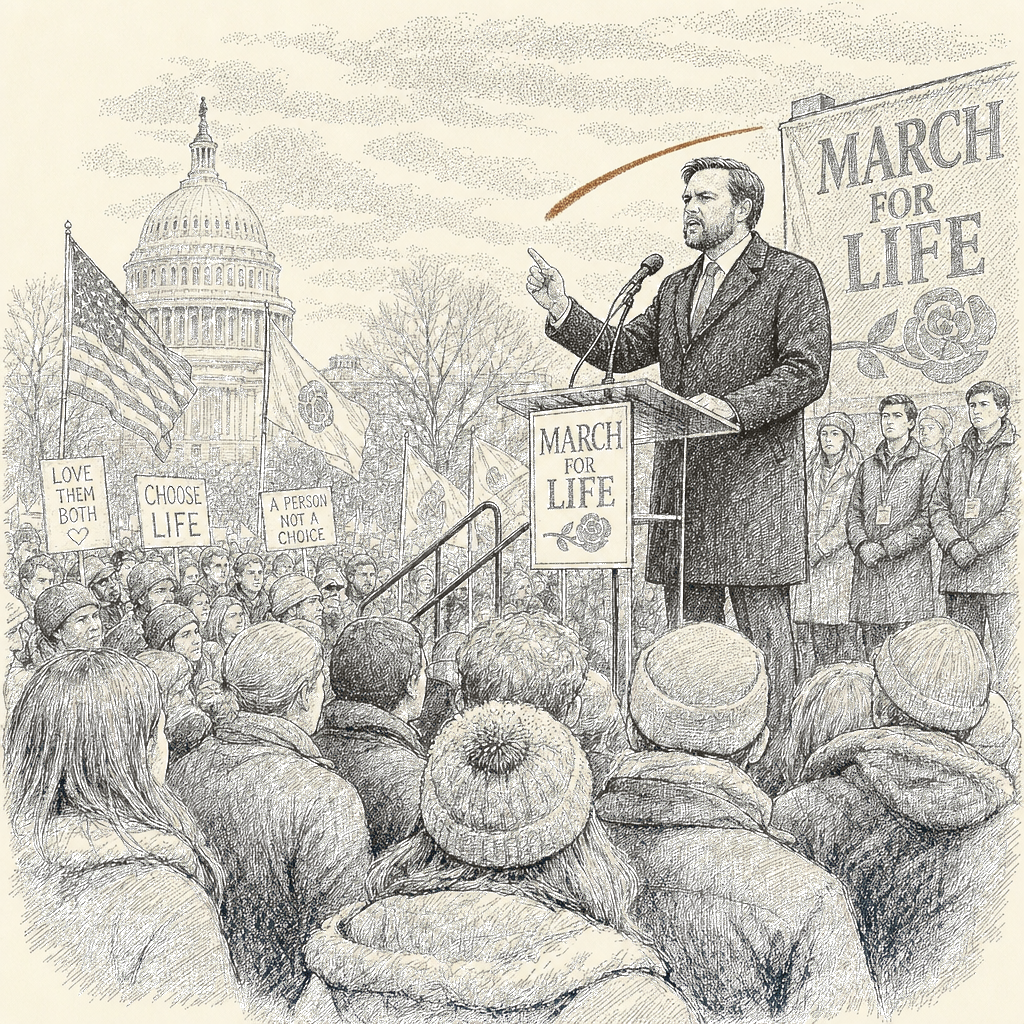
Vice President JD Vance spoke Friday at the annual March for Life rally in Washington, urging anti-abortion activists to “take heart” in the Trump administration’s efforts to restrict abortion access. Vance detailed the administration’s expansion of restrictions on U.S. foreign aid to abortion-supporting groups and praised the 2022 Supreme Court decision that overturned Roe v. Wade, calling it “the most important Supreme Court decision of my lifetime.”
The rally, which draws tens of thousands of supporters annually to the National Mall, reflects the Trump administration’s alignment with the anti-abortion movement and its emphasis on restricting abortion access through judicial appointments and executive policy.
Vice President JD Vance addressed the annual March for Life rally in Washington on Friday, praising the Trump administration’s record on abortion restrictions and urging anti-abortion activists to continue their efforts.
Speaking to tens of thousands of supporters gathered at the National Mall and Supreme Court, Vance said, “There is still much road ahead to travel together.”
Vance’s Remarks at the Rally
The vice president has consistently prioritized efforts to expand the country’s population, previously stating at last year’s March for Life that “I want more babies in the United States of America.” On Friday, he emphasized his personal commitment to the issue: “Let the record show, you have a vice president who practices what he preaches.”
Expanding Foreign Aid Restrictions
Vance highlighted the Trump administration’s expansion of the Mexico City policy, which bars U.S. foreign aid to organizations that support abortion services. The expanded version, implemented this week, extends the restriction to international and domestic organizations that promote gender identity or diversity, equity and inclusion programs. “We believe that every country in the world has the duty to protect life,” Vance said.
The vice president cited the Supreme Court’s 2022 decision in Dobbs v. Jackson Women’s Health Organization, which eliminated the federal constitutional right to abortion, as a major achievement of the Trump administration’s approach to the issue. He called it “the most important Supreme Court decision of my lifetime,” noting that Trump’s appointment of conservative justices “put a definitive end to the tyranny of judicial rule on the question of human life.”
Trump’s Presidential Leadership
Trump addressed the March for Life crowd in a recorded video message, recounting what he described as his administration’s “unprecedented strides to protect innocent life and support the institution of the family like never before,” citing his appointment of judges who he said interpret the Constitution as written.
Trump made history at the march in 2017 when he became the first sitting U.S. president to address the event, speaking by video. He attended in person in 2020, further solidifying the march’s role in Republican politics.
The March for Life demonstration, which emerged from the 1973 Roe v. Wade decision that established a federal constitutional right to abortion, has become a centerpiece of conservative anti-abortion activism. Since the Dobbs ruling in June 2022, the annual event has adopted a more celebratory tone, with organizers advancing state-level restrictions through legislatures and pursuing a complete elimination of abortion access.
Family News and Faith Leaders
Earlier in the week, Vance and his wife, second lady Usha Vance, announced via social media that they are expecting their fourth child, a son, in late July.
From the Vatican, Pope Leo XIV, the first U.S.-born pope, sent a message of support to march participants. In a letter shown at the event, he wrote: “I would encourage you, especially the young people, to continue striving to ensure that life is respected in all of its stages. May Jesus, who promised to be with us always, accompany you today as you courageously and peacefully march on behalf of unborn children.”
The Mexico City policy has a three-decade history. First established by President Ronald Reagan in 1981, the policy was rescinded by subsequent Democratic administrations and restored during Trump’s first term in 2017.