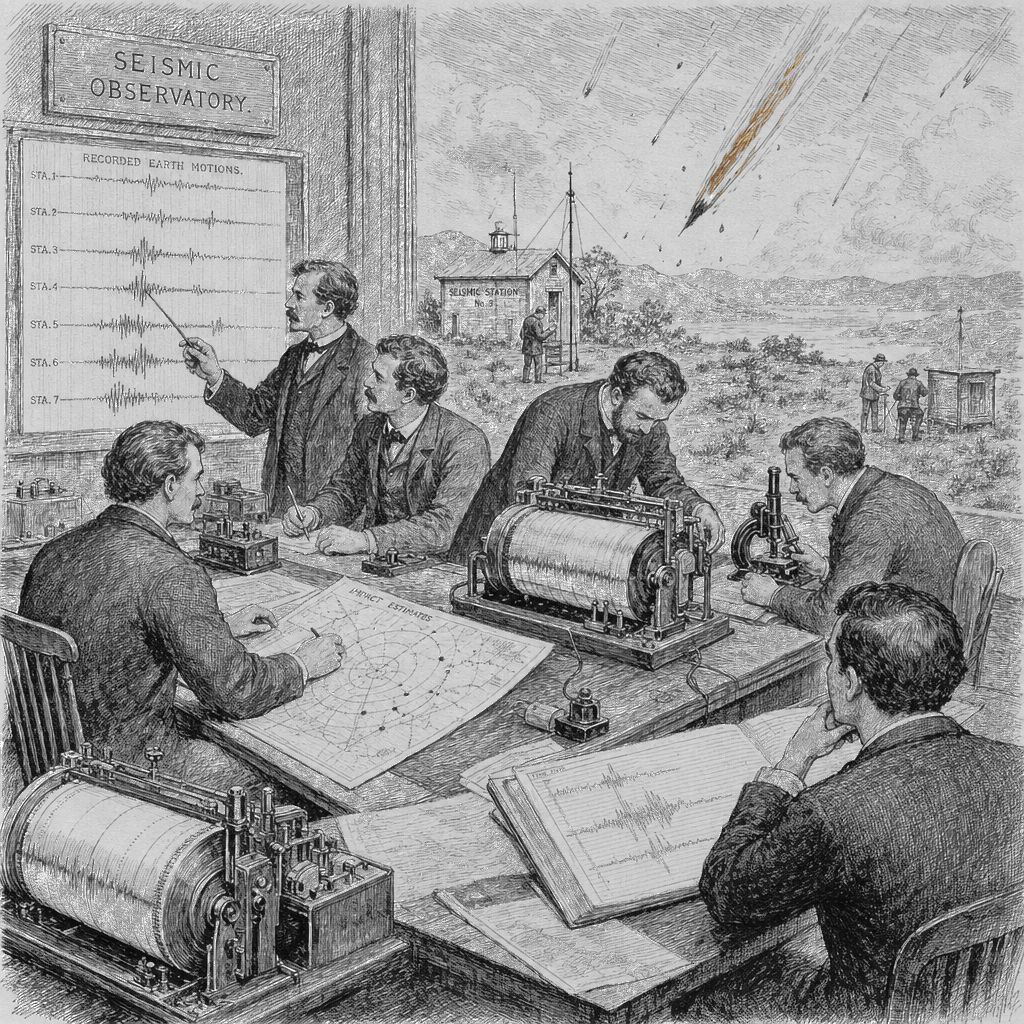
Scientists can use earthquake monitoring networks to track falling space debris more accurately than radar, according to a new study published Thursday. The research by Johns Hopkins University’s Benjamin Fernando and colleagues showed that seismic readings from sonic booms generated by a Chinese space module as it reentered Earth’s atmosphere in 2024 placed the object’s path nearly 20 miles farther south than orbital radar had predicted. The findings offer a faster way to locate debris and assess whether falling objects pose a risk to aircraft in flight.
With thousands of new satellites launching each year and older spacecraft falling from orbit, the ability to quickly pinpoint where debris will land is increasingly critical. As satellite constellations expand, the volume of uncontrolled reentries is expected to surge, making reliable tracking methods essential for safety.
“The problem at the moment is we can track stuff very well in space,” said Benjamin Fernando, lead researcher at Johns Hopkins University. “But once it gets to the point that it’s actually breaking up in the atmosphere, it becomes very difficult to track.”
Tracking the Shenzhou-15 Reentry
The study, published in the journal Science, focused on a reentry event in 2024 when a 1.5-ton module abandoned from China’s Shenzhou-15 crew capsule broke apart over Southern California. The module had remained in a decaying orbit since it was jettisoned after returning three Chinese astronauts from the country’s space station in 2023. As the module plummeted through the atmosphere, it created multiple sonic booms that seismic stations across more than 120 locations recorded.
Fernando and his team, working with Imperial College London’s Constantinos Charalambous, used that seismic data to plot the debris’s path. The seismic method proved more precise than existing orbital-tracking tools. In addition to locating the debris field, the seismic readings provided information about how and when the module fragmented during descent.
Measuring Accuracy and Broader Applications
Without debris recovered on the ground, it remains impossible to verify how precisely the team’s predictions matched the actual fall path. Yet the research could have significant applications. In remote areas like the South Pacific, where NASA plans to crash the International Space Station in five years, nuclear blast monitoring stations could potentially use the same approach to track debris. SpaceX is developing a deorbiting vehicle to ensure the space station’s controlled reentry.
Expanding the Seismic Catalog
Fernando’s team is building a catalog of seismic observations of reentering space objects. They have already used publicly available seismic data to track a few dozen other reentries, including debris from three failed SpaceX Starship test flights in Texas.
An Increasingly Crowded Orbit
The growing volume of orbiting satellites intensifies the risk. “There are thousands, tens of thousands, more satellites in orbit than there were 10 years ago,” Fernando said, citing SpaceX’s Starlink constellation and other companies’ internet satellites. “Unfortunately, we don’t really have anything other than the word of the company to say that when they break up, they completely burn up in the atmosphere.”
In a companion Science article, Chris Carr of Los Alamos National Laboratory, who was not involved in the study, said further research is needed to reduce the time between an object’s final plunge and the determination of its trajectory. The method, Carr wrote, “unlocks the rapid identification of debris fall-out zones, which is key information as Earth’s orbit is anticipated to become increasingly crowded with satellites, leading to a greater influx of space debris.”