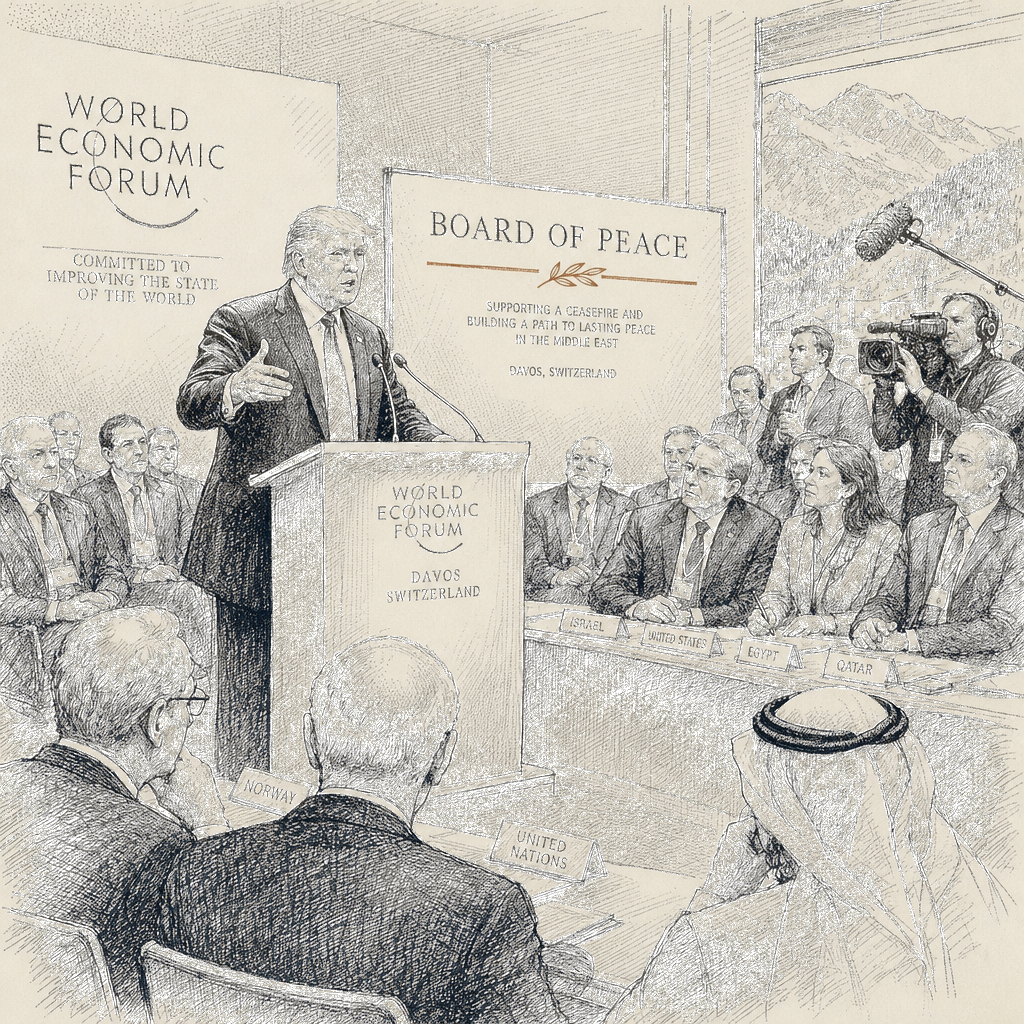
President Donald Trump on Thursday inaugurated a “Board of Peace” at the World Economic Forum in Davos, Switzerland, describing it as a new vehicle to help lead efforts to maintain a ceasefire in Israel’s war with Hamas.
In remarks and interviews during the trip, Trump said he believed “we’re going to have, I think, over 50” countries would ultimately join the board. But at the launch event, Trump was joined by officials from 19 countries, underscoring uncertainty about how broadly the group will take shape.
The event also aimed to inject momentum into what Trump framed as a longer-term effort involving Gaza. Trump said he believed the board would work alongside the United Nations rather than replace it, and he told the audience, “This isn’t the United States, this is for the world,” adding, “I think we can spread it out to other things as we succeed in Gaza.”
Several U.S. allies signaled public doubts about whether they would participate. Norway and Sweden said they wouldn’t join the board, and France declined, citing concerns that the group could seek to replace the United Nations. Canada, according to the report, was uncommitted, leaving room for additional decisions ahead.
The day’s diplomacy included a public exchange between Trump and Canadian Prime Minister Mark Carney. Carney had made blunt remarks about a “rupture” in the rules-based order at Davos, and Trump responded in a social media message saying the Board of Peace was withdrawing its invitation to Carney regarding Canada’s joining.
Trump’s comments also suggested that political approval processes could affect membership. He told reporters that “the letter only went out two days ago. We had almost 30 people already,” and said some leaders have told him they want to join but need approval from their parliaments, specifically naming Italian Prime Minister Giorgia Meloni and Polish President Karol Nawrocki.
The board’s internal rules were not publicly available as of the launch, according to the report. Trump said the charter had not yet been released, and when asked whether he would remain chairman beyond his time in office, he replied, “It’s in theory, for life — but I’m not sure I want that.”
At Trump’s Davos event, Ali Shaath, described as the head of a new, future technocratic government in Gaza, said the Rafah border crossing would open in both directions next week. Israel did not confirm that timetable; instead, Israel said it would consider the matter next week, the report said. The report also noted that the Gaza side of Rafah is currently under Israeli military control.
Beyond Gaza, the Board of Peace announcement unfolded as Trump continued other diplomacy involving Ukraine and Russia. Trump met privately in Davos for about an hour with Ukrainian President Volodymyr Zelenskyy, saying, “I had a good meeting — but I’ve had numerous good meetings with President Zelenskyy and it doesn’t seem to happen.” Zelenskyy, the report said, stated there would be two days of trilateral meetings in the United Arab Emirates involving the U.S., Ukraine and Russia starting Friday.
Trump said Zelenskyy told him he would like to make a deal, and he quoted his assessment of the talks as: “There were times when Putin didn’t want to make a deal, times when Zelenskyy didn’t want to make deal. Now I think they both want to make a deal — but we’ll find out.”
Iran also featured in the broader picture of Trump’s “peace” push. Trump said the U.S. is moving a fleet of ships toward Iran “just in case” it decides it wants to act, and he said the U.S. would keep in place a threat to slap 25% tariffs on countries doing business with Iran.