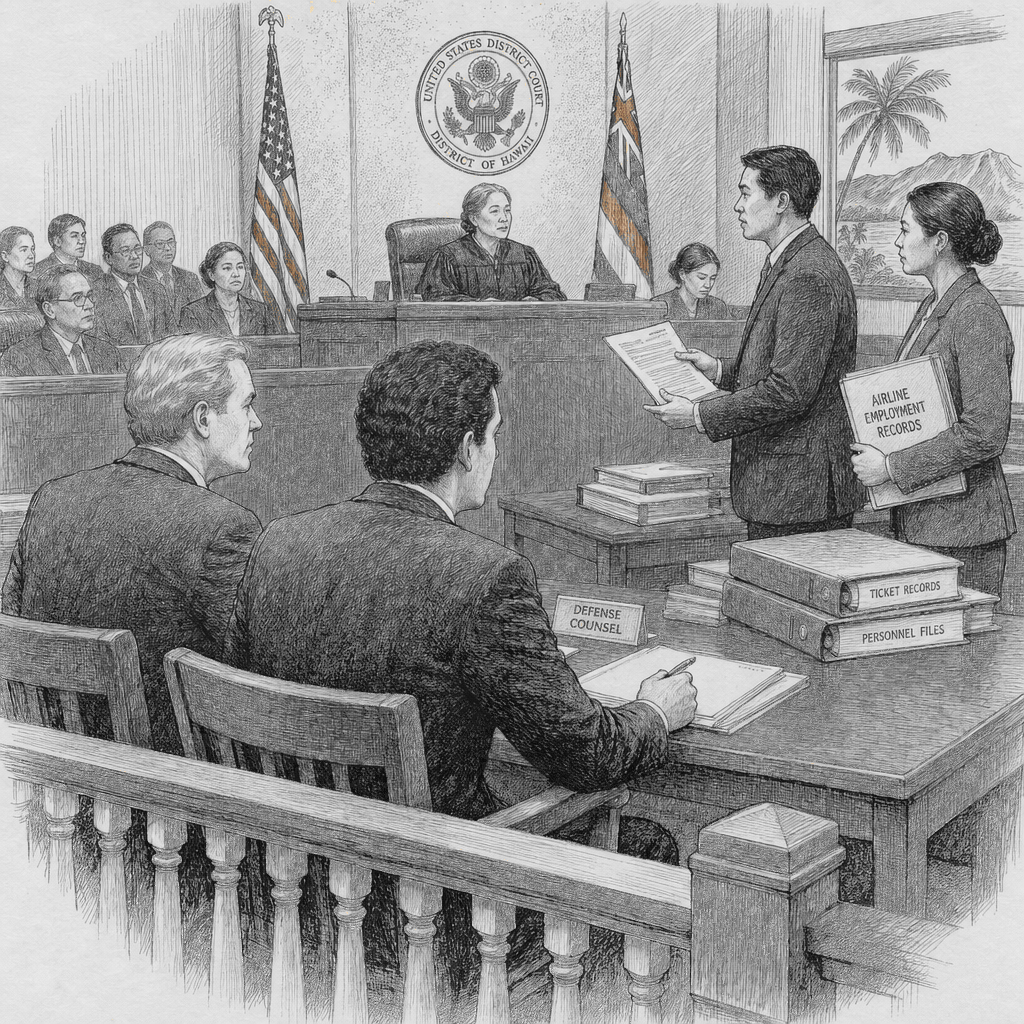
A Canadian man prosecutors say posed as a working airline pilot pleaded not guilty Tuesday in federal court in Hawaii to wire fraud charges, after allegedly obtaining hundreds of free tickets from three U.S. carriers over four years by presenting fraudulent crew credentials.
Dallas Pokornik, 33, of Toronto, was arraigned following his extradition to the United States. He had been arrested in Panama after a federal grand jury in Hawaii indicted him last October. His federal public defender declined to discuss the case.
Federal authorities say Pokornik, a former flight attendant, exploited the airline industry’s inter-carrier courtesy program — which allows crew members to fly free or at steep discounts on other carriers — by allegedly using fraudulent employee identification from a Toronto-based airline where he had previously worked.
HONOLULU — Dallas Pokornik, 33, of Toronto, pleaded not guilty Tuesday in federal court in Hawaii to wire fraud charges after prosecutors say he used fraudulent airline crew credentials to obtain hundreds of free flights on three U.S. carriers over four years.
Pokornik was arraigned following his extradition to the United States after an arrest in Panama. A federal grand jury in Hawaii indicted him last October. His federal public defender declined to discuss the case.
Federal prosecutors say Pokornik worked as a flight attendant for a Toronto-based airline from 2017 to 2019, then used fraudulent employee identification from that carrier to obtain tickets reserved for pilots and flight attendants on three other airlines. Court documents contained no explanation of why the airlines did not recognize the credentials as invalid.
The indictment did not name the airlines involved but said the U.S. carriers are based in Honolulu, Chicago, and Fort Worth, Texas. A spokesperson for Hawaiian Airlines said the company does not comment on litigation. Representatives for United Airlines and American Airlines did not immediately respond to a request for comment.
How the alleged scheme worked
Passenger airlines typically offer free or steeply discounted standby seats to their own crew members and those of other carriers — a practice that helps get crew where they need to go. Employees may also request a jump seat, a shoulder-harness seat in the cockpit or cabin. Federal Aviation Administration regulations prohibit cockpit jump seats from being used for leisure travel; the plane’s captain must approve who occupies them.
Prosecutors said Tuesday that Pokornik requested to sit in the cockpit’s jump seat. It was not clear from court documents whether he ever actually rode in a cockpit, and the U.S. Attorney’s Office in Honolulu declined to say.
Airlines generally rely on third-party databases of active employees to verify whether someone seeking crew travel benefits actually works for a carrier. John Cox, a retired pilot who runs an aviation safety firm in St. Petersburg, Florida, called the allegations surprising given that cross-checking capability.
“The only thing I can think is that they did not show him as no longer employed by the airline,” Cox said. “Consequently when the checks were made at the gate, he showed up as a valid employee.”
Bruce Rodger, an airline pilot who owns an aviation consulting firm, described the standard process for crew members traveling for work: they scan a “known crew member” card linked to a database containing their photo and present an employee badge and government-issued identification. Using the known crew member process for leisure travel is not permitted, Rodger said.
Canadian carriers respond
Porter Airlines, a Toronto-based carrier, said in an emailed statement it was “unable to verify any information related to this story.” Air Canada, which is based in Montreal and has a major hub in Toronto, said it had no record of Pokornik working there.
Industry background
The airline industry tightened crew travel standards following the high-profile case of Frank Abagnale, whose 1980 memoir described posing as a pilot to fly for free. Additional restrictions on who may board a plane and enter a cockpit were imposed after the September 11, 2001, terrorist attacks.
Prosecutors’ assertion that Pokornik sought cockpit access echoes a 2023 incident in which an off-duty pilot riding in the cockpit of a Horizon Air flight tried to cut the engines midflight. That pilot, Joseph Emerson, told police he had been struggling with depression; a federal judge sentenced him to time served last November.