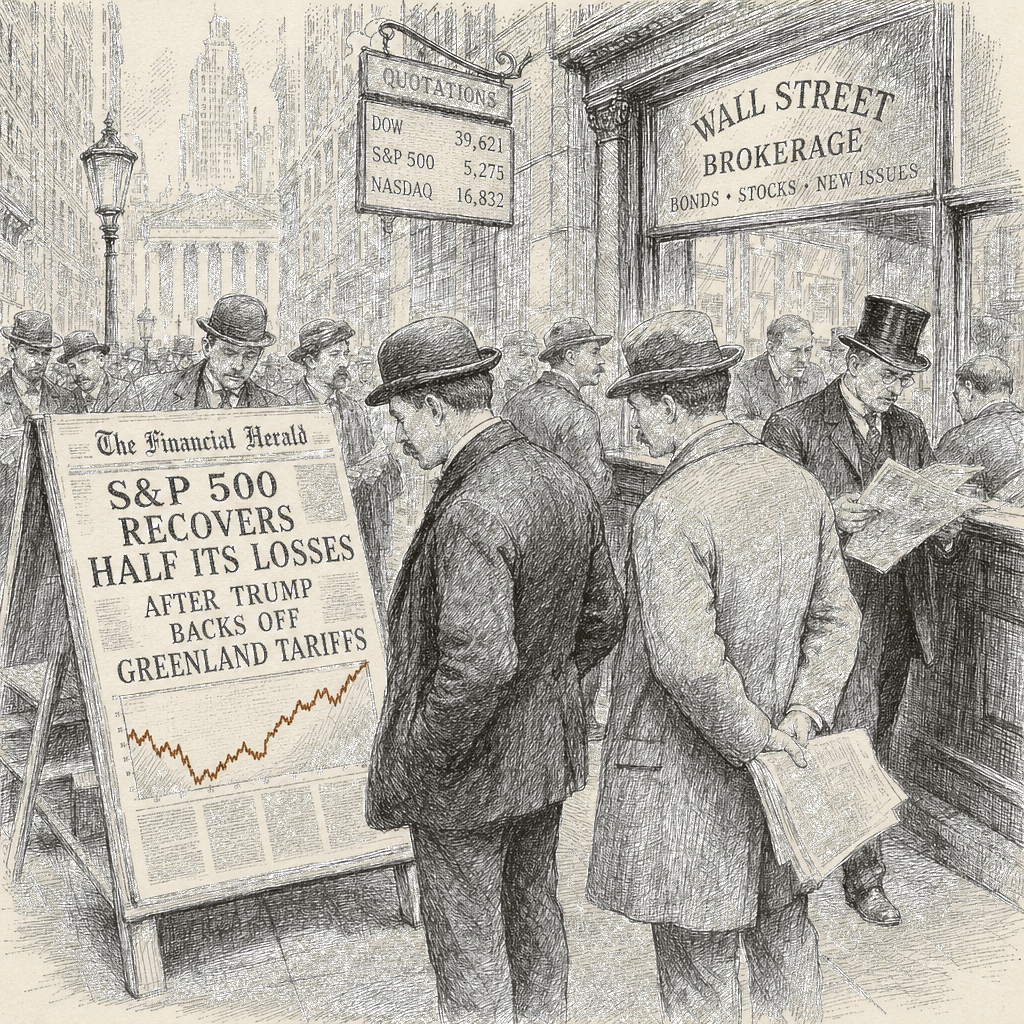
The U.S. stock market bounced back Wednesday after President Donald Trump announced a framework for a deal on Greenland and said he would not impose tariffs on eight European countries he had previously threatened. The S&P 500 rallied 1.2%, recovering just over half of Tuesday’s 2.1% plunge as investors reassessed the likelihood of Trump’s tariff threats translating into actual policy.
The sharp reversal illustrates Wall Street’s recalibration of Trump’s negotiating patterns—treating his tariff announcements as openings in bargaining rather than as finalized policy, with traders increasingly betting that the economic damage from implementation will be limited.
The U.S. stock market bounced back sharply Wednesday after President Donald Trump announced a framework for a deal on Greenland and said he would not impose tariffs on eight European countries he had previously threatened to tax. The S&P 500 rallied 1.2%, recovering just over half of Tuesday’s 2.1% plunge. The Dow Jones Industrial Average jumped 588 points, or 1.2%, and the Nasdaq composite climbed 1.2% to 23,224.82.
The reversal came after two days of turmoil triggered by Trump’s Greenland acquisition threats. On Tuesday, before he signaled openness to backing down, the announcement had sent the market to its worst day since October. Wednesday’s recovery illustrated how financial markets now treat his tariff threats: as opening moves in negotiations rather than finalized policy, with traders calibrating the probability that economic damage will be limited.
“If consummated, will be a great one for the United States of America and its allies in the North Atlantic region,” Trump said of the Greenland framework, according to the AP. The announcement triggered the immediate market rally.
Treasury and currency markets recover
Yields in the bond market eased as investors’ anxiety over trade conflict retreated. The yield on the 10-year Treasury fell to 4.25% from 4.30% the day before, nearly back to where it stood before Trump escalated his Greenland rhetoric. The U.S. dollar, which had weakened the previous day, clawed back some of its losses against other currencies.
Stability also returned to Japan’s volatile government debt market after Prime Minister Sanae Takaichi called a snap election for February 8, capitalizing on strong public support ratings. Japanese long-term bond yields, which had surged to record levels on concerns about fiscal expansion, stabilized. The yield on the 40-year Japanese government bond pulled back to 4.05% after reaching 4.22% the day before. Japan’s Nikkei 225 slipped 0.4%.
Market movers
Halliburton, the oil field services company, rose 4.1% after reporting a stronger profit for the latest quarter than analysts had expected. United Airlines climbed 2.2% following a better-than-expected profit for the final three months of 2025. CEO Scott Kirby said the airline’s strong revenue momentum was continuing into 2026.
Netflix sank 2.2% despite reporting a stronger profit than expected. Investors shifted focus to the company’s slowing subscriber growth and its lower-than-expected profit forecast for the current quarter.
Kraft Heinz fell 5.7% after Berkshire Hathaway warned that it may be interested in selling its 325 million shares in the food company. Berkshire took a $3.76 billion write-down on its Kraft Heinz stake last summer and has signaled displeasure with the company’s strategic direction.
Trump’s negotiating playbook
Trump has a documented history of announcing sweeping tariff threats that send markets lower, then pulling back with deals that prove less disruptive than his initial demands. Wall Street has begun treating these cycles as recurring episodes in a negotiation strategy.
Trump acknowledged the market’s negative reaction to his Greenland rhetoric but dismissed Tuesday’s losses as “peanuts compared to what it’s gone up” since the start of his second term. He predicted the market would rise further in the future.
The pattern has given rise to what some traders call the “TACO” acronym—Trump Always Chickens Out—reflecting market expectations that his most severe tariff threats will not translate into implemented policy.
Human review status: not_triggered.
This article is generated by Main Street Independent’s News Article Generator framework from the Associated Press wire service. License: CC0.