As more space junk crashes back through Earth’s atmosphere, researchers are looking for ways to track uncontrolled objects after they break up—using signals that are already spreading through the ground.
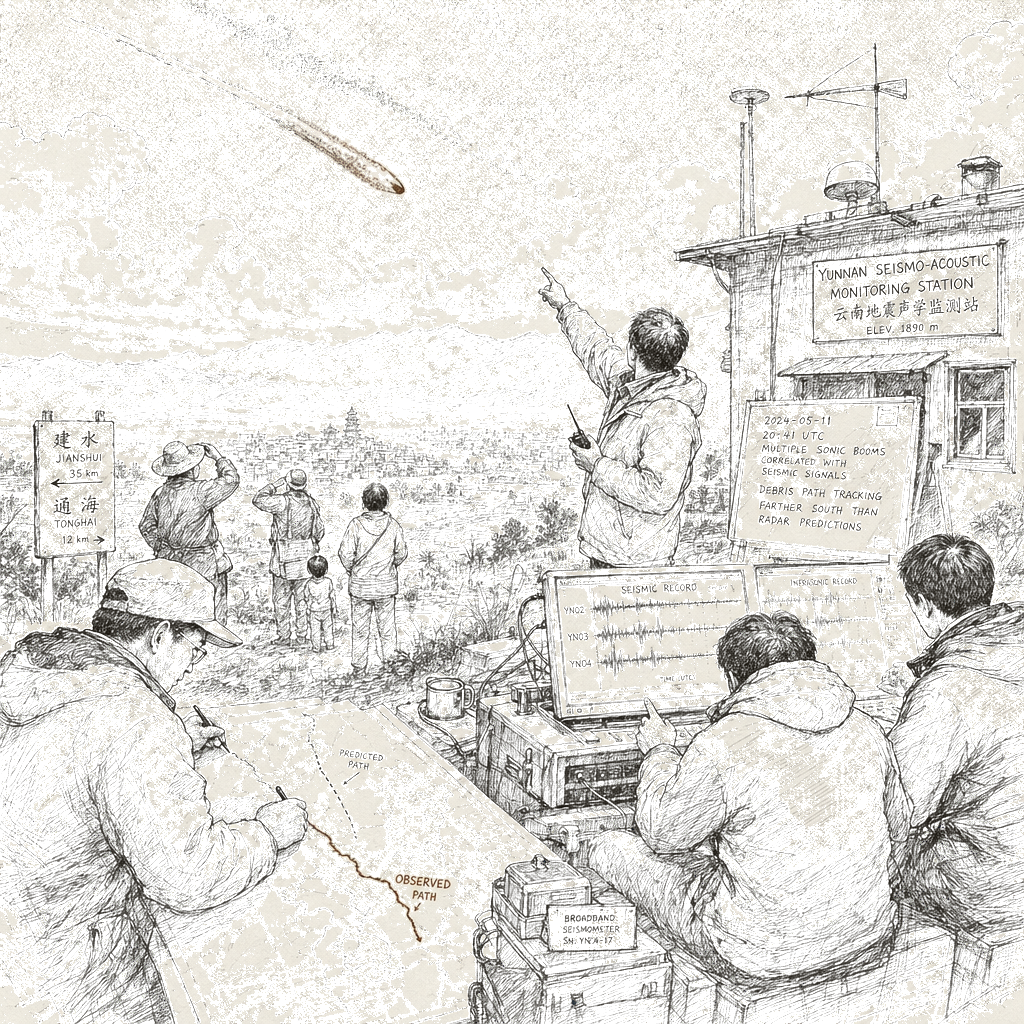
In a new study published in the journal Science, scientists said seismic readings from earthquake monitors captured sonic booms during a 2024 reentry over Southern California. They reported that the seismic data allowed them to place the object’s path nearly 20 miles (30 kilometers) farther south than radar predictions had indicated.
The researchers said that approach could help recovery teams reach surviving fragments more quickly if debris is dangerous. They focused on one debris event, but said they had already used publicly available data from seismic networks to track a few dozen other reentries, including debris from three failed SpaceX Starship test flights in Texas.
Benjamin Fernando, the lead researcher at Johns Hopkins University, said the tracking problem becomes harder once an object starts breaking up in the atmosphere. “The problem at the moment is we can track stuff very well in space,” Fernando said. “But once it gets to the point that it’s actually breaking up in the atmosphere, it becomes very difficult to track.”
Fernando and Constantinos Charalambous of Imperial College London began working together the day after the Chinese debris streaked across the California sky in 2024. Over time, they gathered data from more than 120 seismometers that captured the sonic booms from the reentry, and used that information to plot the object’s suspected path.
The study traced the tracked reentry to a Chinese module that had been cut loose in 2023 after it separated from the Shenzhou-15 capsule returning three Chinese astronauts. The module, described as weighing 1.5 tons (1.36 metric tonnes) and measuring more than 3 feet (1 meter), broke into countless smaller pieces during atmospheric descent, producing multiple sonic booms. Fernando said the seismic readings also offered a sense of the cascading breakup.
Fernando acknowledged a key limitation: with no debris reported on the ground, researchers cannot know how close their predictions were to the actual path. Still, the work aims to narrow estimates of speed and direction—and how the object fragments—within minutes or even seconds.
The researchers said a fast, wider tracking capability could be especially useful in remote regions, where monitoring stations designed for other purposes might detect the sonic booms to fine-tune descent paths. The report also connected the work to plans for space infrastructure changes, saying NASA plans to ditch the International Space Station in five years, and that SpaceX is working on a deorbiting vehicle to ensure a controlled entry.
Fernando said he is looking to publish a catalog of seismically tracked, entering objects and to improve future calculations by factoring in the wind’s effect on falling debris. In a companion Science article, Los Alamos National Laboratory’s Chris Carr, who was not involved in the study, said further research is needed to reduce the time between an object’s final plunge and the determination of its course. Carr said the new method “unlocks the rapid identification of debris fall-out zones,” describing it as key information as Earth’s orbit is expected to become increasingly crowded with satellites.