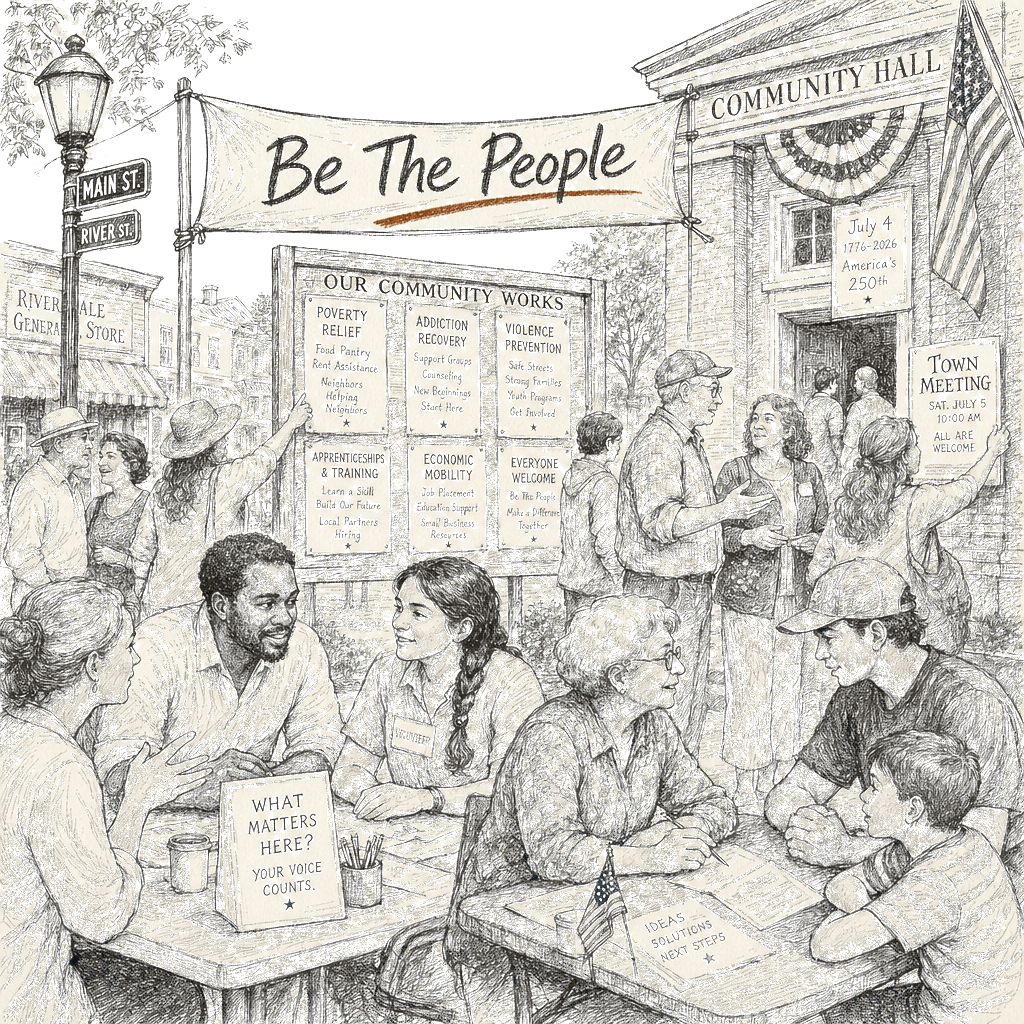
A privately funded initiative called “Be The People” will launch around the nation’s 250th anniversary on July 4, with a first-year budget targeting more than $200 million and a goal of connecting hundreds of millions of Americans with local efforts to address poverty, addiction, violence, and stalled economic mobility.
Brian Hooks, chairman and CEO of Stand Together — a nonprofit network founded by billionaire Charles Koch — leads the campaign, which is backed by 50 philanthropic foundations and individual donors. Hooks said the 250th anniversary is a unique moment “to show people that they matter, that they have a part to play, and that the future is unwritten, but it depends on each one of us stepping up to play our part.”
The initiative will not form as a new nonprofit but will operate as an umbrella banner for existing organizations. Leaders describe it as a 10-year commitment to shift civic behavior and culture, responding to a 2024 Pew Research Center survey that found most Americans in 2023 and 2024 did not believe the country could solve its most important problems.
Hooks called the survey finding a “red alert” for the country.
Founding coalition
Founding members span the nonprofit, corporate, and philanthropic sectors. Among nonprofits, the campaign lists GivingTuesday, Goodwill Industries, Habitat for Humanity, and More Perfect. Businesses include Ron Howard’s Imagine Entertainment and the National Basketball Association. The John D. and Catherine T. MacArthur Foundation is among the philanthropic funders.
Stand Together works across a broad range of issues and has built a role for itself as a convener that brings coalitions together across ideological lines, according to the AP.
On Monday, Martin Luther King III and his wife, Arndrea Waters King, linked their “Realize the Dream” program — which aims to increase acts of service — to the campaign at an Atlanta Hawks game. The Kings said in a written statement: “Our vision is that ‘Be The People’ helps lift up what is already happening in communities across the country and reminds people that service and shared responsibility are defining parts of the American story.”
Beyond traditional volunteering
Hooks said the initiative envisions actions beyond traditional volunteering or service, with roles for businesses and schools. The initiative plans to launch a major data collection effort to track whether people are more engaged and whether problems are actually being solved, he said.
Asha Curran, CEO of GivingTuesday, said collective civic participation tends to reduce polarization. “Our experience with GivingTuesday is that when people volunteer together, when people work together on something to do with positive social impact, they find it harder and harder to demonize each other,” Curran said.
Academic perspectives
Hahrie Han, a political scientist at Johns Hopkins University who has studied civic engagement, said people need authentic opportunities to participate as problem solvers rather than as bystanders. “They’re more likely to be invited into things where people are asked to let professional staff do most of the problem solving and they show up and give their time or their money,” Han said. The result, she said, is that people feel less committed and do not see their participation as advancing their own interests or goals.
Kristin Goss, a professor who directs the Center for the Study of Philanthropy and Voluntarism at Duke University, said a growing number of private foundations have begun funding issues related to the health of U.S. democracy. Goss said funders are growing more concerned about the health of American democracy and the future of pluralism and inclusion. While foundations cannot participate in elections, she said, they can influence policy or public opinion in other ways.
Another group of funders, including the Freedom Together Foundation, launched a project last year to recognize people and groups who stand up for their communities — calling it a “civic bravery” award — and issued a call for funders to invest in helping individuals organize together in response to what they described as a rise in authoritarianism.
The information gap
Hooks said the campaign is assembling major communications teams to ensure that local civic stories reach broader audiences.
“What we’re doing is we’re helping to lift up the story of Americans that is unfolding at the local level, but is not breaking through,” Hooks said. “So we’re holding up a mirror and a microphone to Americans to reveal to each other who we truly are.”