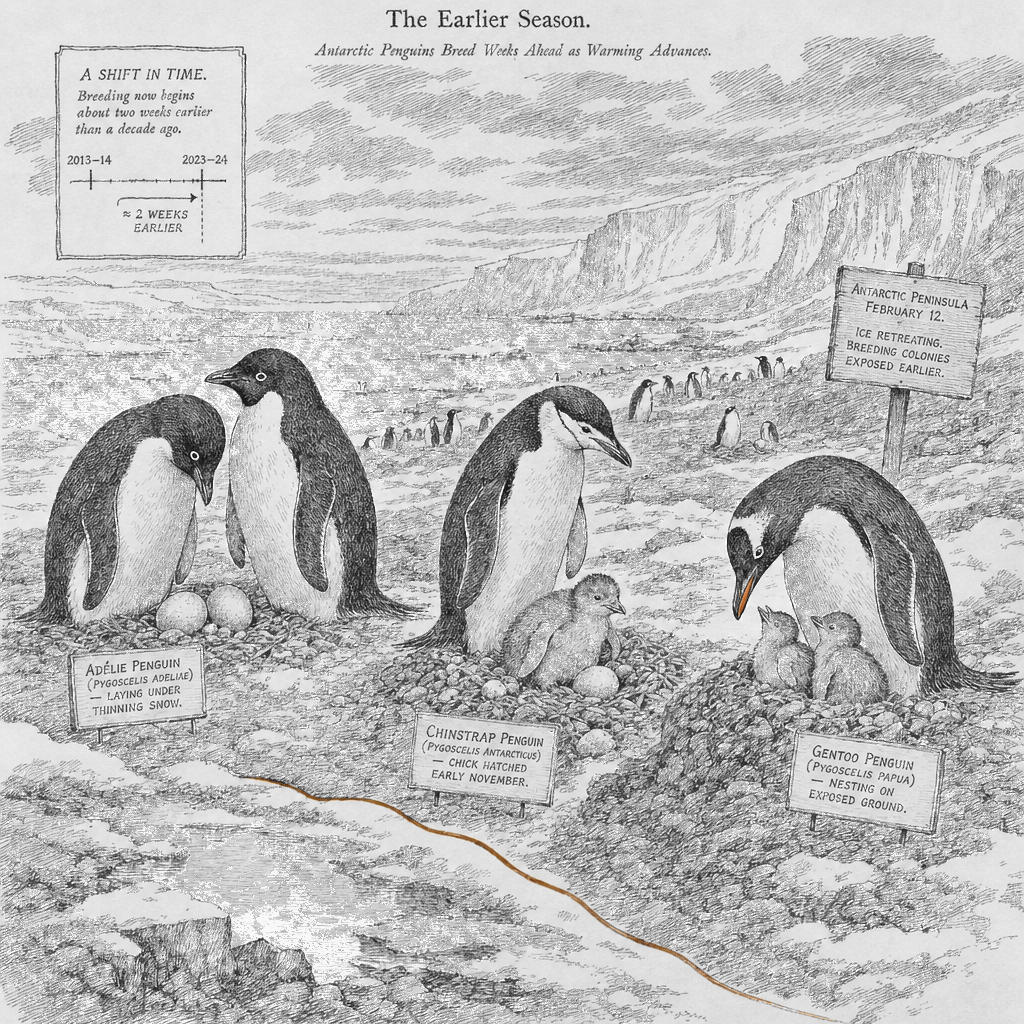
Three Antarctic penguin species are breeding about two weeks earlier than they did a decade ago, driven by rapid warming in one of the world’s fastest-heating regions, researchers reported this week. For two of the species — the chinstrap and Adelie penguins — the timing shift threatens their survival as rising temperatures disrupt the food supply their chicks depend on.
The shift in breeding timing cascades through the penguin ecosystem. Gentoo penguins, more aggressive competitors that don’t migrate as far, now breed simultaneously with chinstraps and Adelies, intensifying competition for limited food. Scientists warn that chinstrap populations may face extinction by century’s end, and Adelies could disappear from the Antarctic Peninsula on the same trajectory.
With temperatures in the Antarctic breeding grounds rising 5.4 degrees Fahrenheit (3 degrees Celsius) from 2012 to 2022, the three brush-tailed penguin species — Adelie, chinstrap, and gentoo — shifted their breeding timelines by roughly two weeks in a single decade, according to a study published Tuesday in the Journal of Animal Ecology.
The Fastest Change Ever Documented
The shift represents the fastest change in life-cycle timing for any vertebrate ever documented, said Ignacio Juarez Martinez, a biologist at Oxford University and the study’s lead author. “Penguins are changing the time at which they’re breeding at a record speed, faster than any other vertebrate,” he said. “And this is important because the time at which you breed needs to coincide with the time with most resources in the environment and this is mostly food for your chicks so they have enough to grow.”
To contextualize the speed of the shift: researchers studying the great tit, a European bird species, found a similar two-week change in breeding timing — but that shift took 75 years. “That took 75 years as opposed to just 10 years for these three penguin species,” said Fiona Suttle, a co-author of the Oxford study.
The earlier warming in western Antarctica — the second-fastest-heating region on Earth after the Arctic North Atlantic — is triggering an earlier bloom of phytoplankton, the base of the food chain that eventually supports penguins. “You have this incredible bloom of phytoplankton,” Martinez explained, which “is the basis of the food chain that eventually leads to penguins.”
When Breeding Overlaps Trigger Competition
Adelies and chinstraps are specialists that eat mainly krill. The gentoos have a more varied diet. These species once bred at different times, avoiding competition. Now, gentoo breeding has shifted earlier faster than the other two species, and the three overlap. Gentoos, which don’t migrate as far and are more aggressive in finding food and establishing nesting areas, are increasingly displacing the other species.
Suttle said she has documented this shift with her own eyes. “I’ve gone back in October and November to the same colony areas where I used to see Adelies in previous years only to find their nests replaced by gentoos,” she said.
Facing Extinction
The outlook for chinstraps and Adelies is dire. “Chinstraps are declining globally,” Martinez said. “Models show that they might get extinct before the end of the century at this rate. Adelies are doing very poorly in the Antarctic Peninsula and it’s very likely that they go extinct from the Antarctic Peninsula before the end of the century.”
Adding to the pressure: commercial fishing has also shifted earlier in response to the changing ecosystem, further shortening the food supply for the penguins, Suttle said.
Documenting Rapid Change
Researchers used a network of 77 remote-control cameras deployed across dozens of penguin colonies from 2011 to 2021 to track the shift. They enlisted help from the public through the Penguin Watch website, where millions of photos were analyzed by citizens. “We’ve had over 9 million of our images annotated via Penguin Watch,” Suttle said. “A lot of that does come down to the fact that people just love penguins so much.”
Michelle LaRue, a professor of Antarctic marine science at the University of Canterbury in New Zealand who was not part of the study, said the findings warrant close monitoring. “This shift in breeding timing is an interesting signal of change and now it’s important to continue observing these penguin populations to see if these changes have negative impacts on their populations,” she said.