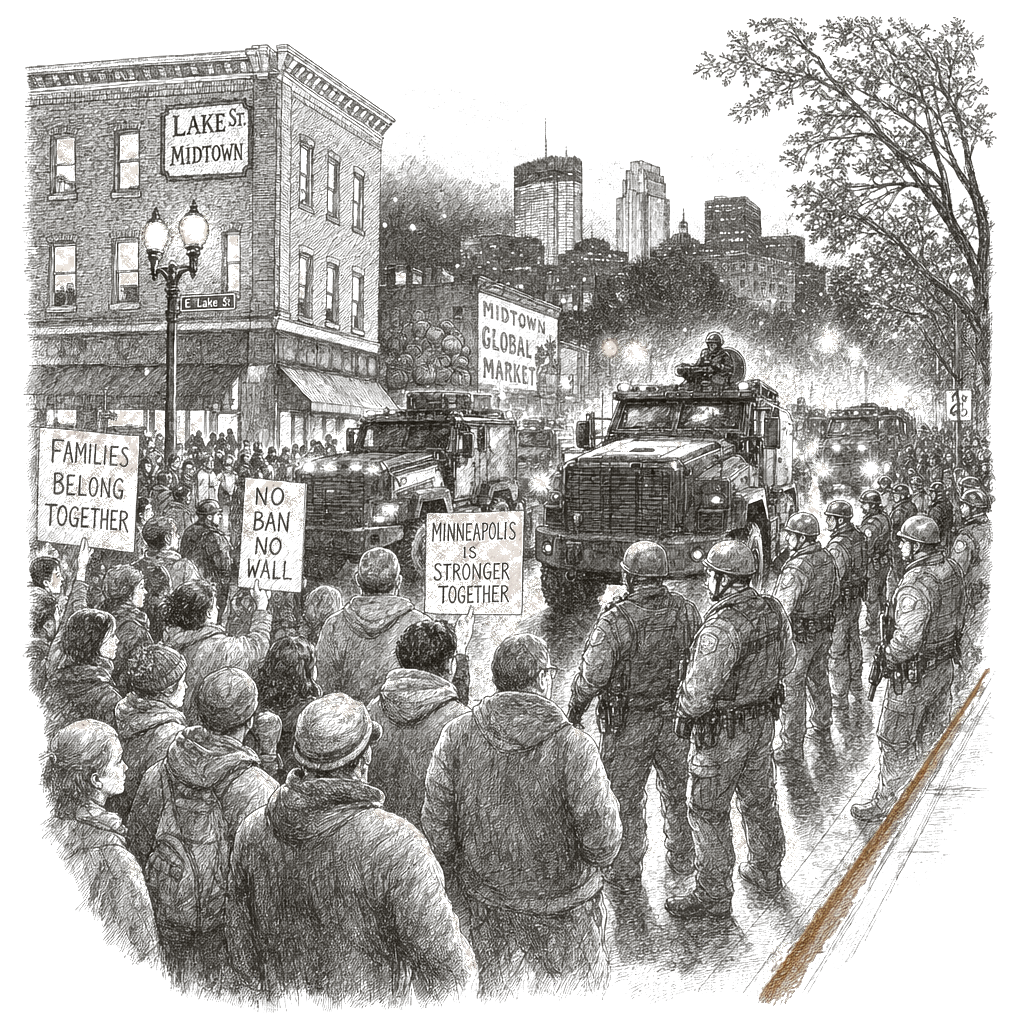
A daily rhythm of enforcement and protests in the Twin Cities
Federal officers carrying out a Trump administration immigration crackdown in and around the Twin Cities have been starting work around sunrise, with hundreds of officers in tactical gear emerging from a bland office building near the main airport, the Associated Press reported. Within minutes, unmarked convoys made up of SUVs, pickup trucks and minivans begin leaving, and the convoys have become a feared and common sight on streets in Minneapolis, St. Paul and surrounding suburbs.
Protesters have also been arriving early. AP described crowds standing across the street from a fenced-in federal compound that houses an immigration court and government offices, where they shout “Go home!” and “ICE out!” as convoys pass. AP reported that confrontations sometimes intensify after nightfall, when convoys return and protesters shake fences and occasionally smack passing cars.
Tear gas and flash grenades during clashes
AP said that after those confrontations heat up at night, federal officers march toward protesters and fire tear gas and flash grenades before hauling away at least a few people. In one quoted account from a recent morning, AP reported a woman shouting, “We’re not going anywhere!” and “We’re here until you leave.”
The AP report portrayed the operation as a pattern that is repeating daily. AP described it as Operation Metro Surge, the administration’s “latest and biggest crackdown yet,” involving more than 2,000 officers. The surge has also drawn city and state officials into direct conflict with the federal government, AP said, and has sparked repeated clashes between activists and immigration officers in Minneapolis and other deeply liberal parts of the region.
Uneven impact across neighborhoods, officials say
The AP account said the crackdown has been less noticeable in some parts of the metro area, especially in whiter, wealthier neighborhoods and suburbs, where convoys and tear gas are rarer. Even in areas where masked immigration officers are more common, AP said they often move quickly—making arrests and disappearing before protesters can gather in force.
Minneapolis Mayor Jacob Frey, a Democrat, told reporters in AP’s account that his police force has just 600 officers and described what he said federal enforcement teams were bringing into the city. AP quoted Frey as saying, “What we are seeing is thousands — plural, thousands — of federal agents coming into our city.”
Disruptions spread in immigrant neighborhoods
AP said the surge’s effect has spread across broad swaths of the Twin Cities area, which it described as home to more than 3 million people. It also reported that travel times amplify the daily confrontations, with AP saying it takes 15 minutes to cross Minneapolis compared with hours to drive across Los Angeles and Chicago, both targets of Trump administration crackdowns.
As concern has rippled through the region, AP reported that children have been skipping school or learning remotely, families have avoided religious services, and some businesses—especially in immigrant neighborhoods—have closed temporarily. AP described day-to-day closures and security measures, including that La Michoacana Purepecha had its door locked with staff letting people in one at a time.
AP also described signage indicating temporary closures and restrictions: Taqueria Los Ocampo posted that it was closed because of “current conditions,” and at Karmel Mall, doors displayed “No ICE enter without court order.”
The aftermath of a deadly confrontation
The AP report connected the crackdown’s tensions to recent violence in Minneapolis tied to immigration enforcement. It said the killing of George Floyd in Minneapolis was nearly six years ago, but that residents still have “raw” scars from that era. AP then described a separate Jan. 7 confrontation in which an Immigration and Customs Enforcement officer shot and killed Renee Good, a 37-year-old American citizen, after she stopped to help neighbors during an enforcement operation.
Federal officials, according to AP, said the officer fired in self-defense after Good “weaponized” her vehicle. City and state officials dismissed those explanations and pointed to multiple bystander videos of the confrontation, AP said.
Community reactions and calls for help
AP reported that Johan Baumeister, who came to the scene of Good’s death to lay flowers, said “Enough is enough.” AP also described him as predicting further unrest, quoting Baumeister saying, “I think they’ll see Minneapolis show our rage again.”
AP said clashes between activists and immigration officers have continued since Good’s death, and it described how confrontations can range from insults and taunting to more serious incidents. AP reported that some protesters tried to provoke federal officers by throwing snowballs at them or shouting obscenities at close range through bullhorns, while it also described serious force coming from immigration officers, including breaking car windows, pepper-spraying protesters, and warning observers not to follow them through the streets.
The AP report said immigrants and citizens have been removed from cars and homes and detained, sometimes for days, and that most clashes ended with tear gas.
In addition to protests, AP described an organized effort by residents and community groups to reduce harm and provide support. It quoted Gov. Tim Walz, a Democrat and regular Trump target, urging people to help their communities and to remain peaceful as demonstrations continue. AP quoted Walz as saying, “It might be shoveling your neighbor’s walk,” and “It might mean being at a food bank.”
AP reported that Walz and other leaders pleaded with protesters to remain peaceful, warning that the White House was looking for a chance to crack down harder. It also described residents handing out bottled water so people could flush tear gas from their eyes and standing watch at schools to warn immigrant parents if convoys approached while they were picking up children.
Food aid and detentions after traffic stops
AP described one example of community aid on Thursday in St. Paul. It said Open Market MN assembled food packs in the basement of a Lutheran church for more than a hundred families staying home, and that Colin Anderson, the group’s outreach director, said the group had seen a surge in requests.
AP also included a personal account from Christian Molina, a suburban Coon Rapids resident who said he was driving through a Minneapolis neighborhood when immigration officers began following him. AP reported Molina’s suspicion that the officers were doing so because he looks Hispanic. AP said he refused to provide papers when asked after the officers sped up, hit his rear bumper and both cars stopped, and that a clash followed that ended with tear gas.
After the officers left, AP reported Molina was left worried about damage to his car and asked, “Who’s going to pay for my car?”
This story has been updated to correct the name of the Immigration and Customs Enforcement agency.
Associated Press reporters Rebecca Santana and Giovanna Dell’Orto in Minneapolis, and Hallie Golden in Seattle, contributed to this story.