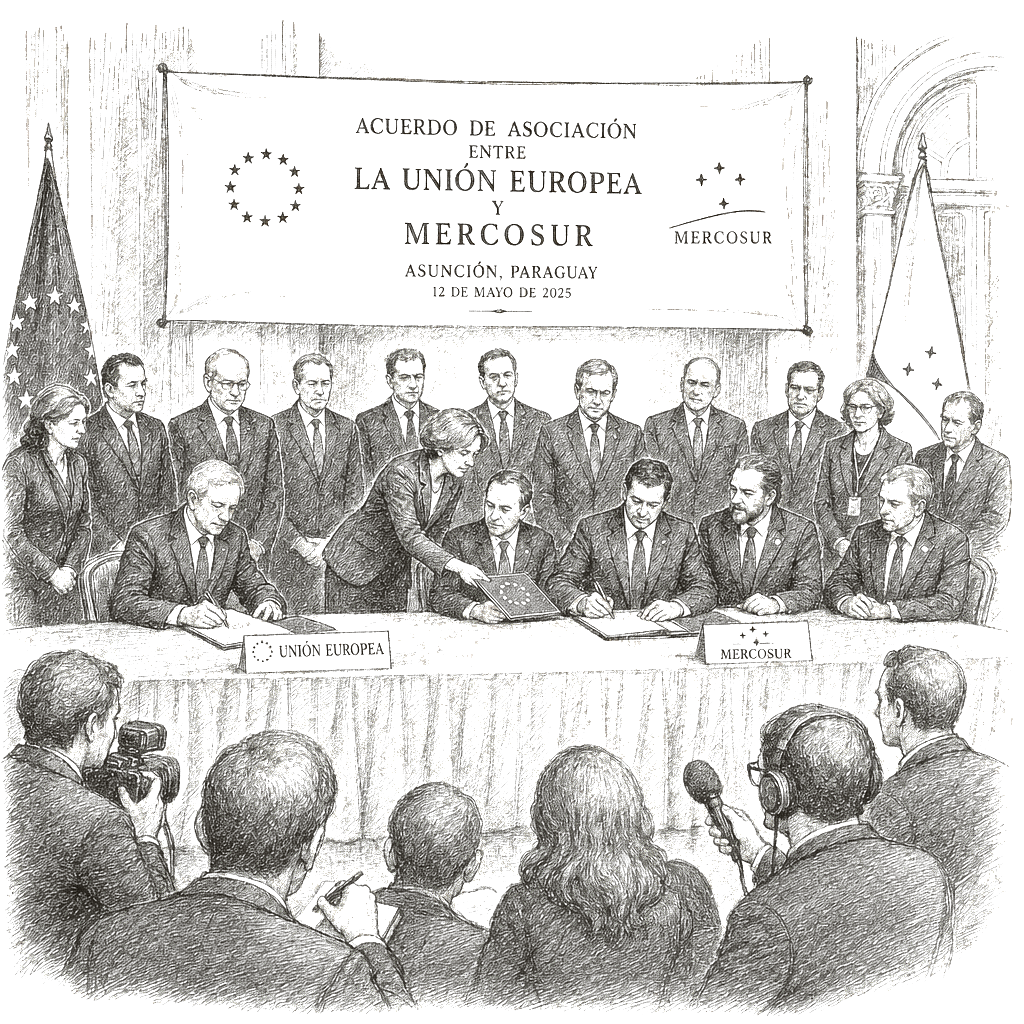
Signing in Asuncion as EU-Mercosur trade ties advance
The European Union and the Mercosur bloc of South American countries formally signed a long-sought free trade agreement Saturday in Paraguay’s capital, Asuncion, according to the Associated Press. The signing ceremony marked the culmination of more than a quarter-century of negotiations between the trading blocs.
The agreement would still need additional political steps before it can take effect. The European Parliament must ratify the deal, a process the AP said is considered all but guaranteed in South America, where the accord has broad support.
Who is in Mercosur—and who is not
Mercosur includes Argentina, Brazil, Paraguay and Uruguay. Bolivia, described as the bloc’s newest member, is not included in the trade deal, and Venezuela has been suspended from the bloc and is also not included.
The AP described the agreement as a major commercial expansion for both regions, supported by South America’s cattle-raising countries and European industrial interests.
Tariffs set to drop across a wide range of goods
The accord would gradually eliminate more than 90% of tariffs on goods traded between the blocs, with the AP listing examples from Argentine beef to German cars. The AP also said the agreement would create one of the world’s largest free trade zones, with shopping benefits for more than 700 million consumers.
EU leaders frame the deal against tariffs and isolation
European Commission President Ursula von der Leyen, who heads the EU’s executive branch, portrayed the signing as a bulwark against protectionist policies and trade tensions around the world.
In remarks at the ceremony, von der Leyen said, “We choose fair trade over tariffs. We choose a productive long-term partnership over isolation,” in an apparent rebuke to U.S. President Donald Trump. She added, “We will join forces like never before, because we believe that this is the best way to make our people and our countries prosper.”
The AP reported that the White House did not immediately respond to a request for comment.
Lula hails the accord but does not attend
Brazilian President Luiz Inácio Lula da Silva, a longtime advocate of the agreement, hailed it as a win for global cooperation. On X, the AP said Lula wrote, “At a time when unilateralism isolates markets and protectionism inhibits global growth, two regions that share democratic values and a commitment to multilateralism choose a different path.”
The AP reported that Lula skipped the signing ceremony, a decision the article described as signaling simmering tensions between the trading blocs.
Farmers and European Parliament approval remain key hurdles
The AP said the final push for the deal faced scrutiny from European agricultural interests, particularly fears among farmers about increased competition from lower-priced imports. It said France remains opposed to the accord, with President Emmanuel Macron worrying that farmers’ frustration with the EU could boost support for the far right in the 2027 presidential election.
EU trade commissioner Maroš Šefčovič told the AP he would begin lobbying Monday to secure European Parliament support. He said the effort would be “very intense” at both group and individual levels and expressed confidence that “everyone will do the procedures as quickly as possible so we can benefit from this historic achievement.” The AP reported that Šefčovič aimed for the deal to be passed in the first half of this year.
In a broader message about international rules, Šefčovič said the agreement sent the signal that, “if someone prefers and believes in high tariffs and power politics, Mercosur and European countries representing more than 700 million people clearly believe in … international law, predictability, certainty and the removing of trade barriers.”
Negotiations lengthened by agricultural regulatory demands
The AP said one reason the agreement took so long to clinch was Brussels’ demand for controls on agricultural processes in South America, including deforestation regulation and rules on plastic packaging. European farmers had argued that they could not compete if their South American counterparts were held to lower standards.
Agathe Demarais, a senior policy fellow with the European Council on Foreign Relations, told the AP that the EU’s approach is often perceived differently: “The EU’s maximalist wish lists of demands from developing economies willing to sign free trade agreements are often perceived as patronizing,” she said.
Milei backs free trade after earlier skepticism
The AP described the deal as part of a revival for Mercosur, after years of political disputes and economic disruptions. It also highlighted the shift in Argentina’s stance under President Javier Milei, who took office in late 2023 after previously criticizing Mercosur as a “prison,” threatening to withdraw, and skipping a 2024 summit.
At Saturday’s signing, the AP reported Milei said, “Argentina understands firsthand that closure and protectionism, sheltered by rhetoric rather than results, are the greatest causes of economic stagnation,” as he backed the agreement.