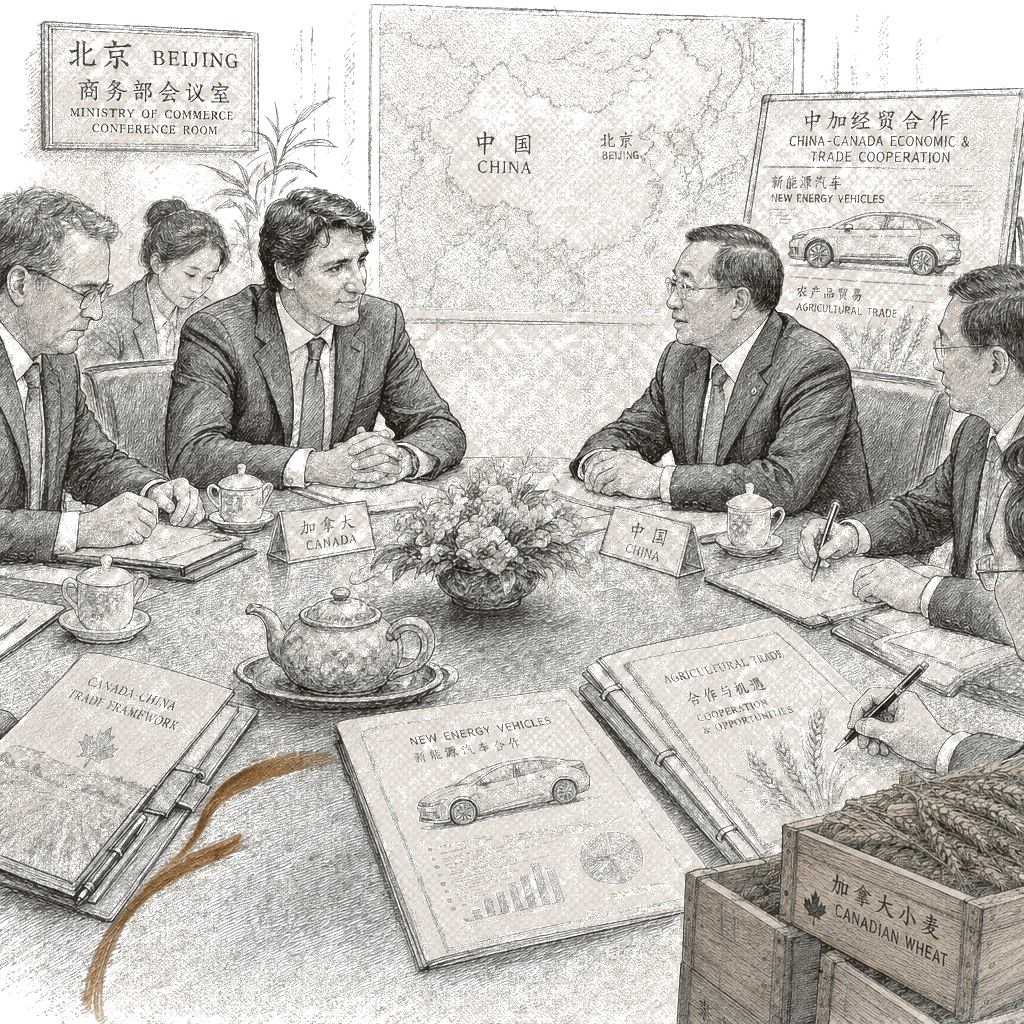
Prime Minister Mark Carney said Canada will cut its 100% tariff on Chinese electric vehicles in exchange for lower tariffs on Canadian farm products, following two days of meetings with Chinese leaders in Beijing.
Carney announced the terms on Friday, saying there would be an initial annual cap of 49,000 Chinese EVs entering Canada at a tariff rate of 6.1%. He said the cap would rise to about 70,000 over five years, and that China would reduce its tariff on canola seeds from 84% to about 15%.
“The relationship has progressed in recent months with China. It is more predictable and you see results coming from that,” Carney said. He also said “this agreement will drive considerable Chinese investment in Canada’s auto sector, creating good careers in Canada and accelerating our progress toward a net zero (emissions) future and the auto industry of the future.”
The announcement came as Canada breaks with the United States on tariffs tied to electric-vehicle and other trade issues. Carney said he had not been able to reach a deal with U.S. President Donald Trump to reduce some tariffs that he said were punishing key sectors of the Canadian economy. Trump, in turn, commended Carney for making a deal with Beijing.
Trump said, “Well, it’s OK. That’s what he should be doing and it’s a good thing for him to sign a trade deal. If you can get a deal with China, you should do that.” U.S. Trade Representative Jamieson Greer later told CNBC that Canada’s decision allowing Chinese EV imports at a low tariff was “problematic,” and that Canada may regret it in the long term.
Carney’s talks with Xi Jinping included a meeting at Beijing’s Great Hall of the People. Xi told Carney that he is willing to continue working to improve ties, and Xi said talks on restoring and restarting cooperation had been under way since their initial meeting in October on the sidelines of a regional economic conference in South Korea.
Carney said he raised improving global governance with Xi, telling the Chinese leader that it is “under great strain.” Later at a news conference, Carney said the system may give way at least in part to country-to-country or regional agreements instead of global ones, saying: “The question is: What gets built in that place? How much of a patchwork is it?”
The AP report said Canada had followed the U.S. in putting tariffs of 100% on EVs from China and 25% on steel and aluminum under former Prime Minister Justin Trudeau. China responded with duties of 100% on Canadian canola oil and meal and 25% on pork and seafood, and the report said China added a steep tariff on canola seeds last August. The report also said overall China’s imports from Canada fell 10.4% last year to $41.7 billion, citing Chinese trade data.
Carney sought to address concerns from Canadian automakers and auto workers by saying the initial cap on Chinese EV imports was about 3% of the 1.8 million vehicles sold in Canada annually. He said China is expected to begin investing in Canada’s auto industry within three years.
In Ontario, the province where Canada’s auto sector is based, Premier Doug Ford criticized the agreement. Ford posted on social media that the deal would give China “a foothold in the Canadian market” and that China “will use it to their full advantage at the expense of Canadian workers.” Ford also said lowering tariffs on Chinese electric vehicles “risks closing the door on Canadian automakers to the American market, our largest export destination.”
Outside government, a Canadian business owner in China, Jacob Cooke, said Carney’s visit was game-changing because it reestablishes dialogue, respect and a framework between the countries. “These three things we didn’t have,” Cooke said, adding that “the parties were not talking for years.”
Analyst Nelson Wiseman, professor emeritus of political science at the University of Toronto, called the deal good for both China and Canada, saying Canada is diversifying its bets economically while China is succeeding in driving “a small wedge between Canada and the U.S.”
Carney left China on Saturday and was scheduled to visit Qatar on Sunday before attending the annual gathering of the World Economic Forum in Davos, Switzerland next week, his office said.