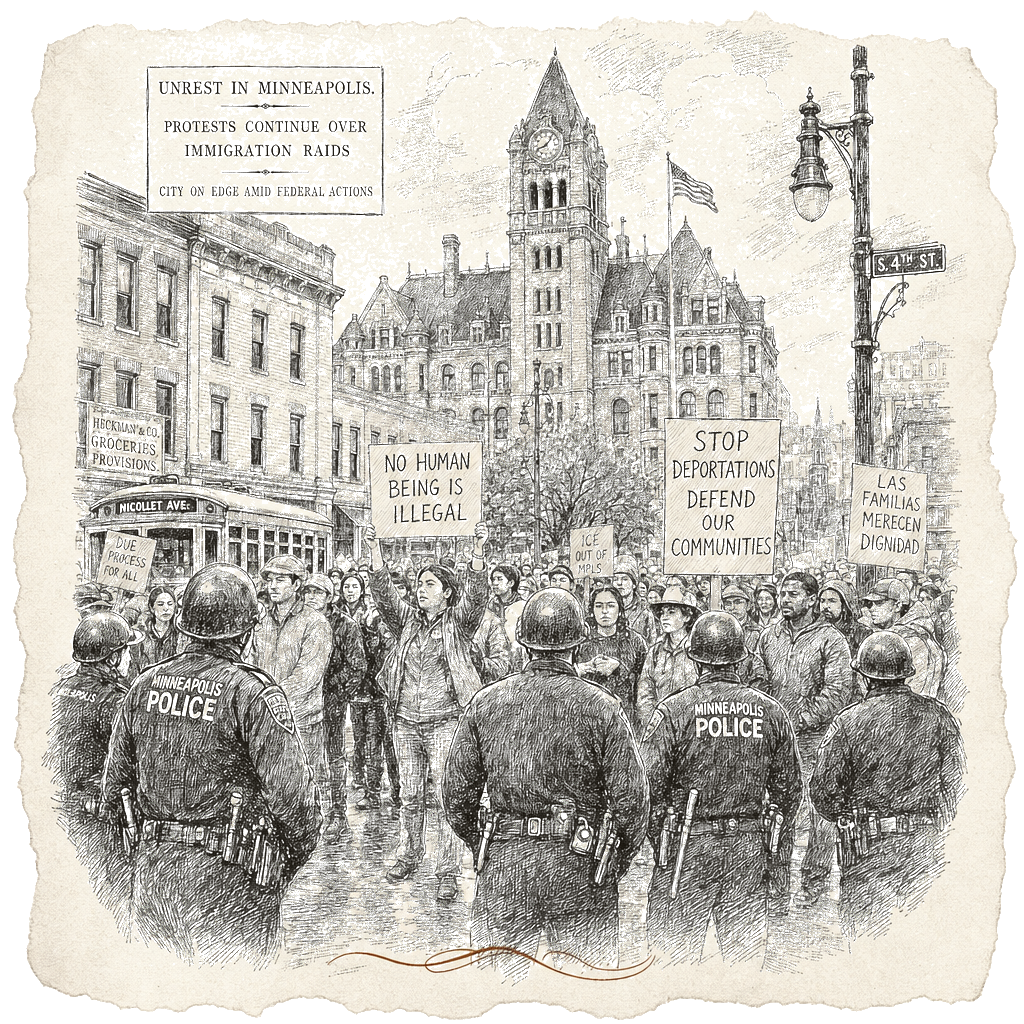
President Donald Trump threatened Thursday to invoke the Insurrection Act and deploy troops to quell protests in Minneapolis tied to federal immigration enforcement. The threat came a day after a man was shot and wounded by an immigration officer, following an attack with a shovel and a broom handle, Associated Press reported.
The Minneapolis protests have grown since Immigration and Customs Enforcement agent Renee Good was fatally shot in the head Jan. 7. AP said the later shooting heightened fear and anger in the city.
Trump has repeatedly threatened to use the Insurrection Act, a rarely used 1807-era law, to deploy the U.S. military or federalize the National Guard for domestic law enforcement over the objections of state governors. AP noted that Trump made similar threats in 2020 after George Floyd was killed and in recent months for immigration protests.
In a social media post, Trump said, “If the corrupt politicians of Minnesota don’t obey the law and stop the professional agitators and insurrectionists from attacking the Patriots of I.C.E., who are only trying to do their job, I will institute the INSURRECTION ACT, which many Presidents have done before me, and quickly put an end to the travesty that is taking place in that once great State.”
Minnesota officials criticized the prospect of federal intervention. Gov. Tim Walz said on X, “I’m making a direct appeal to the President: Let’s turn the temperature down. Stop this campaign of retribution. This is not who we are,” AP reported. Minnesota Attorney General Keith Ellison said he would challenge any such action in court.
Ellison is already suing to try to stop the Department of Homeland Security’s “Metro Surge” operation, which the agency says has resulted in arrests of more than 2,500 people since Nov. 29. AP said the operation grew in early January when ICE sent 2,000 officers and agents to the area.
At protests Thursday night, demonstrators gathered at a federal building used as a base for the crackdown and yelled “shame on you” at officers guarding the facility. AP said Thursday’s gathering was slightly more subdued than the prior night, after Walz and Minneapolis Mayor Jacob Frey implored protesters to remain peaceful. Frey said Wednesday, “This is an impossible situation that our city is presently being put in and at the same time we are trying to find a way forward to keep people safe.”
The legal challenge has also expanded beyond the state. The American Civil Liberties Union of Minnesota filed a class-action lawsuit on behalf of three people who said they were questioned or detained in recent days. The suit alleges that two are Somali and one is Hispanic, and that all three are U.S. citizens, and it seeks an end to what the ACLU describes as racial profiling and warrantless arrests. AP said the government did not immediately comment.
In related developments, Homeland Security said federal officers on Wednesday stopped a driver from Venezuela who is in the U.S. illegally. AP said the person drove off, crashed into a parked car, and then fled on foot. Officers caught up, Homeland Security said, and two other people arrived; the three then attacked an officer.
Homeland Security said the officer fired a defensive shot: “Fearing for his life and safety as he was being ambushed by three individuals, the officer fired a defensive shot to defend his life,” AP reported. The confrontation took place about 4.5 miles (7.2 kilometers) from where Good was killed, Homeland Security said, and AP reported that Minneapolis Police Chief Brian O’Hara said the man who was shot did not have a life-threatening injury.
AP said the FBI reported that several government vehicles were damaged and that property inside was stolen when agents responded to the shooting. Photos described in the report showed broken windows and insults made with paint, and the FBI offered a reward of up to $100,000 for information. AP said the FBI’s Minneapolis office did not immediately reply to messages seeking more details.
Separately, school districts announced changes amid the unrest. AP said St. Paul Public Schools, with more than 30,000 students, would begin offering an online learning option for students who do not feel comfortable coming to school, and that schools would be closed next week until Thursday to prepare for accommodations. Minneapolis Public Schools offered temporary remote learning, and AP said the University of Minnesota would start a new term next week with different options depending on the class.
Madhani reported from Washington, and Golden from Seattle.