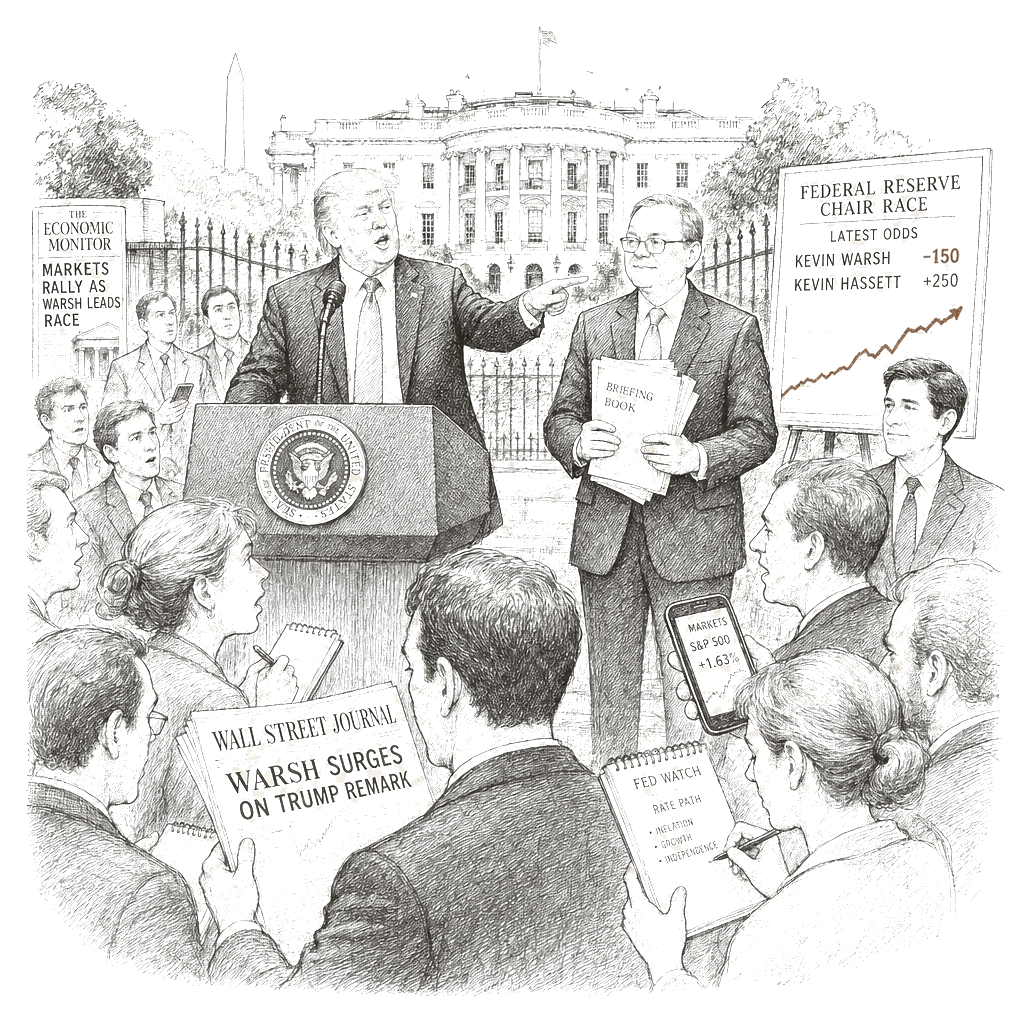
The Fed chair selection carries heightened stakes: the Justice Department’s criminal subpoenas of Powell have deepened Senate concerns about central bank independence, and the ideological gap between Warsh — historically a monetary policy hawk who favors higher interest rates — and Hassett, who is closer to Trump’s preference for lower borrowing costs, could shape U.S. monetary policy for years.
President Donald Trump said Friday he would like to keep Kevin Hassett, his top economic adviser, at the White House rather than nominate him to lead the Federal Reserve — an offhand remark at a public event that upended months of expectations around the search for one of the most powerful financial appointments in the world.
“I actually want to keep you where you are, if you want to know the truth,” Trump said at the White House event when he spotted Hassett, director of the National Economic Council, in the audience. “I just want to thank you, you were fantastic on television the other day.”
The comment, while not clearly definitive, immediately boosted the prospects of Kevin Warsh, a former Federal Reserve governor and already a top contender for the position.
Hassett had led the field
Hassett had been widely seen as the front-runner to replace chair Jerome Powell because he has worked for Trump since his first presidential term. Last month, Trump described Hassett as a “potential Fed chair.”
Powell’s term as chair is set to expire May 15, though he could take the unusual step of remaining on the Federal Reserve board as a governor afterward. Trump appointed Powell in 2018 but later soured on him after the Fed raised its key interest rate that year.
DOJ subpoenas complicated confirmation calculus
Trump’s remarks came days after the Justice Department’s subpoenas of the Federal Reserve drew an unusually direct public video statement from Powell himself, who charged that the subpoenas were essentially punishment for the central bank’s refusal to lower interest rates as sharply as Trump would like. The subpoenas, revealed the previous Sunday, relate to testimony Powell gave before the Senate Banking Committee that touched on a $2.5 billion building renovation project.
The criminal investigation — a first for a sitting Fed chair — drew pushback on Capitol Hill. Many Republican senators dismissed the idea that Powell could have committed a crime.
Analysts said the backlash intensified Senate concerns that the Trump administration is seeking to undermine the Fed’s independence from day-to-day politics, and that it diminished Hassett’s confirmation prospects specifically.
“Making it harder to confirm Hassett, who is distinctively close to the president,” Krishna Guha, an analyst at investment bank Evercore ISI, wrote in a client note. “Warsh is trusted by Senate Republicans and would be much easier to confirm.”
Warsh’s record as a rate hawk
Warsh is historically known as a monetary policy “hawk” — someone who traditionally supports higher interest rates to ward off inflation — as opposed to a “dove,” who prefers lower borrowing costs to spur hiring and economic growth.
The distinction carries practical weight: Trump has repeatedly pushed for lower interest rates, and Hassett has been seen as more aligned with that preference.
Bond markets appeared to reprice the race Friday. The 10-year Treasury yield stood at 4.17%, according to FRED data for January 16 — a level analysts said reflected growing expectations that a Warsh-led Fed would be less likely over time to cut rates than one led by Hassett.