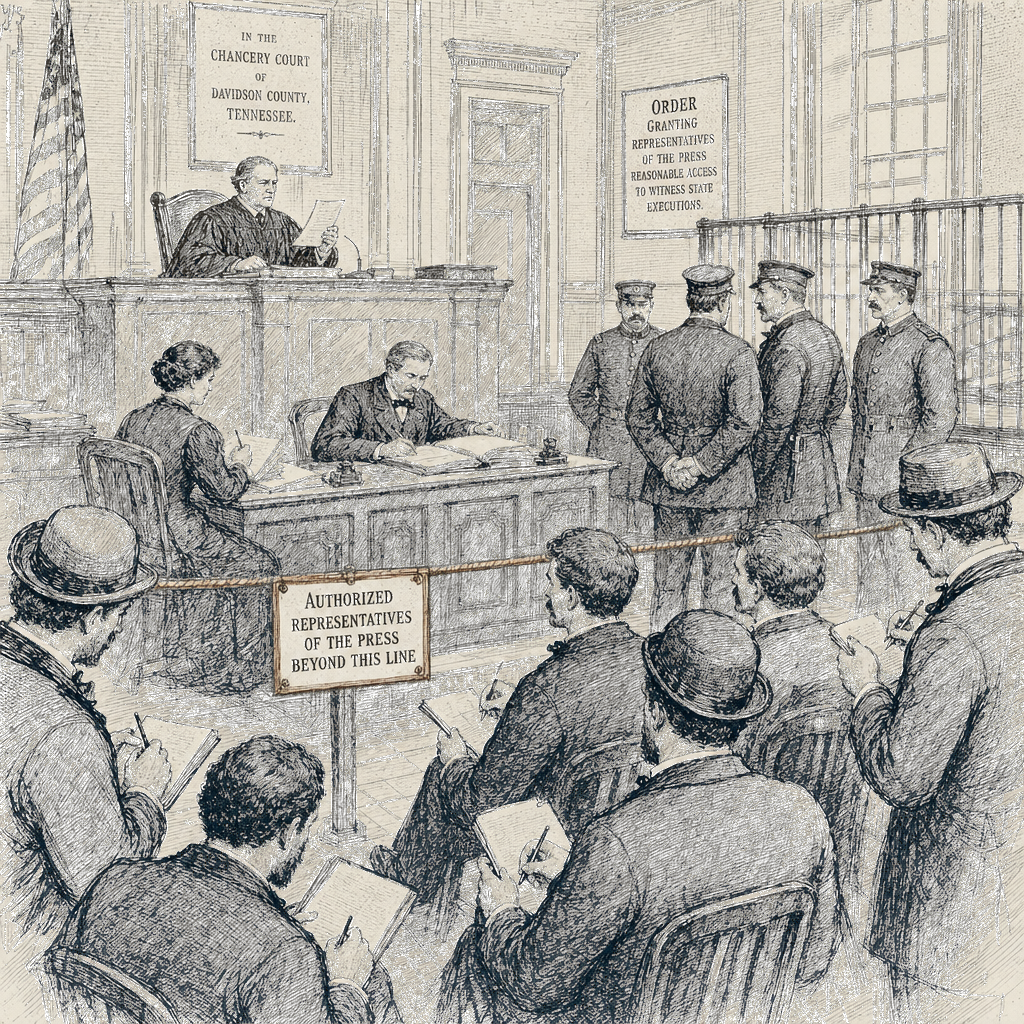
A Tennessee judge on Friday ordered prison officials to grant expanded access to members of the media who witness state-run executions, following a lawsuit filed by a coalition of news organizations that included The Associated Press.
Chancellor I’Ashea L. Myles’ ruling addressed how much reporters could observe lethal injection executions, after prosecutors and prison officials had allowed viewing only during a limited period. The court said the order granted a temporary injunction allowing media members and other witnesses to see most of the execution process, with security procedures in place for execution staff.
Myles’ order came after the coalition sued Tennessee prison officials, arguing that execution protocols unconstitutionally limit what the public and the press can witness. The lawsuit sought a judgment that the protocols are unconstitutional and an injunction requiring the press to see the full execution process, “from the time the condemned enters the execution chamber until after the condemned is declared dead.”
The coalition filed the case in Davidson County Chancery Court in Nashville and named Kenneth Nelsen, the warden of Riverbend Maximum Security Institution in Nashville that houses Tennessee’s execution chamber, and Frank Strada, Tennessee Department of Correction commissioner, as defendants.
The Associated Press reported that it requested comment from the department after hours Friday to a department spokesperson, and the department did not immediately respond. The story also described how, during previous executions, media witnesses began seeing the process only after the condemned person was already strapped to a gurney and connected to IV lines.
In those earlier access arrangements, the coalition said media members did not know the precise moment injections began because the administering team was in a separate room. The protocols described in the reporting also set out steps for how viewing was limited: after syringes of saline and pentobarbital are administered, a team leader signals to the warden and a five-minute waiting period begins; afterward, blinds are closed and the camera is turned off; then a doctor comes in to determine if the person is dead.
If the doctor determines the person is dead, the warden announces via intercom that the sentence was carried out, and witnesses are directed to exit. The Associated Press reported that those arrangements effectively gave witnesses a 10 to 15 minute window to observe.
Prison officials argued that the First Amendment does not provide the press a right to special access to information not regularly available to the public, and they said the restrictions were necessary because allowing full viewing would endanger prison security and people involved in the process.
In his order, Myles required security steps for the execution team, stating that team members must wear disposable protective suits that cover their regular work uniform, identification badge and hair. The order also said team members will be offered a mask to further conceal their identity should they choose to wear one.
For viewing access, Myles ordered that during lethal injection executions, curtains to the official witness room must open to the execution chamber at 10 a.m., the reported protocols’ time for when an inmate is secured with restraints on a gurney and the IV insertion process begins, and that the curtains must remain open until the pronouncement of death.
Myles wrote, “This Court finds that a meaningful and full observation of executions allows the public to assess whether the state carries out death sentences in a lawful and humane manner and ensures that the execution process remains subject to democratic oversight.”
The Associated Press reported that, in addition to AP, the media coalition includes Gannett Co., Inc.; Nashville Public Media, Inc.; Nashville Public Radio; Scripps Media, Inc.; Six Rivers Media, LLC; and TEGNA INC.