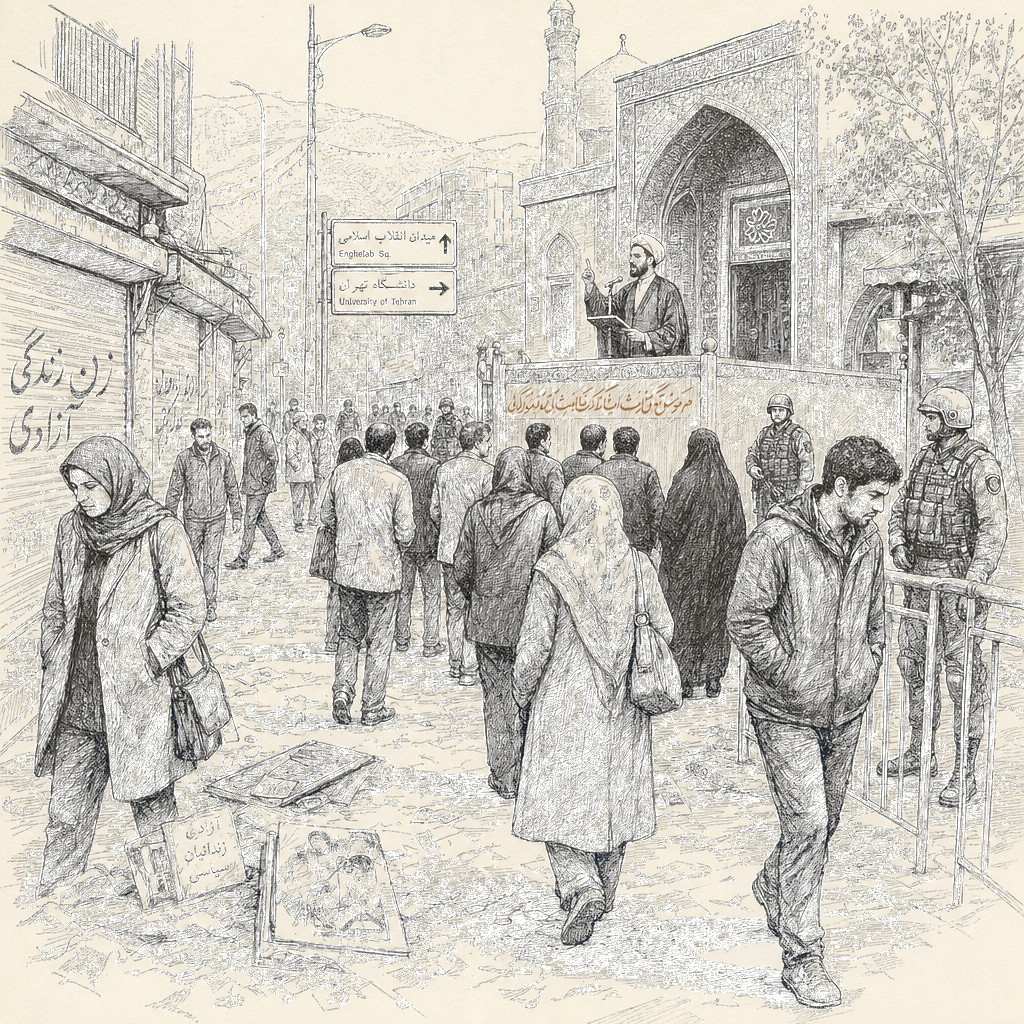
Uneasy calm in Iran follows protests and crackdown
Iran appeared to return to uneasy calm after a wave of protests that began Dec. 28 over the country’s ailing economy and later widened into demonstrations challenging the theocracy, the Associated Press reported on Jan. 16.
The AP said there were no signs of protests for days in Tehran, where shopping and street life had resumed, though a week-old internet blackout continued. The outlet added that Iranian authorities had not reported unrest elsewhere in the country.
Khatami calls for executions and threatens Trump
In remarks carried by Iranian state radio, a senior hard-line cleric, Ayatollah Ahmad Khatami, called for the death penalty for detained demonstrators and directly threatened U.S. President Donald Trump, according to the AP.
As chants rose during prayers, protesters and attendees called for “Armed hypocrites should be put to death!” The AP reported that Khatami described demonstrators as the “butlers” of Benjamin Netanyahu and “Trump’s soldiers,” and he told Netanyahu and Trump to await “hard revenge from the system.”
Khatami also said, “Americans and Zionists should not expect peace,” the AP reported.
Trump emphasizes Iran’s canceled executions
The AP said Trump struck a conciliatory note as tensions between the United States and Iran were being managed by allies and diplomats, indicating he may be backing away from a military strike. Trump, speaking to reporters in Washington, said, “Iran canceled the hanging of over 800 people,” and added that “I greatly respect the fact that they canceled.”
The AP reported that Trump did not clarify who he spoke to in Iran to confirm the state of any planned executions. The AP also said executions and the killing of peaceful protesters are among “red lines” Trump has set for possible action against Iran.
Competing death-toll claims; AP cannot independently verify
The AP reported that the U.S.-based Human Rights Activists News Agency put the protest death toll at 3,090, saying the number has continued to rise and that it is based on a network of activists inside Iran. The AP said it was unable to independently confirm the toll, and that Iran’s government has not provided casualty figures.
Diplomacy to defuse tensions as Putin calls both sides
While the AP reported that demonstrations and expectations of imminent U.S. retaliation had appeared to recede, diplomats raised concerns about the potential regional impact of military action. One diplomat told AP that officials from Egypt, Oman, Saudi Arabia and Qatar had raised concerns with Trump, warning a U.S. intervention could shake the global economy and destabilize a volatile region.
The AP also reported that Russian President Vladimir Putin spoke Friday to Iranian President Masoud Pezeshkian and to Israel’s Benjamin Netanyahu. Kremlin spokesman Dmitry Peskov said the calls were made as allies sought to defuse tensions.
Exiled crown prince urges continued fight and return
The AP reported that days after Trump pledged “help is on its way” for protesters, Iran’s exiled Crown Prince Reza Pahlavi urged the U.S. to follow through. Pahlavi told reporters in Washington, “I believe the president is a man of his word,” and said, “regardless of whether action is taken or not, we as Iranians have no choice to carry on the fight.”
The AP reported that Pahlavi vowed, “I will return to Iran,” and that hours later he urged protesters to take to the streets again from Saturday to Monday.
Khatami lists protest damage
The AP said Khatami also provided the first overall statistics on damage from the protests. He claimed that 350 mosques, 126 prayer halls and 20 other holy places had sustained damage, and he said that 80 homes of Friday prayer leaders were damaged as well.
The AP reported Khatami said 400 hospitals, 106 ambulances, 71 fire department vehicles and another 50 emergency vehicles were damaged.
Shutdown persists as people cross borders and seek communication
Despite signs that protests had been smothered inside Iran, the AP reported that thousands of exiled Iranians and their supporters took to the streets in cities across Europe. With internet service still disrupted, some Iranians reportedly crossed borders to communicate with the outside world.
At a border crossing in Turkey’s eastern province of Van, the AP reported that a traveler named Mehdi said he was traveling to get around the communications blackout and that “I will go back to Iran after they open the internet.”
The AP also reported that Turkish citizens were among those escaping unrest in Iran, and it quoted Mehmet Önder, 47, describing how he remained in a Tehran hotel before returning to Turkey. Önder told AP he heard heavy gunfire and said, “The guns they were firing were not simple weapons. They were machine guns.”
The AP added that the conflict appeared poised to spill over borders: a Kurdish separatist group in Iraq said it launched attacks on Iran’s paramilitary Revolutionary Guard in recent days in retaliation for Tehran’s crackdown on protests. A representative of the Kurdistan Freedom Party, or PAK, said its members had played a role in the protests through both financial support and armed operations to defend protesters when needed, and that the attacks were carried out by members of its military wing based inside Iran.