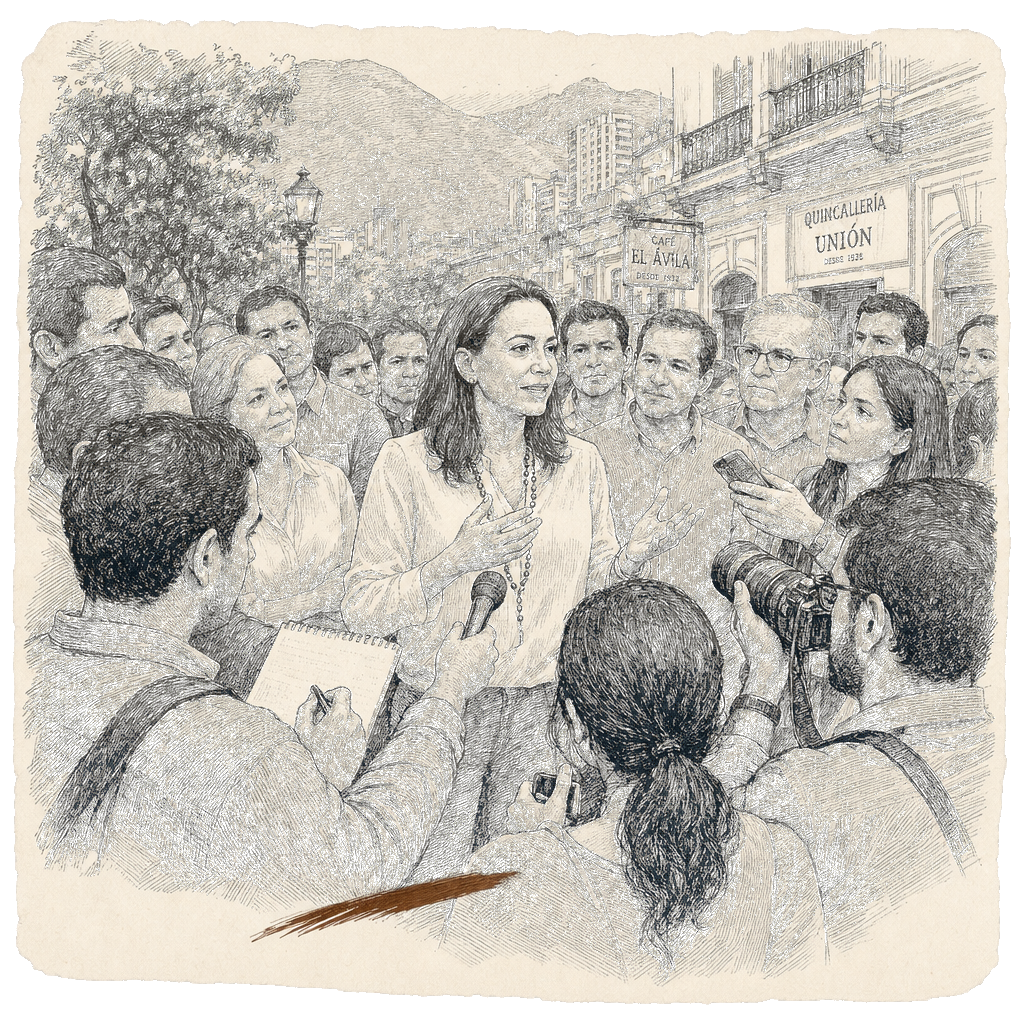
Trump’s endorsement of acting President Delcy Rodríguez—Nicolás Maduro’s longtime second in command—has effectively sidelined Machado despite her Nobel Peace Prize and her movement’s claim to have won Venezuela’s 2024 presidential election. With the United States focused more on Venezuela’s oil infrastructure than on a path to free elections, Machado is cultivating Trump’s support while offering few specifics about the opposition’s next steps.
Venezuelan opposition leader María Corina Machado said Friday she is “profoundly, profoundly confident that we will have an orderly transition” to democracy in Venezuela, but she declined to set a timetable for free elections and would not say when she planned to return home from Washington.
Machado, who won the Nobel Peace Prize in 2025, spoke at the Heritage Foundation, a conservative think tank in Washington, one day after presenting her Nobel medal to President Donald Trump at the White House. She said she would return to Venezuela “as soon as possible” but offered no further detail.
Her measured public stance reflects the constrained position she occupies: Trump’s administration has endorsed acting President Delcy Rodríguez—Nicolás Maduro’s longtime second in command—as the interim leader Washington prefers to manage Venezuela in the near term, sidelining Machado’s opposition movement despite its claim to have won Venezuela’s 2024 presidential election.
As Machado spoke in Washington on Friday, CIA Director John Ratcliffe was in Venezuela meeting with Rodríguez, according to the Associated Press—further confirmation that Rodríguez was the figure Washington preferred to see managing Venezuela at the moment.
Machado downplays friction with U.S. approach
Machado dismissed suggestions that Trump had snubbed her movement by working with Rodríguez.
“This has nothing to do with a tension or decision between Delcy Rodríguez and myself,” she said. She did not elaborate, instead offering general statements about her movement’s popular mandate and the government’s human rights record. “The only thing they have is terror,” she said of Maduro’s government.
She also waved away concerns that her movement would struggle to assert authority over security forces long loyal to Maduro. “There are not religious tensions within the Venezuelan society or racial or regional or political or social tensions,” she said, while also acknowledging “the difficulty of destroying a 27-year structure allied with the Russians and the Iranians.”
On the question of what she asked of Trump, Machado said, “I think I don’t need to urge the president on specific things.”
Trump, for his part, said little publicly about plans for elections and far more about reviving Venezuela’s crumbling oil infrastructure. His administration has relied on an oil blockade and threats of further military action to keep the interim government in line, according to the AP. In a sign that Washington is exploring normalized relations with Caracas, U.S. officials are reportedly considering reopening the U.S. Embassy there, which Trump closed during his first term.
Nobel medal draws scrutiny
The Nobel Institute has been clear that the prize cannot be shared or transferred. Nevertheless, Trump said Machado left the medal for him to keep. “And by the way, I think she’s a very fine woman,” Trump said. “And we’ll be talking again.”
The gesture preceded Trump’s public statement that it would be difficult for Machado to lead Venezuela because she “doesn’t have the support within or the respect within the country.”
Background
Machado campaigned extensively across Venezuela ahead of the 2024 presidential election, rallying millions of voters seeking to end 25 years of single-party rule under the Chavista movement. When authorities barred her from running, a previously unknown former diplomat, Edmundo González, replaced her on the ballot. Election officials loyal to the ruling party declared Maduro the winner despite what the AP described as “ample credible evidence to the contrary.”
Machado went into hiding but vowed to continue fighting for a democratic transition. She emerged in December 2025 to accept her Nobel Peace Prize in Oslo—the first time in more than a decade that she had left Venezuela.