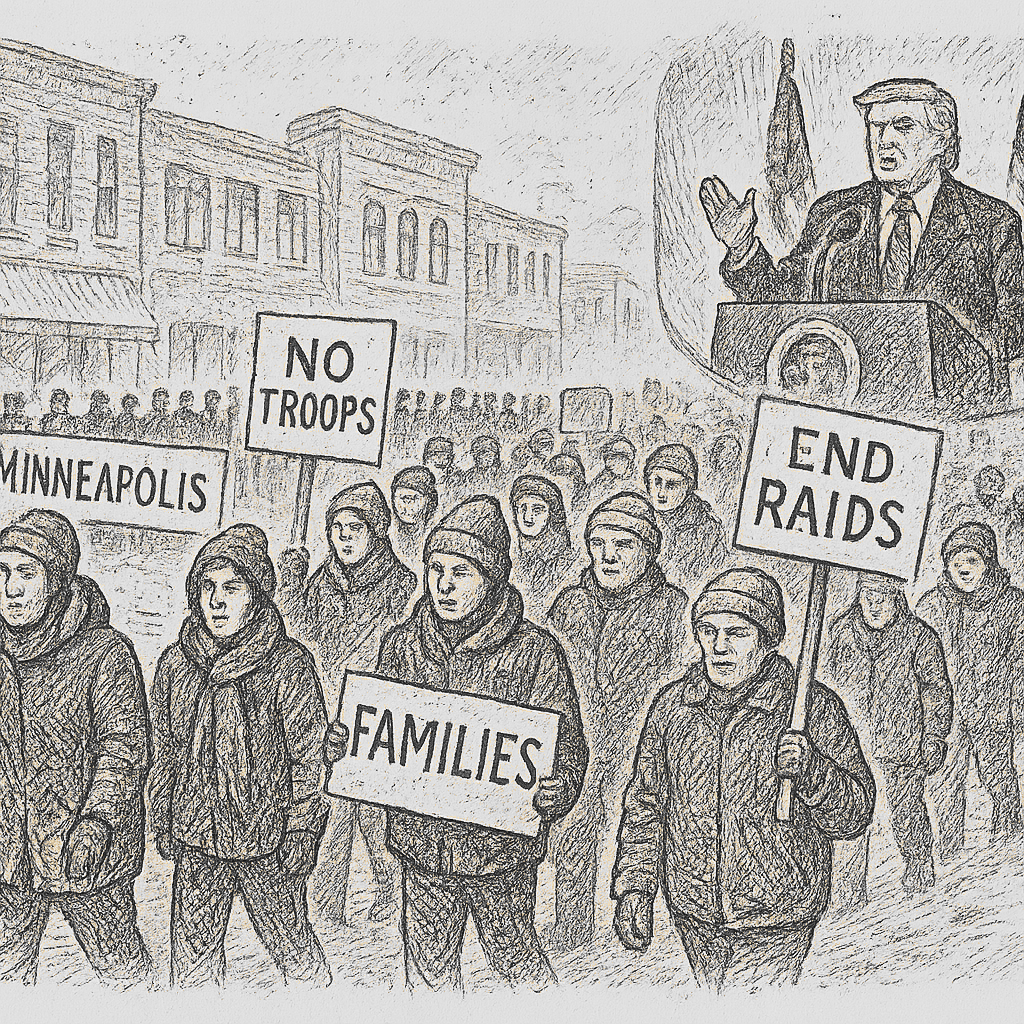
President Donald Trump on Thursday threatened to invoke an 1807 federal law and deploy troops to Minneapolis, where federal immigration enforcement operations have triggered protests, a second officer-involved shooting, and school closures since an ICE agent fatally shot Renee Good on Jan. 7. The threat came one day after an immigration officer shot and wounded a Venezuelan man following a confrontation in which three people attacked the officer with a shovel and broom handle, according to the Department of Homeland Security.
The standoff in Minneapolis has intensified since DHS launched what it calls Metro Surge, an operation that DHS said has arrested more than 2,500 people in the Twin Cities since Nov. 29. Minnesota Gov. Tim Walz and Attorney General Keith Ellison have publicly resisted the administration’s actions, with Ellison vowing to challenge any Insurrection Act deployment in court.
President Donald Trump on Thursday threatened to invoke the Insurrection Act and deploy troops to Minneapolis, where federal immigration enforcement operations have triggered protests, a second officer-involved shooting, and school closures since an ICE agent fatally shot Renee Good on Jan. 7.
“If the corrupt politicians of Minnesota don’t obey the law and stop the professional agitators and insurrectionists from attacking the Patriots of I.C.E., who are only trying to do their job, I will institute the INSURRECTION ACT, which many Presidents have done before me, and quickly put an end to the travesty that is taking place in that once great State,” Trump said in a social media post.
The Insurrection Act, an 1807 federal law, allows the president to deploy the U.S. military or federalize the National Guard for domestic law enforcement over the objections of state governors. Presidents have invoked the law more than two dozen times, most recently in 1992 when President George H.W. Bush deployed forces to end unrest in Los Angeles, at the request of local authorities.
State officials push back
Minnesota Gov. Tim Walz, a Democrat, said on X: “I’m making a direct appeal to the President: Let’s turn the temperature down. Stop this campaign of retribution. This is not who we are.”
Minnesota Attorney General Keith Ellison said he would challenge any Insurrection Act deployment in court. Ellison is already suing to stop the Department of Homeland Security surge. DHS said its Metro Surge operation has arrested more than 2,500 people in the Twin Cities since Nov. 29; ICE, a DHS agency, sent 2,000 officers and agents to the Minneapolis area in early January.
The American Civil Liberties Union of Minnesota filed a class-action lawsuit on behalf of three U.S. citizens — two Somali and one Hispanic — alleging racial profiling and warrantless arrests. The government did not immediately respond to the filing.
Similar lawsuits filed in Los Angeles and Chicago have seen initial success before being stayed on appeal, according to the Associated Press.
The Wednesday shooting
Trump’s threat followed a Wednesday confrontation in which a federal immigration officer shot and wounded a man during an enforcement stop.
DHS said officers stopped a driver from Venezuela who was in the U.S. illegally. The person drove off, then crashed into a parked car before fleeing on foot. Officers caught up, and two additional people arrived and joined in attacking the officer with a shovel and broom handle, DHS said.
“Fearing for his life and safety as he was being ambushed by three individuals, the officer fired a defensive shot to defend his life,” DHS said in a statement. DHS said all three people involved in the attack were from Venezuela and in the U.S. illegally.
Minneapolis Police Chief Brian O’Hara said the man who was shot did not sustain a life-threatening injury. O’Hara’s account largely matched DHS’s description of events.
The shooting occurred approximately 4.5 miles (7.2 kilometers) from where Good was killed. The FBI offered a reward of up to $100,000 for information after agents responding to the scene found several government vehicles damaged and property stolen inside.
Protests and school disruptions
Demonstrators gathered Thursday night outside the federal building being used as a base for the enforcement operation, according to the AP. The protest was described as somewhat more subdued than in prior days, following appeals for calm from Walz and Minneapolis Mayor Jacob Frey.
“This is an impossible situation that our city is presently being put in and at the same time we are trying to find a way forward to keep people safe,” Frey said Wednesday.
St. Paul Public Schools, with more than 30,000 students, said it would close next week until Thursday to prepare remote learning accommodations for students who do not feel safe attending in person. Minneapolis Public Schools, with a similar enrollment, also announced a temporary remote learning option. The University of Minnesota said it would offer varied learning options depending on the class when its new term begins next week.