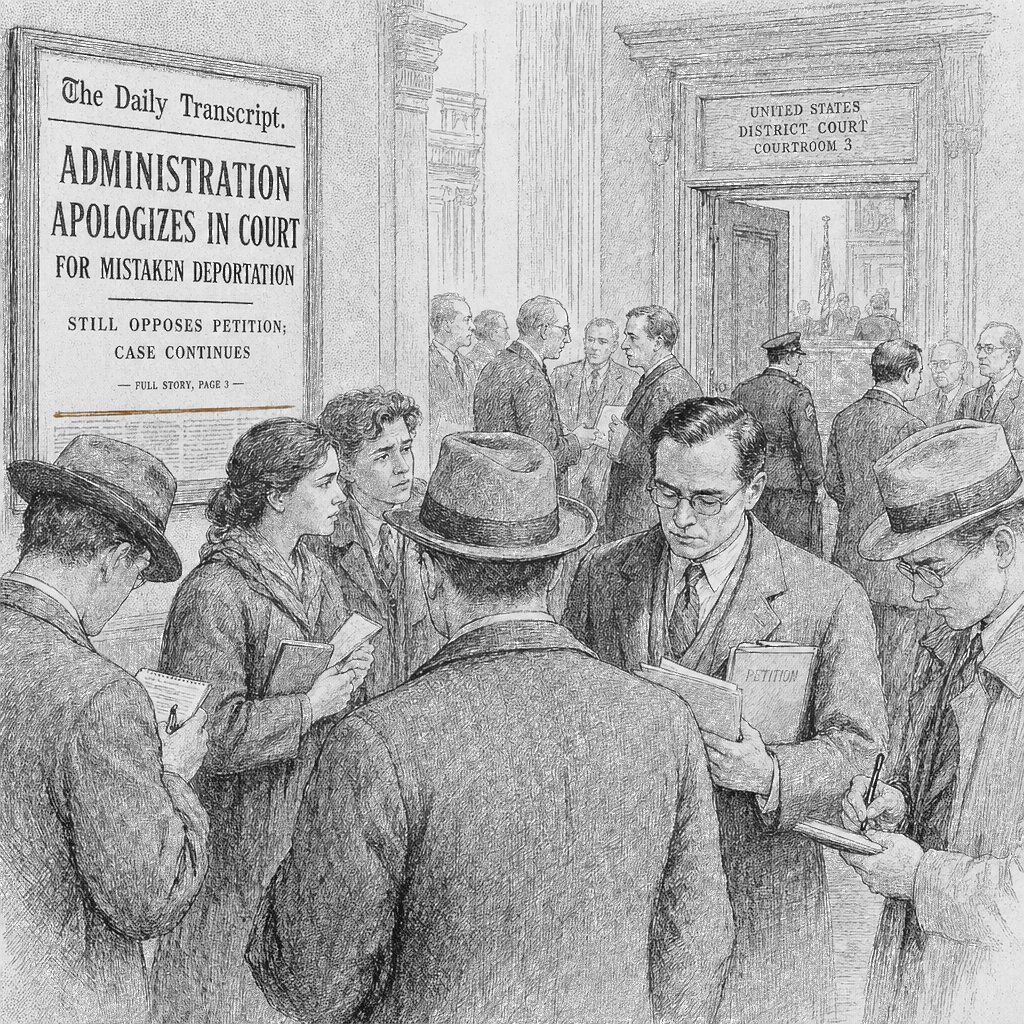
The Trump administration apologized in federal court Tuesday for a ‘mistake’ in the deportation of Any Lucia Lopez Belloza, a 19-year-old Babson College freshman who was removed to Honduras in November despite an emergency court order directing her to remain in the United States — but still argued the error should not affect her case or result in her return. Lopez Belloza had been detained at Boston’s Logan Airport on Nov. 20 while trying to board a flight home to surprise her family for Thanksgiving.
The case adds to a documented pattern of deportations carried out despite active judicial orders, and a federal judge in Boston acknowledged Lopez Belloza as the victim of a bureaucratic failure while appearing to side with the government on whether the court retains jurisdiction to order a remedy.
The Trump administration apologized in federal court Tuesday for a “mistake” in the deportation of Any Lucia Lopez Belloza, a 19-year-old Babson College freshman who was removed to Honduras in November despite an emergency court order directing her to remain in the United States — but still argued the error should not affect her case or result in her return.
Lopez Belloza was detained at Boston’s Logan Airport on Nov. 20, where she had come to catch a flight home to surprise her family for Thanksgiving. She was flown to Honduras two days later, despite a federal court order issued Nov. 21 directing the government to keep her in Massachusetts or elsewhere in the United States for at least 72 hours.
At a federal court hearing Tuesday in Boston, Assistant U.S. Attorney Mark Sauter told U.S. District Judge Richard Stearns that the deportation resulted from a single officer’s error. “On behalf of the government, we want to sincerely apologize,” Sauter said, describing the violation as “an inadvertent mistake by one individual, not a willful act of violating a court order.”
The Error
An Immigration and Customs Enforcement deportation officer, according to court filings and statements made in open court, mistakenly believed the court order no longer applied once Lopez Belloza had left Massachusetts. The officer failed to activate a system that alerts other ICE officers that a case is subject to judicial review and that removal should be halted, and did not notify ICE’s enforcement office in Port Isabel, Texas, that the removal mission needed to be canceled.
In a declaration filed with the court Jan. 2, the officer said he believed the judge’s order did not apply once Lopez Belloza was no longer in the state.
Government Defends Underlying Removal
Despite the apology, the government argued the court lacks jurisdiction over the case, contending that lawyers for Lopez Belloza filed their legal action several hours after she had already arrived in Texas en route out of the country.
The government also defended her underlying removal. An immigration judge ordered the deportation of Lopez Belloza and her mother in 2016, and the Board of Immigration Appeals dismissed their appeal in 2017, prosecutors said. The government argued she could have pursued additional appeals or sought a stay of removal.
Her attorney, Todd Pomerleau, disputed that framing. “I was hoping the government would show some leniency and bring her back,” Pomerleau said. “They violated a court order.”
Pomerleau said one possible resolution would be allowing Lopez Belloza to return to finish her studies while he works to reopen the underlying removal order.
Judge Calls It a Tragedy, Appears to Back Jurisdiction Argument
Judge Stearns said he appreciated the government’s acknowledgment of the error, calling it a “tragic” bureaucratic mistake. He appeared to rule out holding the government in contempt, noting the violation did not appear intentional.
The judge also appeared to side with the government on the jurisdictional question, suggesting the court order had been filed several hours after Lopez Belloza had been sent to Texas. He suggested she could explore applying for a student visa.
“It might not be anybody’s fault, but she was the victim of it,” Stearns said.
A Pattern of Deportations Despite Court Orders
Lopez Belloza’s case is one of several in which deportations have proceeded in apparent conflict with judicial orders. Kilmar Abrego Garcia was deported to El Salvador despite a ruling that should have prevented it; the Trump administration initially fought efforts to bring him back but eventually complied after the U.S. Supreme Court weighed in. In another case, a Guatemalan man identified as O.C.G. was returned to the United States after a judge found his removal from Mexico likely “lacked any semblance of due process,” according to the Associated Press.
Lopez Belloza’s family emigrated from Honduras to the United States in 2014. She is currently staying with grandparents in Honduras and studying remotely; she was recently visiting an aunt in El Salvador, according to the Associated Press.