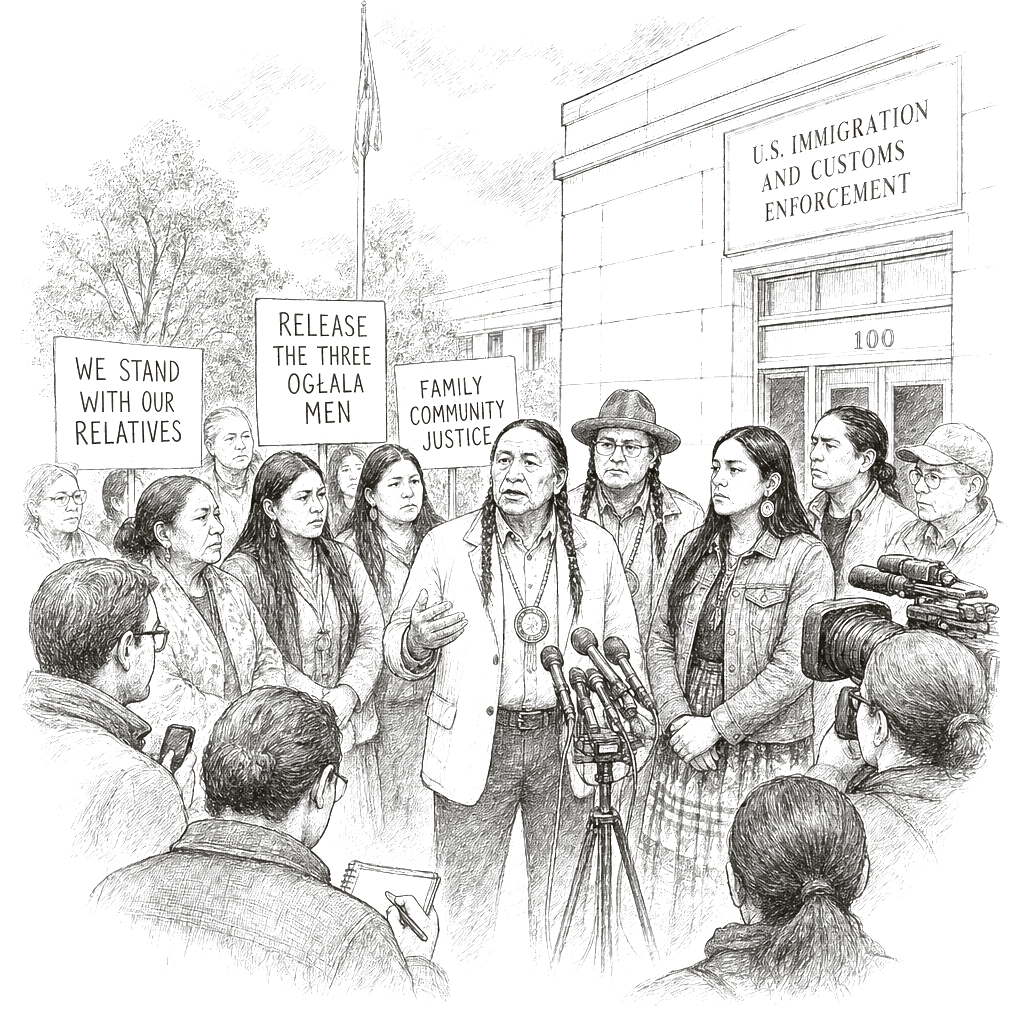
The detentions expose a recurring conflict over whether ICE agents can legally detain citizens of federally recognized tribes — whom federal statute designates as U.S. citizens — a dispute that has surfaced involving at least three other tribal nations in recent months.
The president of the Oglala Sioux Tribe called Tuesday for the immediate release of three tribal citizens transferred to an Immigration and Customs Enforcement facility at Fort Snelling in Minnesota, asserting that enrolled tribal members are U.S. citizens who fall outside federal immigration jurisdiction.
Frank Star Comes Out issued the demand in a statement and an accompanying memorandum sent to Department of Homeland Security Secretary Kristi Noem. Three of the four tribe members arrested last Friday at a homeless encampment in Minneapolis have been moved to ICE custody at the fort, Star Comes Out said. One of the four has been released.
“The Oglala Sioux Tribe’s memorandum makes clear that ‘tribal citizens are not aliens’ and are ‘categorically outside immigration jurisdiction,’” Star Comes Out said. “Enrolled tribal members are citizens of the United States by statute and citizens of the Oglala Sioux Nation by treaty.”
DHS withheld detainees’ information, tribe says
When tribal officials contacted DHS to learn the status of the detained men, the agency provided only their first names, Star Comes Out said. It refused to share further information unless the tribe “entered into an immigration agreement with ICE.” The tribe has no plans to do so, he said.
DHS did not respond to a request for comment.
Star Comes Out said on Facebook that all four men were experiencing homelessness and living under a bridge in Minneapolis at the time of their arrest. He called for the release of all tribal citizens in ICE custody and a meeting between tribal and federal officials.
Facility carries weight for Indigenous communities
The choice of Fort Snelling as the detention site carries particular historical resonance. The fort was the first U.S. military outpost in the region, and Dakota people were held prisoner there during the Dakota War of 1862.
Nick Estes, an associate professor in American Indian Studies at the University of Minnesota and a member of the Lower Brule Sioux Tribe, said the site’s record shapes how Indigenous communities read the current detentions.
“It has this really notorious anti-Indigenous, specifically anti-Dakota, history,” Estes said. “It’s kind of like a continuation on the monopoly of violence from the military outpost to the ICE facility.”
Pattern of tribal member detentions
The Minneapolis arrests are not isolated. Navajo Nation elected leaders said last year that tribal citizens in Arizona and New Mexico reported being stopped and detained by ICE officers. In November, a member of the Salt River Pima-Maricopa Indian Community in Arizona who had been arrested in Iowa was reportedly scheduled for deportation in error before she was released. That same month, Elaine Miles, a member of the Confederated Tribes of the Umatilla Indian Reservation in Oregon and an actress known for her roles in “Northern Exposure” and “The Last of Us,” said ICE officers stopped her in Washington state and told her that her tribal ID looked fake.
Indigenous rights groups and the Red Lake Band of Chippewa Indians have established locations in Minneapolis where tribal citizens can obtain tribal ID cards in case they are approached by federal agents.
“I never thought that I’d have my tribal ID hanging around my neck, but I do,” said Mary LaGarde, executive director of the Minneapolis American Indian Center. “So, it’s just important that they have proper identification on them and not to panic.”