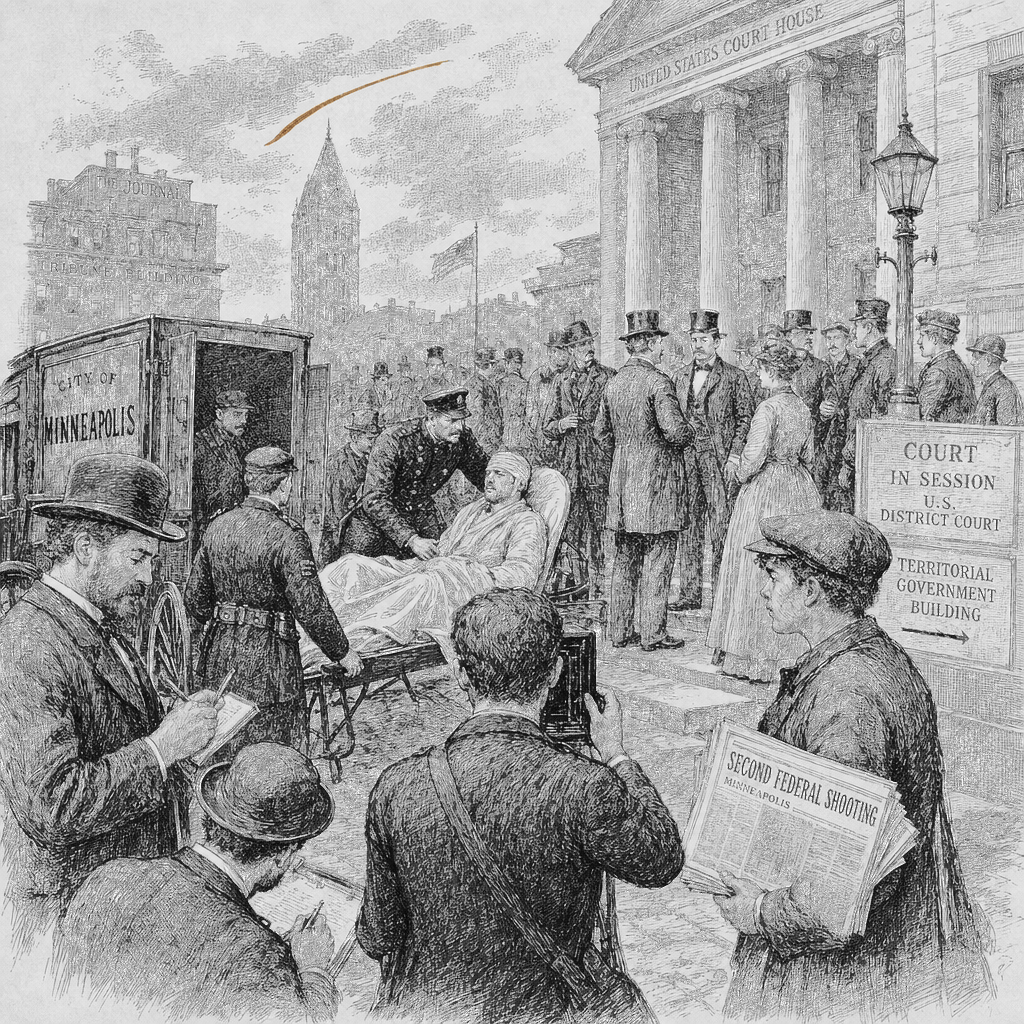
A federal immigration officer shot a man in the leg in Minneapolis on Wednesday after being attacked with a shovel and broom handle during an arrest attempt, the Department of Homeland Security said — the second shooting involving federal agents in the city since an ICE officer fatally shot Renee Good seven days earlier.
Smoke filled the street near the scene as officers in gas masks fired tear gas and grenades at onlookers, who threw snowballs and chanted, “Our streets.”
The shooting deepened a crisis that has drawn Minnesota and its two largest cities into federal court, prompted the Pentagon to recruit military lawyers to serve as prosecutors, and led Gov. Tim Walz to describe federal enforcement operations as “a campaign of organized brutality against the people of Minnesota by our own federal government.”
The Wednesday shooting
DHS said in a statement posted on X that officers stopped a Venezuelan national in the country illegally. The person drove away, crashed into a parked car, and fled on foot. After officers caught up with the individual, two people from a nearby apartment joined in attacking the officer, DHS said.
“Fearing for his life and safety as he was being ambushed by three individuals, the officer fired a defensive shot to defend his life,” DHS said.
The city of Minneapolis said on X that the man shot was hospitalized with non-life-threatening injuries and asked the public to “remain calm.” The two people from the apartment were taken into custody, DHS said. The shooting occurred about 4.5 miles north of where Good was killed on Jan. 7.
Courts weigh restraining order
Earlier Wednesday, U.S. District Judge Katherine Menendez gave the Justice Department until Monday to respond to a request for a restraining order on immigration enforcement operations, in a lawsuit filed by the state of Minnesota and the cities of Minneapolis and St. Paul.
State Assistant Attorney General Brian Carter told the court that “what we need most of all right now is a pause. The temperature needs to be lowered.”
Menendez described the matters before her as “grave and important” and noted a scarcity of legal precedent for some of the central questions. Justice Department attorney Andrew Warden said the judge’s approach was appropriate. Menendez is also presiding over a separate lawsuit challenging the tactics used by ICE and other federal officers when encountering protesters and bystanders; a ruling in that case could come this week.
‘Organized brutality’
In a televised address Wednesday evening, Walz said Minnesota was in chaos and that what was happening in the state “defies belief.”
“Let’s be very, very clear, this long ago stopped being a matter of immigration enforcement,” Walz said. “Instead, it’s a campaign of organized brutality against the people of Minnesota by our own federal government.”
Walz said “accountability” would come through the courts. DHS said it has made more than 2,000 arrests in Minnesota since early December and vowed to continue operations.
Pentagon recruits military lawyers
CNN reported, citing an internal military email, that Defense Secretary Pete Hegseth asked the branches to identify 40 judge advocate general officers, with 25 set to serve as special assistant U.S. attorneys in Minneapolis. Pentagon spokesperson Kingsley Wilson appeared to confirm the report by posting it on X with a comment that the military “is proud to support” the Justice Department.
The Pentagon did not respond to Associated Press requests for further detail. Last week it sent 20 lawyers to Memphis, Tennessee.
Mark Nevitt, an associate professor at Emory University School of Law and a former Navy JAG officer, said the deployments raise concern about drawing legal support away from the military.
“There are not many JAGs but there are over one million members of the military, and they all need legal support,” Nevitt said.
Injuries to the officer who killed Good
Jonathan Ross, the ICE officer who shot and killed Good on Jan. 7, suffered internal bleeding to his torso during that encounter, a Homeland Security official told the Associated Press on condition of anonymity because the official was not authorized to discuss Ross’s medical condition. The official did not describe the severity, and the agency did not respond to questions about the extent of the bleeding, how the injury occurred, or Ross’s treatment.
Video from the Jan. 7 scene showed Ross and other officers walking without obvious difficulty after Good was shot and her Honda Pilot crashed into other vehicles. Homeland Security Secretary Kristi Noem has said Ross was struck by Good’s SUV and that Good used the vehicle as a weapon — a self-defense claim that Minnesota officials have disputed. Ross’s attorney, Chris Madel, declined to comment.
Good’s family hires Floyd law firm
Good’s family retained Romanucci & Blandin, the law firm that represented George Floyd’s family in a $27 million settlement with the city of Minneapolis. Floyd died in May 2020 after a white police officer pinned his neck to the ground.
The firm said Good was following orders to move her car when Ross shot her and that it would conduct an independent investigation and share its findings publicly.
“They do not want her used as a political pawn,” the firm said of Good and her family, “but rather as an agent of peace for all.”
Students march; university braces
Hundreds of students left St. Paul schools Wednesday and marched in freezing temperatures to the state Capitol, waving signs reading “Love Melts ICE” and “DE-ICE MN.”
The University of Minnesota informed its more than 50,000 students that some classes may move online when the new academic term begins next week. President Rebecca Cunningham noted that “violence and protests have come to our doorstep.” The campus sits adjacent to the main Somali neighborhood in Minneapolis.