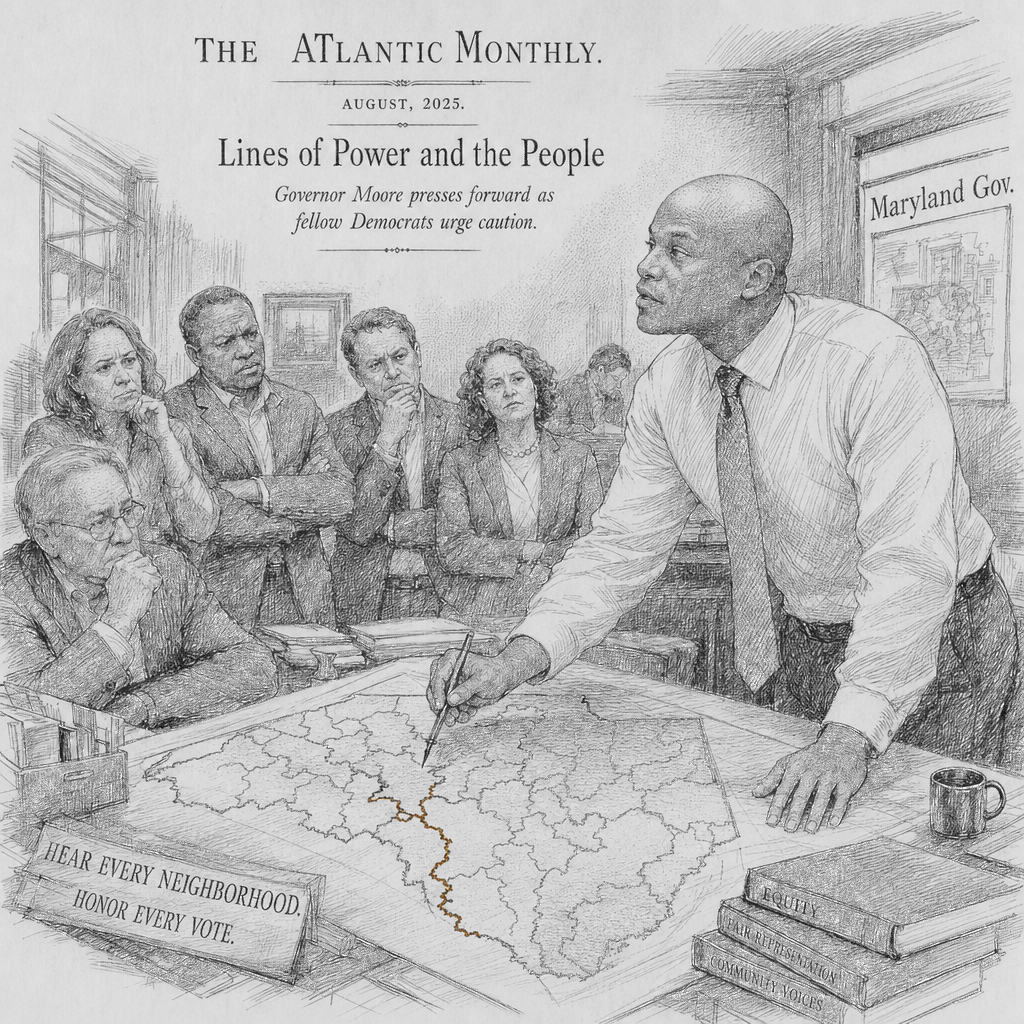
Maryland’s redistricting bid is part of a broader national battle sparked by President Donald Trump, who called on Texas Republicans in July to redraw their congressional map without new census data. Democrats in several states have responded with their own redrawing efforts, though the Maryland effort faces significant resistance from within the governor’s own party.
ANNAPOLIS, Md. — Maryland Gov. Wes Moore said Wednesday he wants the Democratic-controlled state legislature to vote on a new congressional map, pressing ahead with a mid-decade redistricting effort as the state’s annual 90-day legislative session began. The move came despite warnings from Maryland Senate President Bill Ferguson, a fellow Democrat, that the push could cost the party seats rather than gain one.
Moore told the Associated Press that the General Assembly “has not just the authority, but the responsibility to be able to then have a vote on the recommendations of the commission” — a panel he appointed to review potential maps, which is expected to recommend one soon.
“This is a thorough process that they have gone through, and I think when they complete their work, it’ll then go in front of the House and then go in front of the Senate, and I do think that the bodies at that point should take it to their members,” Moore said.
Maryland’s redistricting push is part of a broader national battle sparked by President Donald Trump, who called on Texas Republicans in July to redraw their congressional map without new census data — an unusual step that has not been common since the late 1800s. Democrats in several states have responded with their own redrawing efforts. The national battle has so far produced nine more seats that Republicans believe they can win and six more that Democrats think they can win, putting the GOP ahead by three, according to the AP. Redistricting is being litigated in several states, and there is no guarantee that either party will win the seats it has redrawn.
Moore said he convened the Maryland commission because if other states were redrawing their maps, Maryland officials should not “sit on their hands.”
Senate president warns of backfire
Ferguson, a Baltimore Democrat, said the effort to flip the seat held by Republican Rep. Andy Harris could jeopardize at least one and potentially two seats currently held by Democrats. He pointed to a 2021 Maryland congressional map that a judge ruled unconstitutional, describing it as “a product of extreme partisan gerrymandering.” That earlier map had been drawn to make it easier for a Democrat to defeat Harris. Maryland passed a revised map in 2022 and both parties dropped their legal fight.
Ferguson said redrawing the map again could prompt a fresh legal challenge and allow a court to impose its own districts — potentially an outcome worse for Democrats than the status quo.
“The reason we don’t do this is because there are huge risks associated with it that not only risk us not moving forward in the objective of having another Democratic seat,” Ferguson told the AP. “It would be, in my opinion, a higher likelihood that we would lose a seat, rather than gain.”
Ferguson said a majority of the Senate’s 34 Democrats also oppose redistricting this year. He declined to say whether he would hold a floor vote if a new map were sent to his chamber.
“I think that’s hypothetical,” Ferguson said. “We’ll see. I think we’re already too late generally, and so we’ll see what happens in the debate moving forward.”
A mid-cycle map change could also disrupt the state’s election calendar. Maryland has a candidate filing deadline of Feb. 24 and a primary scheduled for June 23, Ferguson noted.
House speaker awaits the commission’s recommendation
Democrats in Maryland outnumber Republicans 2-1, and the party holds a 7-1 edge over Republicans in the state’s U.S. House delegation.
Maryland House Speaker Joseline Peña-Melnyk, a Democrat, said she supports the work of the governor’s redistricting commission but wants to see its recommendation before commenting on how to proceed.