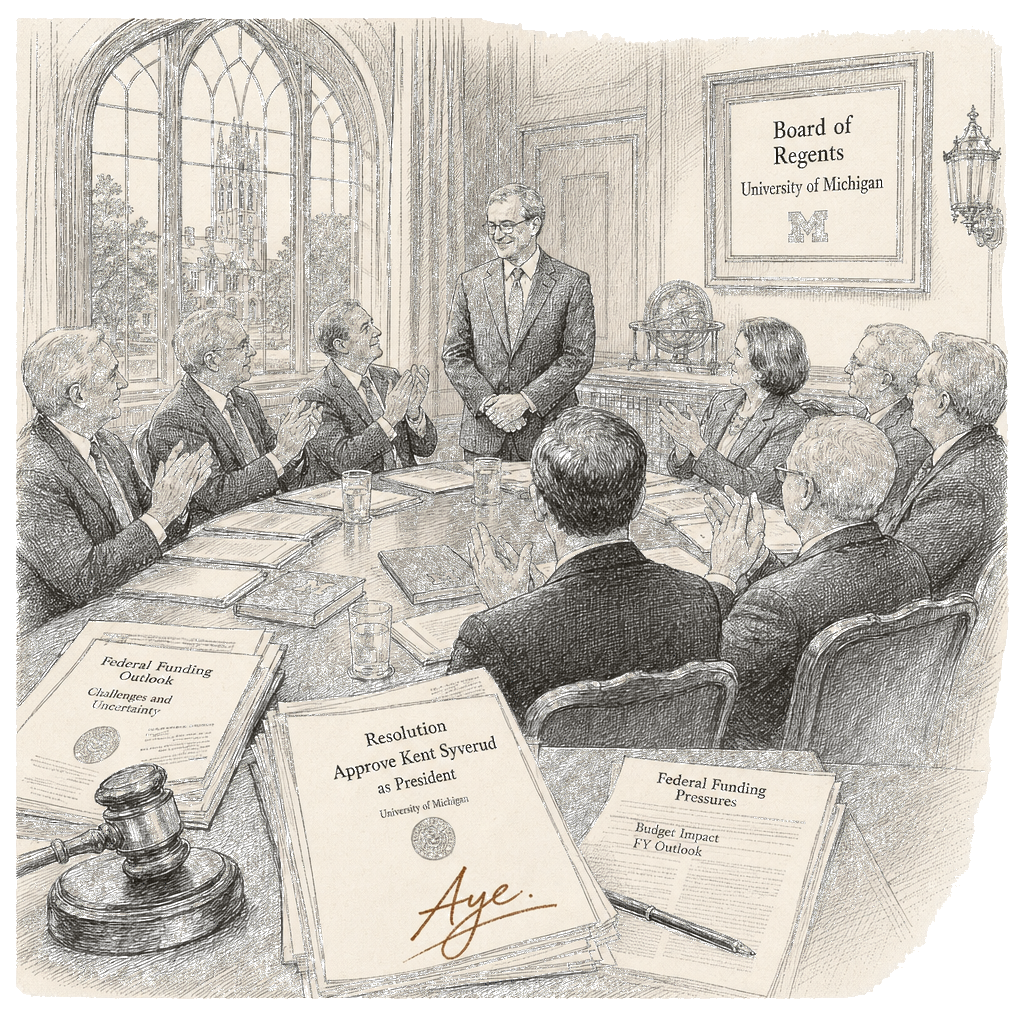
Syverud inherits an institution whose research enterprise drew $1.2 billion in federal funds in fiscal year 2025, a stream now under pressure: 189 U-M grants have been cut since President Donald Trump began his second term, according to university officials.
The University of Michigan Board of Regents unanimously approved Kent Syverud as the institution’s 16th president on Monday, tapping the current Syracuse University chancellor to lead a school grappling with federal grant cuts, consecutive athletic department scandals, and rising tuition costs.
Syverud, 69, will begin the role July 1 under a five-year contract with a base salary of $2 million and a potential annual performance award of up to 30 percent of that figure.
“These are challenging times for Michigan, for higher education and the whole world,” Syverud said after the board’s special meeting. “We have a choice in how to respond. We can curl up in a ball … or we can do what Michigan has always done at its best: We can lead.”
Filling a revolving door
Syverud becomes U-M’s third president in five years and, according to the university, the first U-M alumnus to hold the office in nearly a century. He replaces interim President Domenico Grasso, the former U-M Dearborn chancellor who has held the office since May after Santo Ono stepped down after less than three years.
Board chair Mark Bernstein framed the appointment as a necessary response to an era of mounting pressure. “For our university and our society, American higher education faces more challenges now than at any point since World War II,” Bernstein said. “Given our position in the nation and the state, it is imperative for us to have a leader who is prepared to meet these challenges.”
Bernstein described Syverud as “a deep, steady and broad thinker” with “a track record of success.”
Federal funding cuts
Federal funding pressure stands as perhaps the most immediate challenge Syverud will face. U-M’s research enterprise drew $1.2 billion in federal funds in fiscal year 2025 out of $2.16 billion in total research spending across its Ann Arbor, Dearborn, and Flint campuses, according to Arthur Lupia, U-M vice president for research and innovation. Since President Donald Trump began his second term, federal funds have been cut for 189 U-M grants, Lupia said, though the university continued to contest some of those cuts and remained uncertain how many had been reinstated.
Regent Paul Brown described the federal government’s shifting posture toward research universities as a fundamental break with the postwar consensus. “It’s the first existential question that academia have faced in 50 years,” Brown said, adding that the change was occurring “without a national debate.”
Brown said Syverud, who has a legal background, was suited to push back on federal mandates. “He’s a humble negotiator, so hopefully we can become a part of that national conversation with elected officials and the public: Is this where we really want to go?” Brown said.
Two athletic department scandals
U-M also faces unresolved problems in its athletic department. The university hired law firm Jenner & Block in December to investigate events leading to the firing of head football coach Sherrone Moore, who was dismissed for an inappropriate relationship with a staff member. The investigation report had not been released as of Monday.
Separately, the NCAA in 2025 issued fines against U-M stemming from an illegal scouting and sign-stealing scandal involving the football program, penalties that included the loss of post-season revenue for two seasons.
Tuition and access
In-state undergraduate tuition and fees at U-M’s Ann Arbor campus total $18,346 for 2025-26, the second-highest among Michigan’s 15 public universities, according to the Michigan Association of State Universities. Only Michigan Technological University, at $19,982, costs more for in-state students.
Regent Michael Behm said students receiving tuition support also needed help with books, housing, and other costs beyond tuition. Regent Paul Brown pointed to gaps in K-12 students’ awareness of higher education pathways, noting that universities “lose a huge part of really capable students” because of resource and knowledge gaps in their communities.
Syverud said it was important to reflect the state’s diversity and pledged to treat U-M’s Flint and Dearborn campuses as equal partners rather than secondary branches. “My belief is that University of Michigan is a great university with three main campuses, not with one,” he said. “And I want to understand Flint and Dearborn well, and I don’t want to perform on that. I want to make it true.”
A returning alumnus
Syverud arrived at U-M in 1978 via Greyhound bus with one suitcase and studied on a scholarship, earning graduate degrees in law and economics. He taught at U-M’s law school and met his wife, Dr. Ruth Chen, an environmental toxicologist and Syracuse University professor, when she was a doctoral student at U-M’s School of Public Health. The couple have three sons and five grandchildren.
Syverud acknowledged in a video introduction posted to YouTube that he would not arrive with all the answers. “When I start in July I will need your help,” he said. “The university has had a rough patch recently. I will have a lot of listening and a lot of learning to do.”