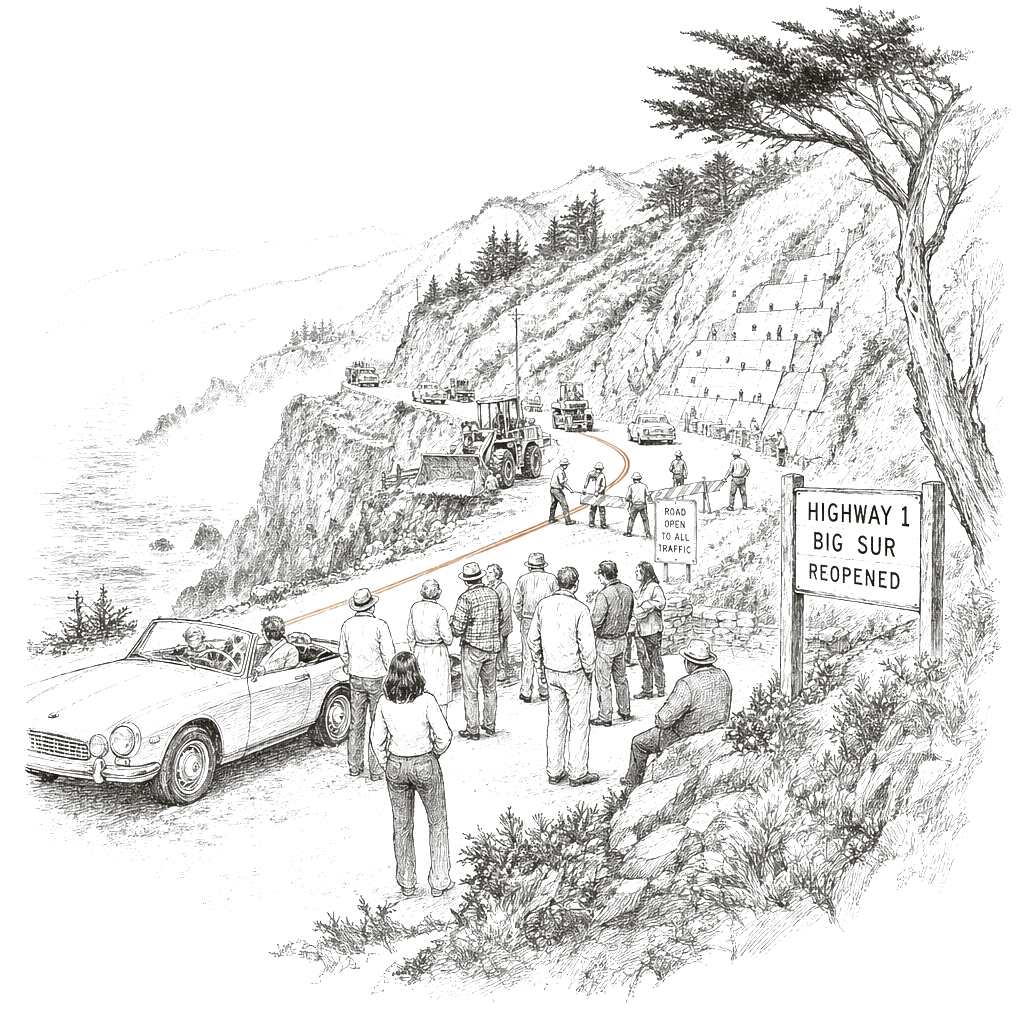
The closure, which began in January 2023 after atmospheric rivers triggered major landslides, isolated Big Sur’s fewer than 2,000 residents and forced travelers onto an eight-hour inland detour. Local business owners said the early reopening gives travelers time to plan spring and summer road trips along one of California’s most-visited routes.
BIG SUR, Calif. — A 90-mile section of California’s Highway 1 along the Big Sur coast fully reopened Wednesday, three years after a series of landslides and a roadway collapse shut the scenic route connecting Los Angeles and San Francisco, the California Department of Transportation said. The reopening, around midday, came three months ahead of schedule.
“Today is a monumental milestone for us,” said Colin Twohig, general manager of the Big Sur River Inn. “We’re hitting the light at the end of the tunnel after three long years.”
Business owners said the early reopening gives travelers time to plan spring and summer trips along the highway, famously a must for California visitors traveling between the two cities.
Three winters of closures
The first shutdown came in January 2023, when a series of powerful atmospheric rivers triggered a major landslide. The highway was buried by mud and rocks again the following year during another wet winter, and a lane also collapsed down a cliff near Rocky Creek Bridge.
The traffic stoppage between Carmel and Cambria cut off access to Big Sur, an isolated stretch of the state’s central coast where misty, forested mountains rise up from the ocean. What used to be a short drive between the highway’s southern and northern sections became an eight-hour trek inland and then back toward the coast.
The last stretch to remain closed was a 7-mile span near Lucia, according to Caltrans, which has called Highway 1 the jewel of the state highway system.
Repairs and reconstruction
Caltrans deployed remotely operated bulldozers and excavators to safely remove tons of debris in steep terrain. Crews then drilled 4,600 steel bars into the slopes in a grid to patch layers of the hillside together and reduce the risk of future slides, the department said.
Gov. Gavin Newsom announced the opening on social media, thanking Caltrans for the speedy work in “reviving a vital economic lifeline for local business owners and residents affected by the closure.”
California Assemblymember Dawn Addis, a Democrat whose district includes Big Sur, said the reopening would benefit the region broadly.
“This turning point will help restore revenue, access to our state parks, support jobs, public safety, and economic stability for many of our residents,” Addis said in a statement.
Economic toll on local businesses
Big Sur, home to fewer than 2,000 residents, is known for panoramic hiking trails along high cliffs and craggy beaches where seals and sea lions sometimes sprawl out. The late author Henry Miller lived there for nearly two decades starting in the 1940s; a library is now devoted to his work.
The road closure hit local businesses hard. Twohig estimated that his inn — which has 22 guest rooms, a large restaurant, and a general store — saw a 20% drop in business during the three years. He said the closure coming directly after COVID-19 restrictions was a one-two punch, adding that the inn spent the down time making improvements and marketing heavily to draw California residents during the off-seasons.
“When you have a hospitality business, you really rely on the busy season, and when there is no busy season, it can be a hard pill to swallow,” Twohig said. “Having that lifeline back is huge.”