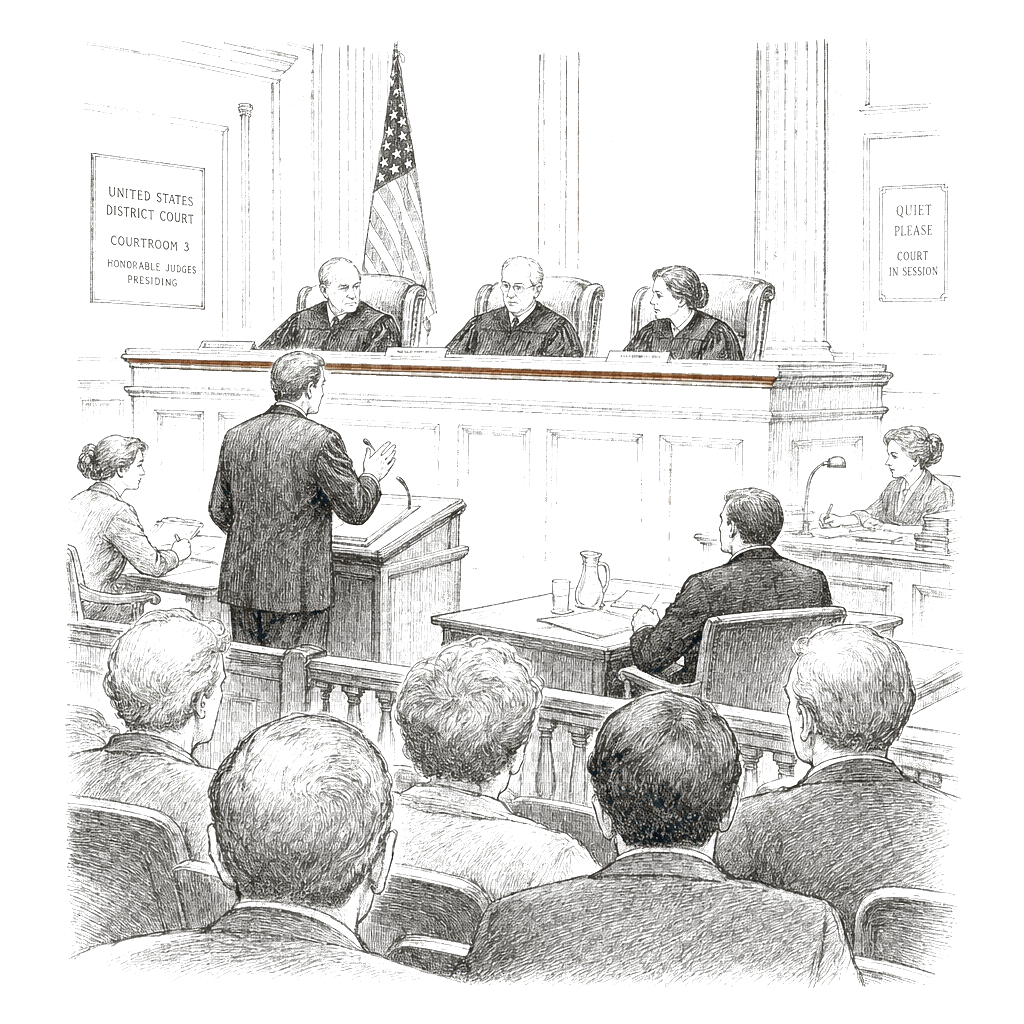
SACRAMENTO, Calif. — A federal three-judge panel ruled 2-1 on Wednesday that California may use its new voter-approved congressional map for the 2026 midterm elections, denying requests from state Republicans and the U.S. Justice Department to block the map on the grounds that it unconstitutionally used race to favor Hispanic voters.
The Los Angeles panel found no strong evidence the district lines were drawn based on race, accepting California Democrats’ argument that the map was drawn for partisan advantage — a legally significant distinction that shields it from federal court review under a 2019 U.S. Supreme Court precedent.
“After reviewing the evidence, we conclude that it was exactly as one would think: it was partisan,” the two-judge majority wrote.
The ruling preserves a map approved by California voters through Proposition 50 in November that Democrats say could help flip as many as five U.S. House seats in 2026. Republicans currently hold 218 seats in the chamber to Democrats’ 213, a narrow margin that both parties are working to shift through redistricting.
Parties React
Gov. Gavin Newsom, a Democrat who is considering a 2028 presidential run and who led the push for Proposition 50, said in a statement: “Republicans’ weak attempt to silence voters failed.”
California Republicans vowed to appeal to the U.S. Supreme Court. Corrin Rankin, chairwoman of the California Republican Party, said in a statement that the dissenting opinion “better reflects our interpretation of the law and the facts, which we will reassert to the Supreme Court.”
The dissent came from U.S. District Judge Kenneth Lee, who was appointed by President Donald Trump. Lee said at least one district was drawn using race as a factor “to curry favor with Latino groups and voters.”
Republicans currently hold nine of California’s 52 congressional seats.
The Partisan-Map Doctrine
California Democrats argued that because the map was drawn for partisan, not racial, advantage, federal courts lack the authority to strike it down. The U.S. Supreme Court ruled in 2019 that partisan gerrymandering is a political question beyond the reach of federal courts, and the Los Angeles panel’s majority agreed that standard applied here.
The ruling follows a similar Supreme Court decision in December that allowed Texas to use its new mid-decade congressional map for the 2026 election, also on the grounds that it was drawn for partisan goals. Conservative Justice Samuel Alito wrote a concurring opinion in that case signaling that the California map might fare the same way — a signal the Wednesday ruling bore out.
National Redistricting Contest
Mid-decade congressional redistricting — redrawing U.S. House district boundaries outside the decennial census cycle — is highly unusual. California’s Proposition 50 effort was mounted partly in response to a similar push in Texas backed by President Trump, aimed at helping Republicans gain five House seats.
Following those two moves, several Republican-led states — including Missouri, North Carolina, and Ohio — have adopted new district lines designed to provide a partisan advantage. A federal judge separately ordered Republican-run Utah to adopt a map that creates a Democratic-leaning district.
The Justice Department has brought legal challenges only against California in the mid-decade redistricting disputes, a focus that Democrats have characterized as selective enforcement.
House Democrats need to gain a handful of seats next year to reclaim control of the chamber, which would allow them to block the Trump administration’s legislative priorities and open the possibility of congressional investigations into the administration.