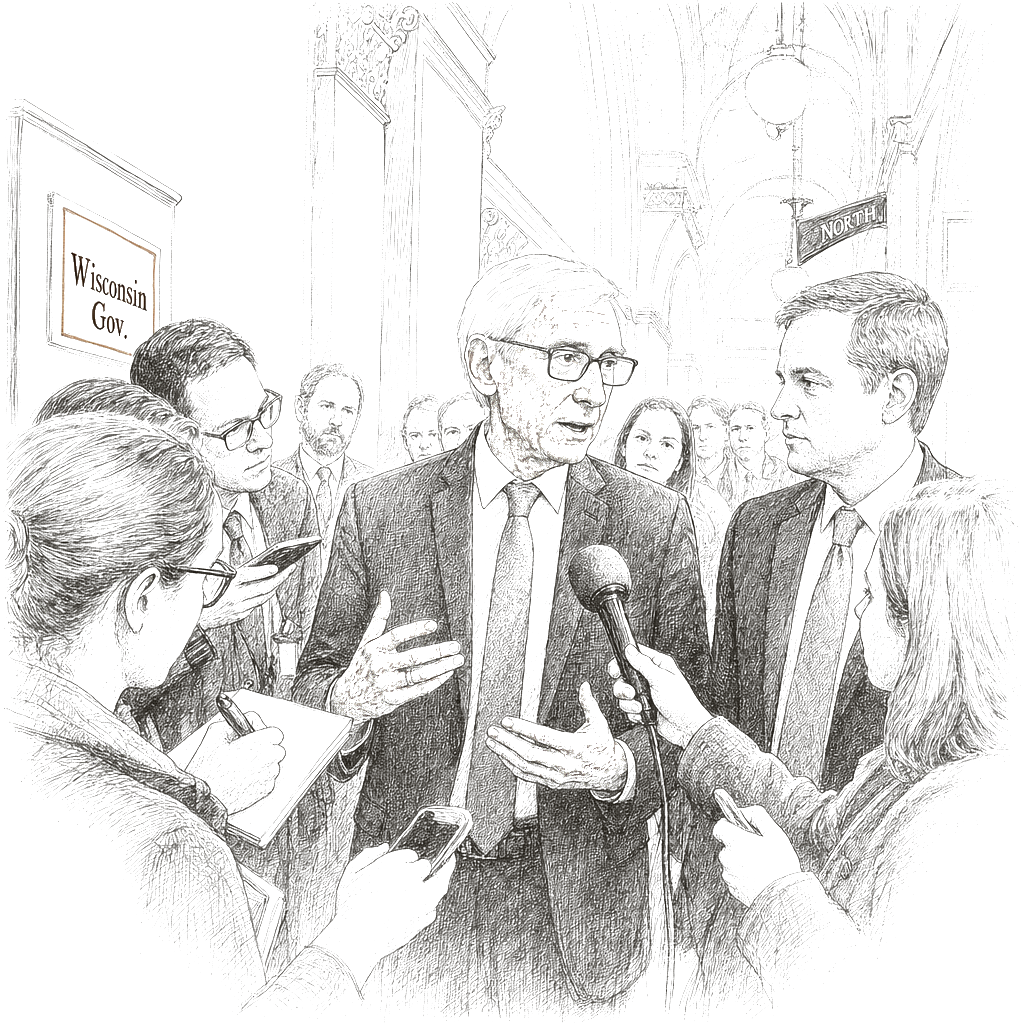
The exchange exposed an intraparty split among Wisconsin Democrats over how forcefully to resist Trump administration immigration enforcement — a debate that sharpened after an ICE officer fatally shot Renee Good in neighboring Minnesota last week.
MADISON, Wis. — Wisconsin Gov. Tony Evers on Monday questioned whether his lieutenant governor’s proposal to ban federal immigration enforcement near schools, hospitals and other sensitive locations was legally achievable — or politically wise.
Lt. Gov. Sara Rodriguez, a Democrat running in the state’s open gubernatorial race, proposed that civil immigration enforcement actions in Wisconsin be banned around courthouses, hospitals and health clinics, licensed child care centers and daycares, schools and colleges, domestic violence shelters, and places of worship. The proposal would allow exceptions for judicial warrants or an immediate threat to public safety.
“I’m not sure we have the ability to do that,” Evers told reporters at a Monday news briefing, according to the Associated Press.
Evers also expressed concern about the measure’s reception in Washington. “We can take a look at that, but I think banning things absolutely will ramp up the actions of our folks in Washington, D.C.,” he said. “They don’t tend to approach those things appropriately.”
Rodriguez holds her position
Rodriguez said Tuesday that she respected Evers’ position but did not back down. “For too long Democrats have dialed back actions in hopes President Trump doesn’t escalate, and that’s not what happens,” she said in a statement. “He always escalates.”
Rodriguez released her proposal after an Immigration and Customs Enforcement officer fatally shot Renee Good in neighboring Minnesota last week, according to the Associated Press. The killing sparked protests across the country, including in Wisconsin.
Minnesota, joined by Minneapolis and St. Paul, sued the Trump administration Monday seeking a temporary restraining order to halt or limit the federal immigration enforcement surge in the state.
Rodriguez also called for all ICE agents operating in Wisconsin to be unmasked, clearly identified and wearing a body camera. “No one should be afraid to drop off their kids at school, seek medical care, go to court, or attend worship because enforcement actions are happening without clear rules or accountability,” she said.
Political and legislative context
Rodriguez’s proposal is largely modeled on measures being considered in California, New York, Illinois and New Jersey. Even if introduced in Wisconsin, the proposal would face no path forward in the Republican-controlled state Legislature.
Rodriguez is one of several Democrats vying to succeed Evers in the open gubernatorial race. Evers and Rodriguez were elected together in 2022 after Rodriguez won the lieutenant governor primary; Evers decided against seeking a third term.
When asked whether ICE agents were welcome in Wisconsin, Evers said, “I think we can handle ourselves, frankly. I don’t see the need for the federal government to be coming into our state and making decisions that we can make in the state.”