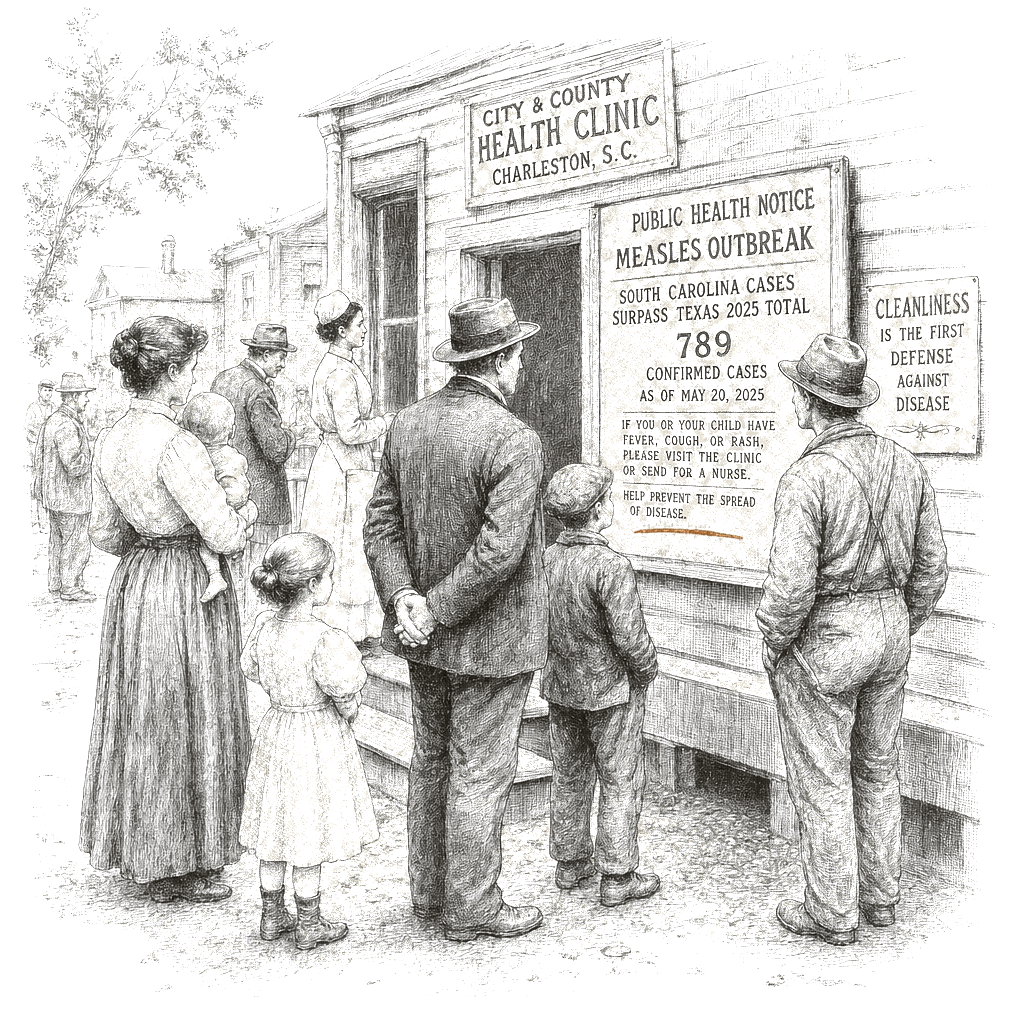
The South Carolina measles outbreak has grown to 789 confirmed cases since September, health officials said Tuesday, surpassing the total recorded in Texas’ 2025 outbreak and showing little sign of slowing. The outbreak, centered in Spartanburg County in the state’s northwest, added 89 new cases in the four days since Friday. A concurrent outbreak along the Utah-Arizona border and confirmed cases in a dozen other states are threatening the United States’ measles elimination status.
The surge accelerates a measles resurgence that the Centers for Disease Control and Prevention says produced the nation’s worst year for the disease since 1991. Declining childhood vaccination rates and a rise in personal and religious exemption claims have allowed the virus to move through communities where coverage has fallen below the 95% threshold needed for herd immunity.
South Carolina
South Carolina’s 789-case total eclipses Texas’ 2025 outbreak figure of 762 cases, which experts said was itself likely an undercount. The Spartanburg County outbreak has grown rapidly into the largest active outbreak in the nation, with hundreds of children across dozens of schools placed in quarantine because of measles exposures, some more than once. The outbreak has also spread beyond South Carolina’s borders to North Carolina and Ohio.
Utah-Arizona border
A separate outbreak is unfolding along the Utah-Arizona border in an area nicknamed Short Creek — the border communities of Hildale, Utah, and Colorado City, Arizona. Arizona health officials have documented 222 cases in Mohave County, and a small number of cases were detected for the first time in recent days in Maricopa, Pima, and Pinal counties. Utah has confirmed 216 cases, 55 of them in the past three weeks. Experts in both states have said they are concerned about undercounts.
National picture
The Centers for Disease Control and Prevention had confirmed 416 measles cases nationwide in 2026 as of Thursday — nearly 20% of the total recorded in all of 2025, with the year less than two weeks old. In addition to the South Carolina and Utah-Arizona outbreaks, confirmed 2026 cases have been reported in California, Florida, Georgia, Idaho, Kentucky, Minnesota, North Carolina, Ohio, Oregon, Virginia, and Washington.
Last year was the worst for measles in the United States since 1991, according to the CDC. The country confirmed 2,255 cases across nearly 50 separate outbreaks. Three people died, all of them unvaccinated, including two children in Texas.
Vaccine and transmission
Measles is caused by a highly contagious airborne virus that spreads when an infected person breathes, coughs, or sneezes. Symptoms include high fever, runny nose, cough, red and watery eyes, and a rash. Most people recover, but infection can lead to serious complications including pneumonia, blindness, brain swelling, and death.
Two doses of the measles, mumps, and rubella vaccine are 97% effective against measles, with protection considered lifelong. The first dose is recommended for children between 12 and 15 months old; the second between 4 and 6 years old. Herd immunity — the threshold at which measles has a harder time spreading through a community — requires vaccination rates above 95%. Childhood vaccination rates have fallen nationwide since the pandemic, and more parents have been claiming religious or personal-conscience waivers to exempt their children from required shots.