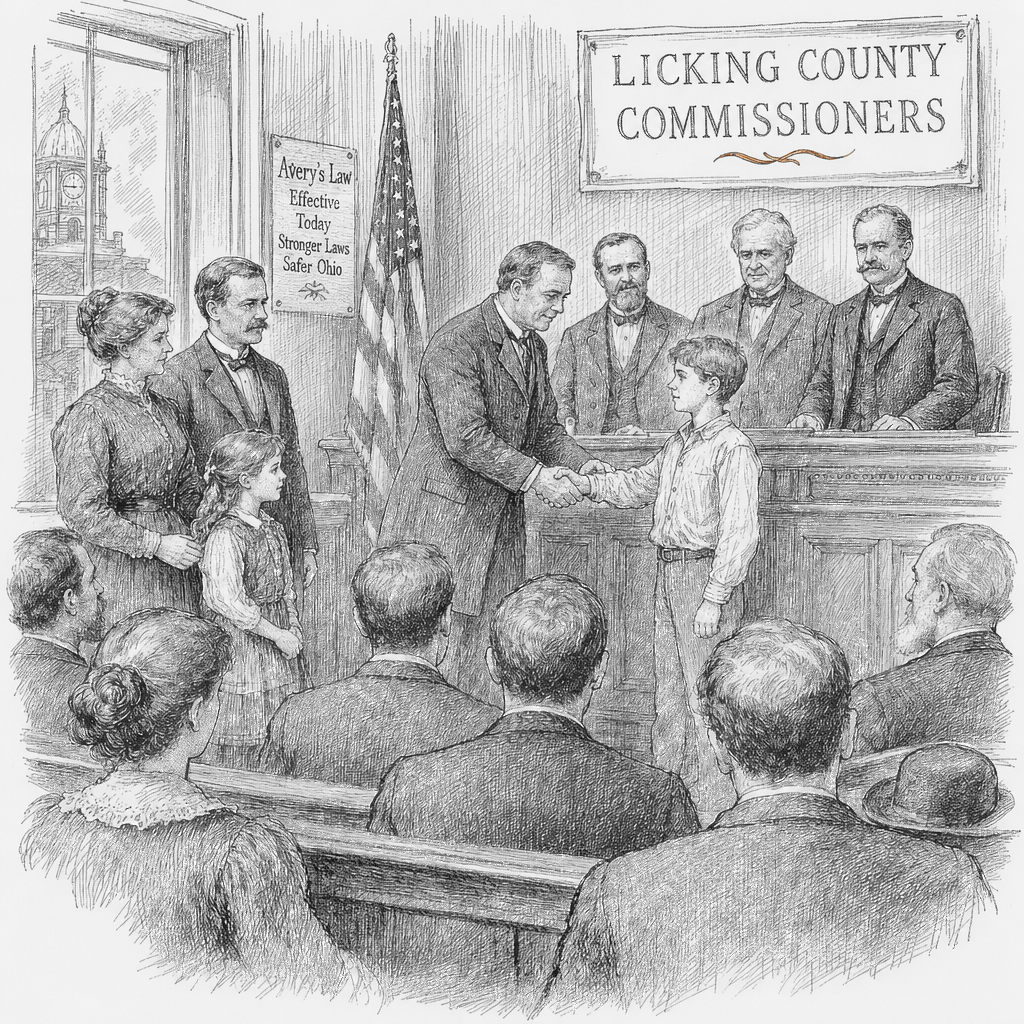
Licking County commissioners and state lawmakers honored Avery Russell, a 12-year-old dog-attack survivor from Blacklick, and Licking County Chief Dog Warden Larry Williams at a ceremony Jan. 8 in Newark, Ohio, marking the December passage of Avery’s Law — a bipartisan measure Gov. Mike DeWine signed Dec. 19 that gives Ohio’s county dog wardens significantly stronger tools to address dangerous animals.
The law takes effect March 18 and imposes criminal penalties on owners whose dogs attack without provocation, grants wardens authority to seize an animal immediately after an attack, and mandates euthanization — following due process — when a dog kills or seriously injures a person.
Avery’s Law arrives as a statewide investigation published in March 2025 by four Ohio newspapers documented roughly 17,000 dog bites reported annually to local public health agencies statewide, with children disproportionately represented in serious injuries and deaths, and found that existing law left most owners facing only small fines and misdemeanor charges.
The ceremony
Commissioners Rick Black, Tim Bubb, and Duane Flowers joined Rep. Kevin Miller, R-Newark, and Rep. Meredith Lawson-Rowe, D-Reynoldsburg, at the Licking County Administration Building for the brief ceremony. Rep. Cecil Thomas, D-Cincinnati, who also contributed to the bill, did not attend.
Williams, the chief dog warden, was named warden of the year in 2025 by the Ohio County Dog Wardens Association. Miller, a former Ohio State Highway Patrol trooper who led the bill’s drafting, said he called Williams at all hours of the day and night for details that would help shape the legislation.
Avery Russell, of Blacklick in eastern Franklin County, was attacked by two pit bulls at a Reynoldsburg house in June 2024, according to Lawson-Rowe. Avery underwent multiple surgeries and subsequently told her story to news reporters, state lawmakers, and the governor.
Avery’s mother, Drew Russell, said the day of the attack changed their lives in ways they couldn’t imagine — “like a bomb” that shifted her attention almost entirely to her daughter’s recovery. Some people have suggested she was exploiting her daughter by allowing her to participate in the campaign for the new law.
“No,” Drew Russell said. “She wants to do this” — with the goal of protecting other children.
Lawson-Rowe said her one non-negotiable in the bipartisan effort was that the bill carry Avery’s name: “my hero, Avery Russell.”
The law
Miller, Lawson-Rowe, and Thomas each brought separate bills on the issue. When Lawson-Rowe learned after the attack that Miller and Thomas had also drafted legislation, the three combined their bills into a single measure. It passed unanimously in both chambers of the Ohio General Assembly in about six months — “light speed” for Statehouse action, Miller said.
Avery’s Law does the following:
- Imposes criminal penalties on a dog owner who negligently fails to keep their dog from committing, without provocation, an attack
- Gives the local dog warden authority to seize a dog immediately following such an attack
- Revises investigation and enforcement requirements when an authority receives a complaint indicating a possible violation of dog law
- Includes protections for dogs defending themselves, their owners, or their property
- Mandates euthanization of the dog, after due process, if it kills or seriously injures a person
Williams and his partner, Assistant Chief Dog Warden Jeremy Grant, will gain these expanded authorities when the law takes effect March 18.
Background
The legislative push followed a statewide investigation published in March 2025 by the Cincinnati Enquirer, Columbus Dispatch, Akron Beacon Journal, and Canton Repository that detailed how Ohio’s existing dog laws fail victims and their families.
The series reported that about 17,000 dog bites are reported each year to local public health agencies in Ohio, with many more going unreported. “Children are disproportionately represented in the serious injuries and deaths,” the investigation found, adding that “pediatric hospitals across Ohio treat hundreds of children for dog bites each year.”
The series also found that “the owners of vicious dogs pay relatively small fines and may face misdemeanor charges,” with felony charges brought only in rare cases where prosecutors could document the dog’s prior history of aggressive behavior.
That changes March 18.