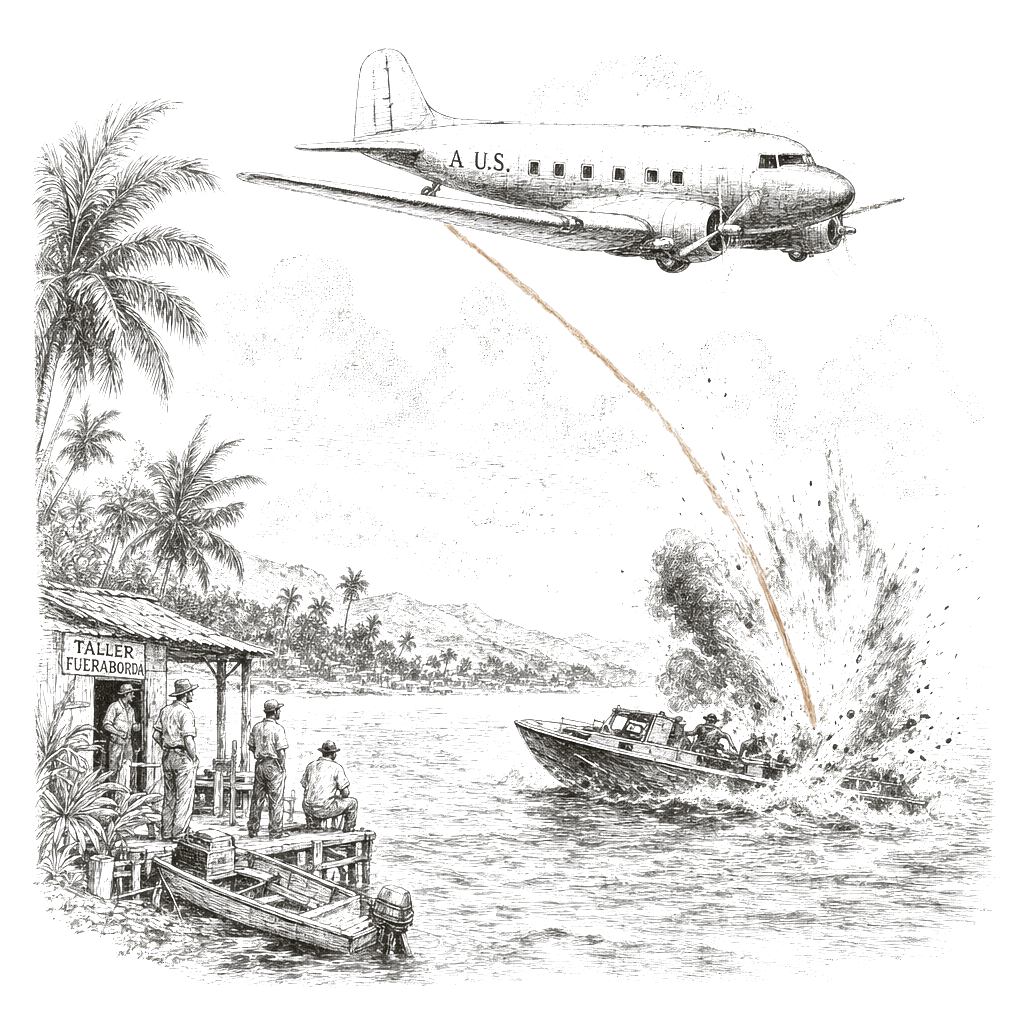
WASHINGTON — A U.S. military aircraft used in the opening strike of a monthslong campaign against alleged drug-smuggling boats off the coast of Venezuela was painted to resemble a civilian plane, two people familiar with the operation told the Associated Press on condition of anonymity. The plane, part of a secret U.S. surveillance fleet, also carried its munitions inside the fuselage rather than beneath the wings — an additional element of the apparent disguise.
The details appear to conflict with Pentagon guidelines on the laws of war, which prohibit troops from feigning civilian status during combat — a practice legally known as “perfidy.” The revelations come as the Senate prepares to vote this week on a war powers resolution that would bar further U.S. military action in Venezuela without congressional authorization.
The Sept. 2 strike involving the disguised plane was the first in a campaign that killed at least 115 people and culminated this month in the U.S. military’s capture of Venezuelan President Nicolás Maduro, who is now in U.S. custody facing federal drug trafficking charges.
Laws of war and the disguise
U.S. military manuals prohibit troops from feigning civilian status during combat. The Defense Department’s laws-of-war manual, which runs more than 1,000 pages, specifically identifies “feigning civilian status and then attacking” as an example of perfidy. The Air Force manual states the practice was prohibited because it means an adversary “neglects to take precautions which are otherwise necessary.” The Navy’s manual states that “attacking enemy forces while posing as a civilian puts all civilians at hazard,” and that sailors must use offensive force “within the bounds of military honor, particularly without resort to perfidy.”
Pentagon press secretary Kingsley Wilson said in a statement that “the U.S. military utilizes a wide array of standard and nonstandard aircraft depending on mission requirements.” Wilson added that each aircraft goes through a “rigorous procurement process to ensure compliance with domestic law, department policies and regulations, and applicable international standards, including the law of armed conflict.”
The details were first reported by The New York Times and confirmed by the AP through two people who spoke on condition of anonymity to discuss the sensitive matter.
The Sept. 2 strike and a follow-up that drew scrutiny
The Sept. 2 operation was the first in a campaign the Trump administration said was directed at drug cartels it has designated unlawful combatants. The administration has argued the U.S. is in an “armed conflict” with drug cartels in the region and that those operating the targeted boats are unlawful combatants.
The Sept. 2 strike drew separate legal scrutiny after a follow-up strike killed two survivors who were holding onto wreckage of the initially struck vessel. Legal experts have said that strike may have been unlawful because firing on shipwrecked sailors is prohibited under the laws of war. Defense Secretary Pete Hegseth told Cabinet members at a Dec. 1 meeting that he “watched that first strike live” but had left before the follow-up strike took place.
Congress has called on Hegseth to release unedited video of the operation. Hegseth has said he will not.
Senate war powers vote; Trump lobbies Republicans
The Senate is preparing to vote as soon as Wednesday on a war powers resolution that would prohibit further military operations in Venezuela without congressional authorization. The measure advanced last week with votes from both Republicans and Democrats.
President Trump has been calling Republican senators in an effort to dissuade them from backing the measure, Senate Majority Leader John Thune said Tuesday. Thune, who did not vote for the resolution when it advanced, said Trump was “very, very fired up” and described him as “animated” on the subject when they spoke before the earlier vote.
Senators review classified legal rationale
On Tuesday, senators were able to review in a classified setting at the Capitol the White House’s legal opinion justifying the military ouster of Maduro. The document was described as lengthy.
Sen. Rand Paul, Republican of Kentucky, who has long opposed U.S. military campaigns abroad, said afterward that the administration’s legal rationale should not remain classified. “Legal arguments and constitutional arguments should all be public, and it’s a terrible thing that any of this is being kept secret because the arguments aren’t very good,” Paul said.
Sen. Peter Welch, Democrat of Vermont, said he was not confident in the legality of the Venezuelan operation. “There’s an ongoing question whether the use of military can be for bringing a person to justice,” Welch said, calling Maduro “a really bad guy.” Welch said the document addressed the military action “but not the current reality that the president is saying we’ll be there for years and that we’re running Venezuela.”
Secretary of State Marco Rubio has said that U.S. control over Venezuela will be exercised through a quarantine on sanctioned oil tankers tied to the country.