A funding impasse
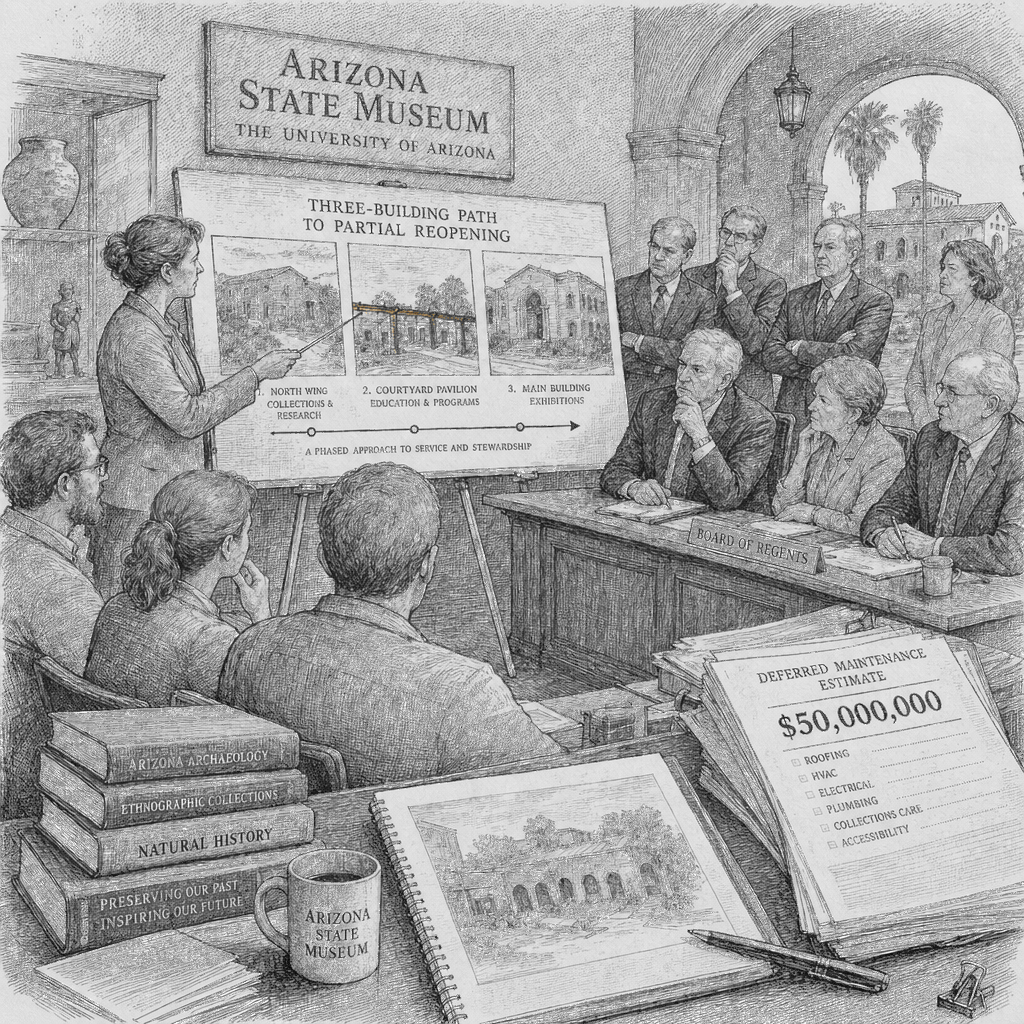
In September 2024, the University of Arizona requested $50 million in system revenue bonds from the Arizona Board of Regents to cover urgent repairs to the museum’s electrical and plumbing systems. The board declined.
“I would rather see us polish the young people of Arizona with $50 to $90 million in state-funded education than I would like to see the UA have to stand up and deliver because the state has ignored this project for years and years,” Regent Gregg Brewster said at the time, according to Arizona Luminaria, which first published this report in a partnership with the Associated Press.
State statute places responsibility for managing the museum with the Board of Regents. Nick Opich, a spokesperson for the board, said in a statement that “there have been no further developments regarding the Arizona State Museum.”
The board did approve a separate financial measure in September 2024: fee increases of up to 265% for cultural resource compliance services affecting anyone conducting projects on Arizona state lands, including utility companies, public agencies, conservation programs, and tribal partners.
“The updated fees help ensure that these highly specialized services are appropriately supported without relying on tuition revenues,” said Mitch Zak, a university spokesperson.
A three-building approach
With the original $50 million request stalled, the university has turned to a plan that reorganizes the museum across three sites. The South Building, which currently holds archaeological collections mandated by law to be preserved, would be cleared of those collections and opened to the public. A new 40,000-square-foot off-campus curation and research facility would receive the relocated collections.
Once the South Building is open, the university’s two historic on-campus buildings — including the South Building — would be dedicated to exhibits, teaching, research laboratories, and multi-purpose public programming.
Maura Raffensperger, chair of the museum council, said the administration of UA President Suresh Garimella has committed to the effort.
“They’re working on it all the time. Is it a very complex issue you’re dealing with hundreds of thousands of artifacts and it’s monumental. It’s a monumental task,” Raffensperger said. “The direction that the current administration is taking is very positive.”
The legal obligation to maintain the collections drives the complexity. “The South Building is filled with archaeological repositories which were mandated by law to keep and so we need a storage space for all that’s in that building so that we can open it up as a public space,” Raffensperger said.
The collections expand by an average of about 1,000 cubic feet per year.
“Over the past several months, the university’s facilities management team has been assessing building conditions and developing options,” Zak said. “They expect to present a recommendation to leadership by early summer that makes the best use of constrained resources.”
North Building remains unaddressed
The North Building — formally the Raymond H. Thompson Building — faces conditions that the current plan does not resolve. Its electrical wiring dates to the building’s original construction roughly a century ago and is encased in wood; its fire alarm and suppression systems are outdated.
“While the university has made it a priority to try to get the South Building able to be open to the public again and they have approved certain updates to the South Building, the North Building is still not a priority at this point of the university,” Raffensperger said.
The museum’s website previously described the closure as “an extended-temporary period of time (probably 2 years).” That language has since been updated to state “there is currently no plan to reopen the (North) building.”
Some vaults inside the North Building maintain controlled environments and remain accessible through private tours, which can be arranged by contacting Darlene Lizarraga, the museum’s director of marketing.
Community stakes
Beth Murfee Deconcini, vice chair of the museum council, said her primary concern is restoring public access to the collections.
“I run into people all the time who talk about when they were in school, they came to the Arizona State Museum on school field trips, or with their parents, or both and it was an amazing part of their childhood and growing up and their understanding of where they live and and the history and the innovation and the resilience of the people of this state,” Murfee Deconcini said. “The longer we don’t have a public space, the more people will not have that experience.”