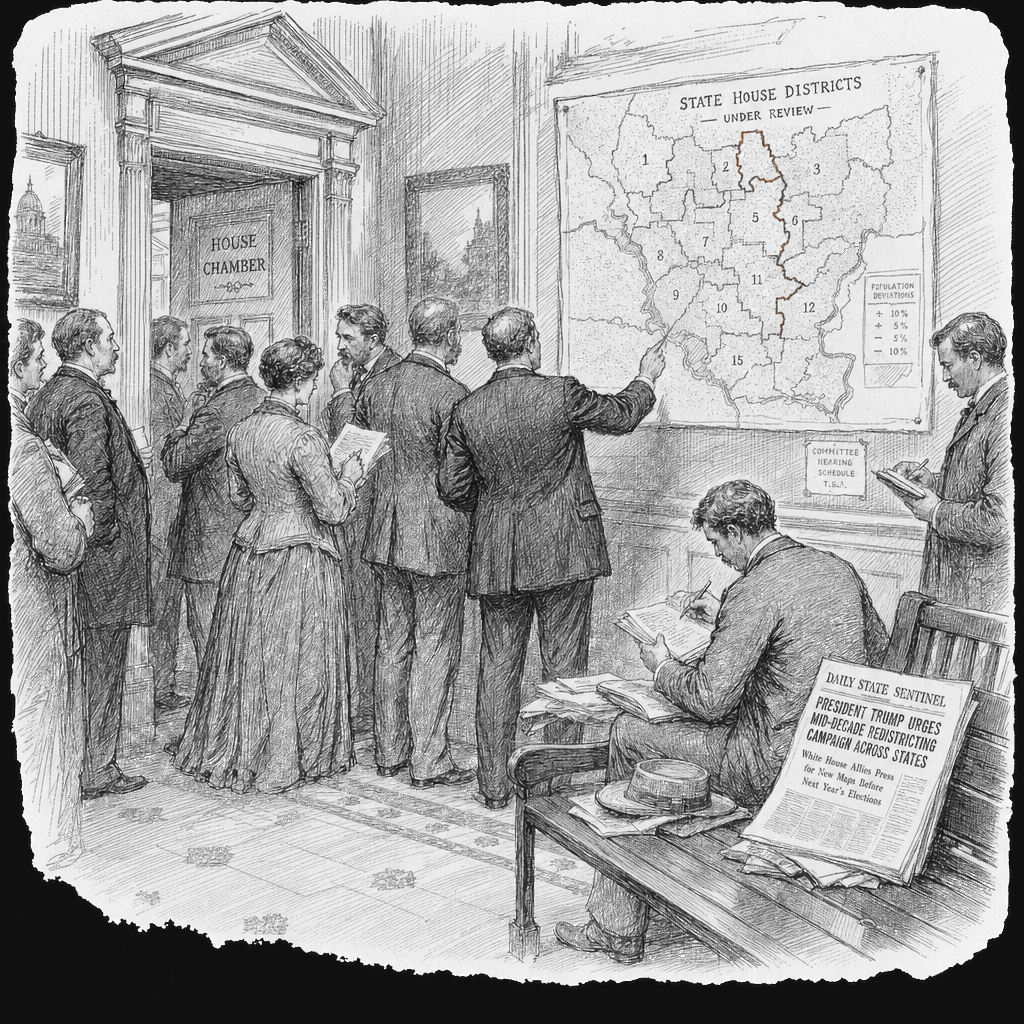
President Donald Trump’s unusual mid-decade redistricting campaign stands at a pivotal moment as state legislative sessions open this week, with Virginia Democrats and Florida Republicans preparing to press forward even as resistance in several other targeted states suggests the movement may have lost momentum. Indiana’s Republican-led Senate dealt the effort its sharpest setback in December, defeating a plan that could have helped the GOP win all nine of the state’s U.S. House seats.
“We’re at a crossroads to see if the mid-decade redistricting movement gains more speed or was simply an attempt by Donald Trump to impact elections that in many states fizzled,” said Jeffrey Wice, director of the Elections, Census and Redistricting Institute at New York Law School.
The outcome could determine whether Republicans extend their estimated three-seat gain from 2025 redistricting — a figure still contested by pending legal challenges — or whether a string of defeats signals the effective limits of Trump’s mid-decade remapping push ahead of the 2026 midterm elections.
A wave that met resistance
Trump launched the effort in July by calling on Texas Republicans to redraw their congressional map without new census data, triggering a mid-decade redistricting battle the likes of which has not been common since the late 1800s, the Associated Press reported.
Texas, Missouri and North Carolina all approved new Republican-friendly House districts. Ohio, required to redistrict under its state constitution, used the opportunity to adopt a more favorable map for Republicans.
But the momentum slowed in the fall. On Oct. 31, Virginia’s Democratic-led legislature took a first step toward redistricting. In November, California voters approved new House districts favoring Democrats, Kansas Republicans abandoned plans for a special session, and a Utah judge adopted a new House map that benefits Democrats.
The sharpest setback came Dec. 11, when Indiana’s Republican-led Senate defeated a plan that could have helped Republicans win all nine of the state’s U.S. House seats, up from their current seven.
Virginia weighs a constitutional path
Virginia’s General Assembly opened its annual session Wednesday with a proposed constitutional amendment on the agenda that would allow mid-decade redistricting — a response to actions taken in other states.
The amendment, which received first-round approval in the fall, would also require passage of a statewide referendum before new districts could take effect. Democrats, who currently hold six of Virginia’s 11 U.S. House seats, have discussed gaining as many as four additional seats but have not released a proposed map.
Gov.-elect Abigail Spanberger, a Democrat, said she would consider redistricting maps that keep communities compact, while placing the ultimate decision with voters.
“I will look at any map that is kind of reasonable and keeping communities compact and together,” Spanberger told the Associated Press. “But ultimately, it’s up to the people of Virginia to choose whether or not to move forward with the referendum.”
Florida waits on a Supreme Court ruling
Florida Republicans currently hold 20 of the state’s 28 U.S. House seats. Gov. Ron DeSantis said he plans to call a special session in April — separate from the regular session that opened Tuesday — to consider congressional redistricting.
DeSantis said he is waiting for a possible U.S. Supreme Court ruling in a Louisiana case that could address whether race can be the predominant factor in creating voting districts. A ruling in favor of race-neutral district drawing could open the way for several Republican-led states to redraw districts currently held by Black or Hispanic Democrats, DeSantis said. He said such a ruling could affect “at least one or two” Florida districts.
Any new Florida map, however, could face a legal challenge under a voter-approved state constitutional provision that prohibits drawing district boundaries to favor or disfavor a political party or incumbent.
Resistance holds in Illinois, Maryland and Kansas
Some Democrats have urged lawmakers in Illinois and Maryland to redraw their already heavily Democratic districts to try to gain one additional seat in each state. Those plans appear to lack traction as legislative sessions begin this week in both states.
Illinois House Speaker Pro Tem Kam Buckner said “there is no active push” for congressional redistricting in the state.
“There is no appetite to reopen something that will consume enormous time, energy and, frankly, political capital without a compelling justification,” Buckner told the AP.
Democratic Maryland Gov. Wes Moore created a special commission to recommend a new congressional map. But Senate President Bill Ferguson remained opposed to redistricting and said a majority of residents do not want new districts.
In Kansas, House Speaker Dan Hawkins told reporters he has no plans to hold a redistricting vote during the legislative session beginning Monday.
“I do not have the votes,” Hawkins said. Republican lawmakers in Kansas lack the two-thirds majority needed to override a likely veto by Democratic Gov. Laura Kelly.