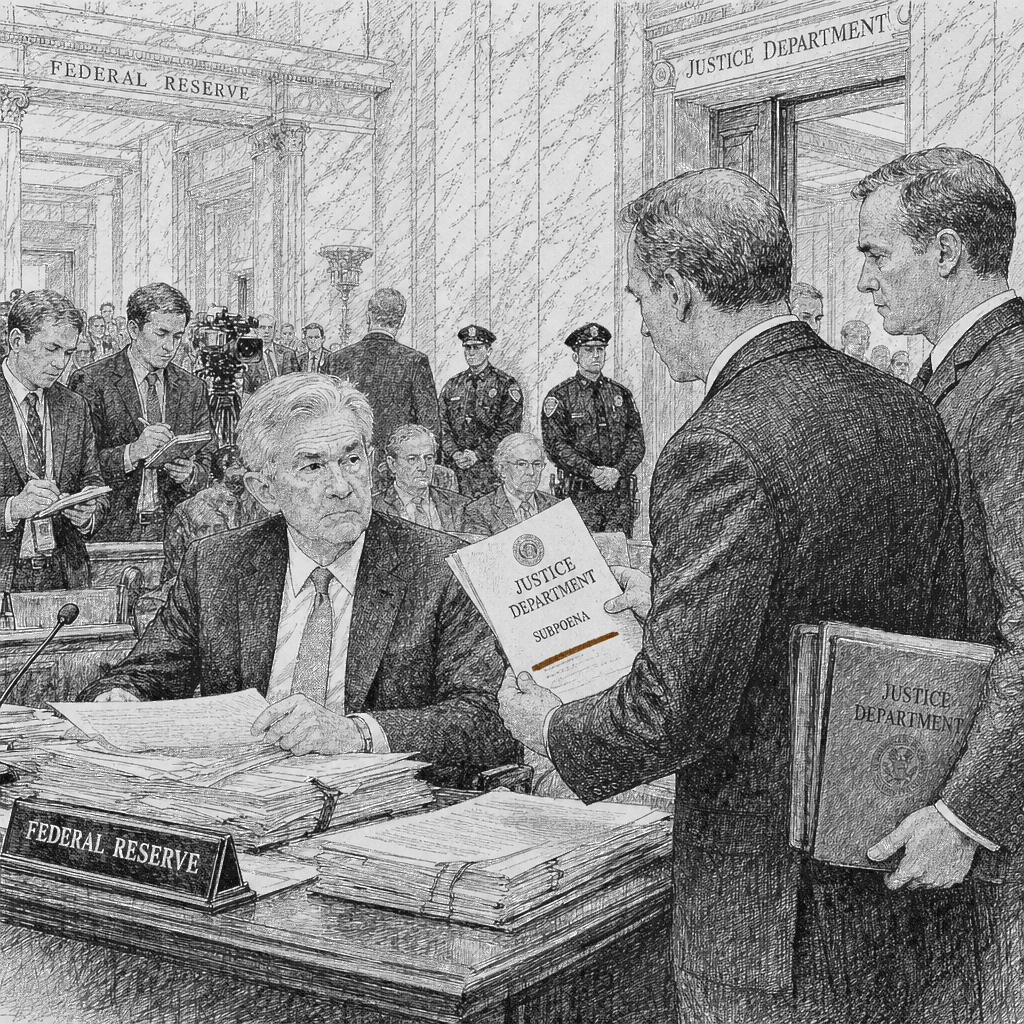
The subpoena marks a significant escalation in Trump’s conflict with the central bank and extends a documented pattern of Justice Department actions against officials who have opposed or declined to accommodate the president — a pattern White House chief of staff Susie Wiles acknowledged when asked.
The Justice Department has subpoenaed the Federal Reserve and threatened criminal indictments of Chair Jerome Powell after his Senate Banking Committee testimony defending the central bank’s independence, Powell said Sunday in a video statement. Powell, whom President Donald Trump appointed as Fed chair in 2017, called the action a “pretext” to weaken the Fed’s historic independence to set monetary policy without presidential influence. Trump told NBC News over the weekend that he knew nothing about the inquiry.
The Powell matter is the latest in a series of legal actions Trump’s administration has taken against officials who have opposed or declined to accommodate the president, according to the Associated Press. The inquiry and Powell’s statement mark a significant escalation in Trump’s battle with the Federal Reserve and his ongoing straining of the U.S. system of checks and balances, the AP reported. White House chief of staff Susie Wiles acknowledged the pattern when asked.
“There may be an element of that from time to time,” Wiles told Vanity Fair. “Who would blame him? Not me.”
Trump had declared in his second inaugural address on Jan. 20, 2025, that “the vicious, violent and unfair weaponization of the Justice Department and our government will end.”
Federal Reserve governor also targeted
Before the Powell subpoena, Trump sought to fire Fed Governor Lisa Cook over mortgage fraud allegations pushed by Bill Pulte, director of the Federal Housing Finance Agency. It was the first time in 112 years that a president had sought to remove a Fed governor, the Associated Press reported.
Cook, a 2022 Biden appointee and the first Black woman to serve on the seven-member board, sued to keep her job. The Supreme Court ruled last fall that Cook could remain on the board while her case advances; the justices are expected to hear arguments this month. The court is separately weighing a case on Trump’s authority to remove officials at independent agencies.
Comey indicted, case dismissed
Former FBI Director James Comey, whom Trump fired during his first administration, was indicted in September on charges of lying to Congress. The indictment came days after Trump posted on social media, naming Attorney General Pam Bondi and writing “JUSTICE MUST BE SERVED, NOW!!!” — a reference to his own impeachments and prosecutions.
A federal judge in Virginia dismissed the case in November, finding that prosecutor Lindsey Halligan had been illegally appointed by the Justice Department. Comey has not been cleared of the underlying charges, which prosecutors could refile.
James blocked in court and grand jury
New York Attorney General Letitia James, who won a civil fraud case against Trump in 2024 — with the financial penalty later vacated by a higher court, both sides still appealing — was indicted on federal mortgage fraud charges two weeks after Comey. Her case was thrown out by the same Virginia judge for the same reason: the prosecutor was illegally appointed.
Two subsequent attempts to secure a new indictment failed in December when grand juries declined to issue charges after hearing evidence from federal prosecutors. More recently, a federal judge in New York disqualified another prosecutor, John Sarcone, from overseeing investigations into James, finding he was not lawfully serving as acting U.S. attorney in the Northern District of New York.
Brennan targeted, Smith under probe
Lawyers for former CIA Director John Brennan said last month their client is a target of a Florida grand jury investigation related to the U.S. government’s assessment of Russian interference in the 2016 presidential election. Brennan’s lawyers wrote that they sought to prevent the Justice Department from steering the investigation to U.S. District Judge Aileen Cannon — the Trump-appointed Florida jurist who later dismissed a federal classified-documents case against the president.
An investigation of Jack Smith, who led multiple Trump prosecutions including the inquiry into the January 6, 2021, Capitol attack by Trump supporters, was confirmed by the Office of Special Counsel in August. Smith was named special prosecutor in November 2022 by then-Attorney General Merrick Garland. In congressional testimony in December, Smith did not yield ground.
“I made my decisions in the investigation without regard to President Trump’s political association, activities, beliefs, or candidacy in the 2024 presidential election,” Smith said. “We took actions based on what the facts and the law required — the very lesson I learned early in my career as a prosecutor.”
Smith also told Congress his team “developed proof beyond a reasonable doubt” that the president criminally conspired to overturn his 2020 election defeat.
Schiff probe now under its own inquiry
California Sen. Adam Schiff’s personal finances and mortgages have been under federal scrutiny, with prosecutors in Maryland conducting an investigation as of late last year. Schiff, who led Trump’s first impeachment proceedings in the House, has consistently said the investigation against him is political retribution.
In November, federal authorities began examining the roles of Pulte and Ed Martin, a Justice Department official, in several of the high-profile mortgage fraud cases the administration has pursued. An inquiry into those investigators is now underway.