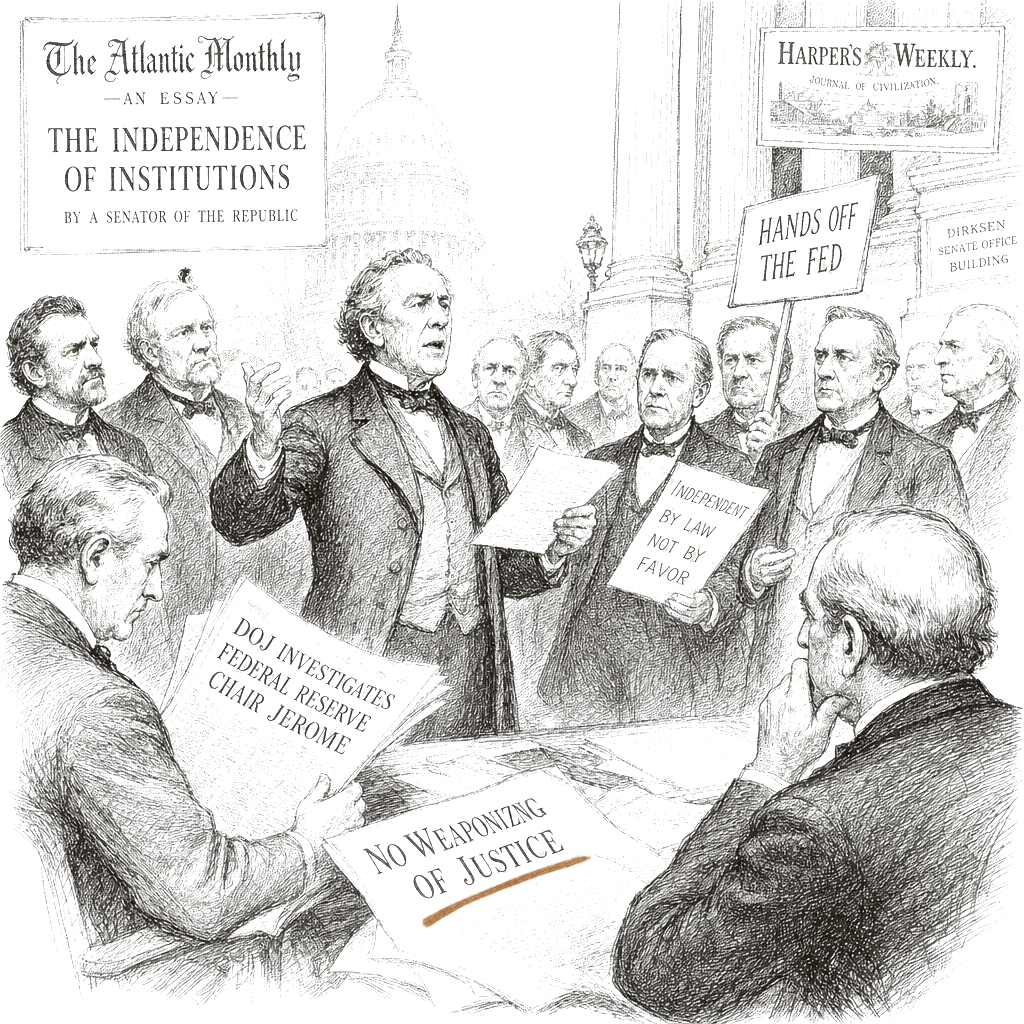
The backlash puts the administration’s authority over an independent agency that Congress created to set monetary policy free from political pressure at the center of a constitutional dispute — one with direct consequences for inflation, employment, and the broader U.S. economy.
WASHINGTON — The Trump administration’s criminal investigation of Federal Reserve Chair Jerome Powell drew swift condemnation Monday from Republican senators, three former Fed chairs, and a coalition of top economists, who called the Justice Department’s subpoenas an unprecedented attempt to use prosecutorial power to undermine the central bank’s independence.
Powell, who revealed the subpoenas on Sunday, characterized them as “pretexts” to pressure him to sharply cut interest rates. The investigation — the first against a sitting Fed chair — stems from Powell’s June congressional testimony about the cost and design elements of a $2.5 billion renovation of the Fed’s headquarters and other buildings. Powell said the Justice Department has threatened criminal indictments over that testimony.
“After speaking with Chair Powell this morning, it’s clear the administration’s investigation is nothing more than an attempt at coercion,” Sen. Lisa Murkowski, R-Alaska, said Monday.
White House press secretary Karoline Leavitt told reporters that President Trump did not direct the Justice Department to investigate Powell, while making clear the administration’s view of his performance.
“One thing for sure, the president’s made it quite clear, is Jerome Powell is bad at his job,” Leavitt said. “As for whether or not Jerome Powell is a criminal, that’s an answer the Department of Justice is going to have to find out.”
Republican senators push back
Sen. Thom Tillis, R-N.C., a member of the Senate Banking Committee, said late Sunday that he would oppose any Trump administration Fed nominees until the investigation is “resolved.”
“If there were any remaining doubt whether advisers within the Trump Administration are actively pushing to end the independence of the Federal Reserve, there should now be none,” Tillis said.
Senate Majority Leader John Thune, R-S.D., said Monday that the administration’s evidence needed to clear a high bar.
“I haven’t seen the case or whatever the allegations or charges are, but I would say they better, they better be real and they better be serious,” Thune said.
Sen. Dave McCormick, R-Pa., said the Fed may have wasted public dollars on its renovation but added, “I do not think Chairman Powell is guilty of criminal activity.”
Former Fed chairs and economists respond
Former Fed chairs Ben Bernanke, Janet Yellen, and Alan Greenspan, along with former Treasury Secretaries Henry Paulson and Robert Rubin, signed a letter Monday calling the investigation “an unprecedented attempt to use prosecutorial attacks” to undermine the Fed’s independence.
“This is how monetary policy is made in emerging markets with weak institutions, with highly negative consequences for inflation and the functioning of their economies more broadly,” the letter stated.
Jason Furman, a Harvard economist and former top economic adviser to President Barack Obama, said the investigation was “ham-handed, counter-productive, and going to set back the president’s cause.” Furman added that the probe could unify the Fed’s interest-rate-setting committee in support of Powell and would mean “the next Fed chair will be under more pressure to prove their independence.”
The economic stakes
The dispute centers on Trump’s demand that the Fed cut its benchmark interest rate, which he argues is warranted because inflationary pressures have faded sufficiently. Powell has taken a more cautious approach.
The Fed’s preferred inflation gauge, the personal consumption expenditures price index, stood 2.79 percent above year-ago levels as of January 2026 — above the Fed’s 2 percent target and a data point Powell has cited as a basis for caution. Erring in either direction on rates carries consequences: premature cuts risk reigniting inflation while keeping rates too high can slow hiring and increase unemployment.
Jeanine Pirro, U.S. attorney for the District of Columbia, defended the subpoenas on social media, saying the Fed had “ignored” her office’s outreach to discuss the renovation cost overruns, necessitating formal legal process.
“The word ‘indictment’ has come out of Mr. Powell’s mouth, no one else’s,” Pirro posted on X.
Trump appeared to preview the legal action at a Dec. 29 news conference.
“He’s just a very incompetent man,” Trump said of Powell. “But we’re going to probably bring a lawsuit against him.”
Powell’s board seat and Trump’s next move
Powell’s term as Fed chair expires in May 2026, but he holds a separate term as a Fed governor through January 2028 — meaning he could remain on the seven-member board even after his chairmanship ends.
Scott Alvarez, former general counsel at the Fed, said the probe appeared designed to send a message to Powell: “We’ll use every mechanism that the administration has to make your life miserable unless you leave the Board in May.”
If Powell remains on the board, the Trump administration would be denied the seat it needs for a working majority — one that could enact significant operational changes at the Fed and influence appointments at the Fed’s 12 regional banks, according to the Associated Press.
Mark Spindel, chief investment officer at Potomac River Capital and the author of a book on Fed independence, said that majority would carry significant institutional weight.
“They could do a lot of reorganizing and reforms” without having to pass new legislation, Spindel said.
Kevin Hassett, director of the White House National Economic Council and a leading candidate to become the next Fed chair, said Monday he was unaware of Powell’s plans regarding the board seat.
“I’ve not talked to Jay about that,” Hassett said.
Powell has declined at several press conferences to answer questions about whether he intends to remain on the board after his chair term ends.