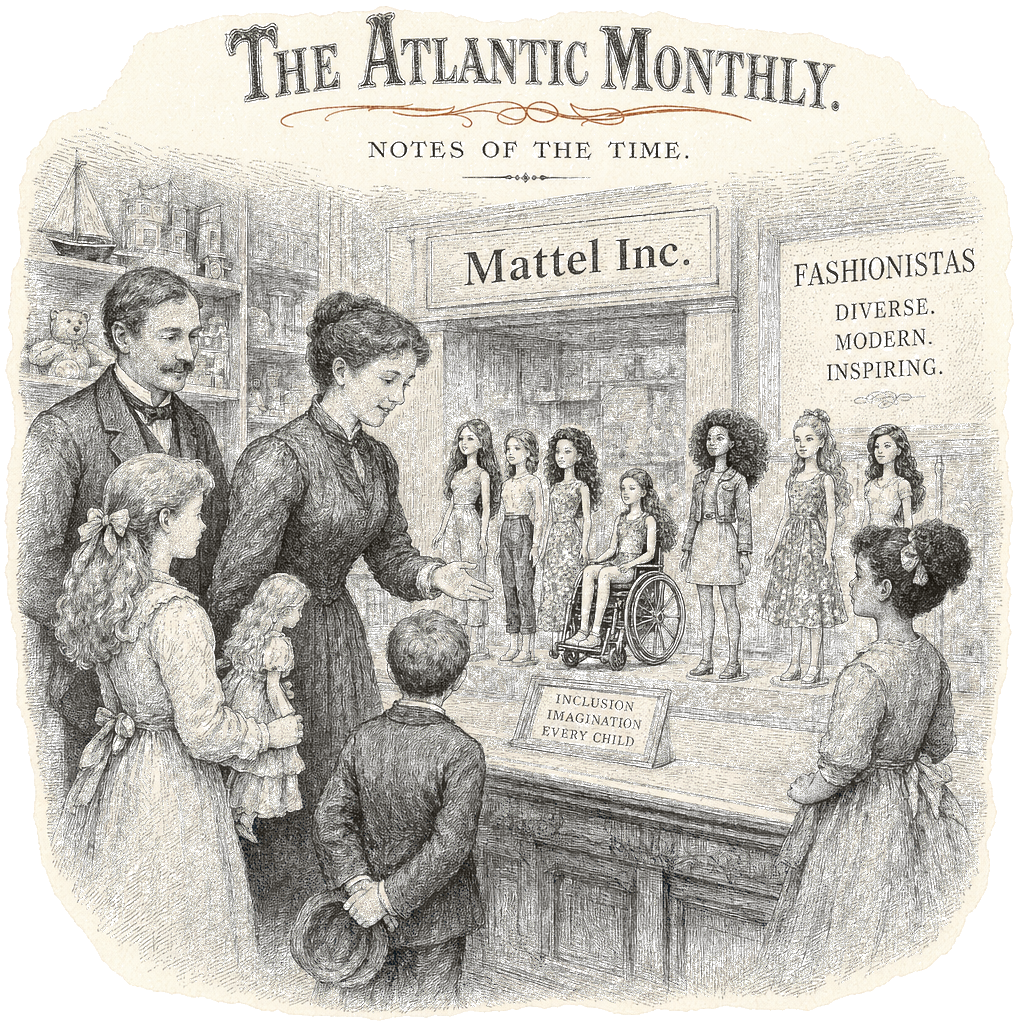
The release adds to a Fashionistas lineup that already includes dolls representing Down syndrome, blindness, Type 1 diabetes, hearing loss, vitiligo, and limb differences, as autism affects an estimated 1 in 31 eight-year-old children in the United States, according to the Centers for Disease Control and Prevention.
Mattel Inc. introduced an autistic Barbie on Monday, expanding its Fashionistas line with a doll developed over more than 18 months in partnership with the Autistic Self Advocacy Network, a nonprofit that advocates for the rights and improved media representation of autistic people.
The Centers for Disease Control and Prevention has reported that autism affects an estimated 1 in 31 eight-year-old children in the United States, making the condition one of the more common developmental diagnoses in the country. The Fashionistas line already includes dolls representing Down syndrome, blindness, Type 1 diabetes, hearing loss, vitiligo, and limb differences, as well as dolls in a range of body types, hair types, and skin colors.
Design choices
Noor Pervez, the Autistic Self Advocacy Network’s community engagement manager, worked closely with Mattel on the doll’s prototype and said translating autism into a visible design was a genuine challenge.
“Autism doesn’t look any one way,” Pervez said. “But we can try and show some of the ways that autism expresses itself.”
The development team built several features into the doll to reflect how some autistic people experience the world. The doll’s eyes shift slightly to the side to represent how some autistic people avoid direct eye contact, Pervez said. The doll also has articulated elbows and wrists to acknowledge stimming, hand flapping, and other gestures some autistic people use to process sensory information or to express excitement, according to Mattel.
Clothing choices presented their own design debate, Pervez said. Some autistic people wear loose garments because they are sensitive to the feel of fabric seams, while others prefer close-fitting clothes that give them a clearer sense of their body’s position. The team chose an A-line dress with short sleeves and a flowy skirt that limits fabric-to-skin contact. The doll also wears flat shoes for stability and ease of movement, Mattel said.
Each doll comes with a pink finger clip fidget spinner, noise-canceling headphones, and a pink tablet modeled after communication devices some nonspeaking autistic people use.
Representation
The doll’s facial features were inspired by Mattel employees in India and mood boards reflecting women with Indian backgrounds, according to Mattel. Pervez said it was important for the doll to represent a segment of the autistic community that is generally underrepresented.
“Barbie has always strived to reflect the world kids see and the possibilities they imagine, and we’re proud to introduce our first autistic Barbie as part of that ongoing work,” said Jamie Cygielman, Mattel’s global head of dolls.
Availability
The doll was expected to be available at Mattel’s online shop and at Target stores beginning Monday at a suggested retail price of $11.87. Walmart stores are expected to start carrying the new Barbie in March, Mattel said.
Context
Mattel introduced its first doll with Down syndrome in 2023 and brought out a Barbie representing a person with Type 1 diabetes last summer. The CDC’s Autism and Developmental Disabilities Monitoring Network has found that Black, Hispanic, Asian and Pacific Islander children in the U.S. were more likely than white children to have an autism diagnosis, and that autism prevalence was more than three times higher among boys than girls.